All species › Passerines › Weavers › Red-Billed Quelea
Red-Billed Quelea | Quelea quelea
Roodbekwever | Quelea Común
The Red-Billed Quelea is often called the most numerous wild bird species in the world. Flocks of hundreds of thousands to millions move like smoke across the savanna, breed in colonies that fill entire thickets and can strip grain crops in a short time.
Click a thumbnail to switch the photo above.
Voice
A sustained loud chatter from the whole flock, and as the male's song a short series of grating, chirping notes with a few high whistles. The roar of wings of a flock taking off carries a long way.
Recording: András Schmidt — CC BY-NC-SA 4.0 · converted to mono · xeno-canto
Identification
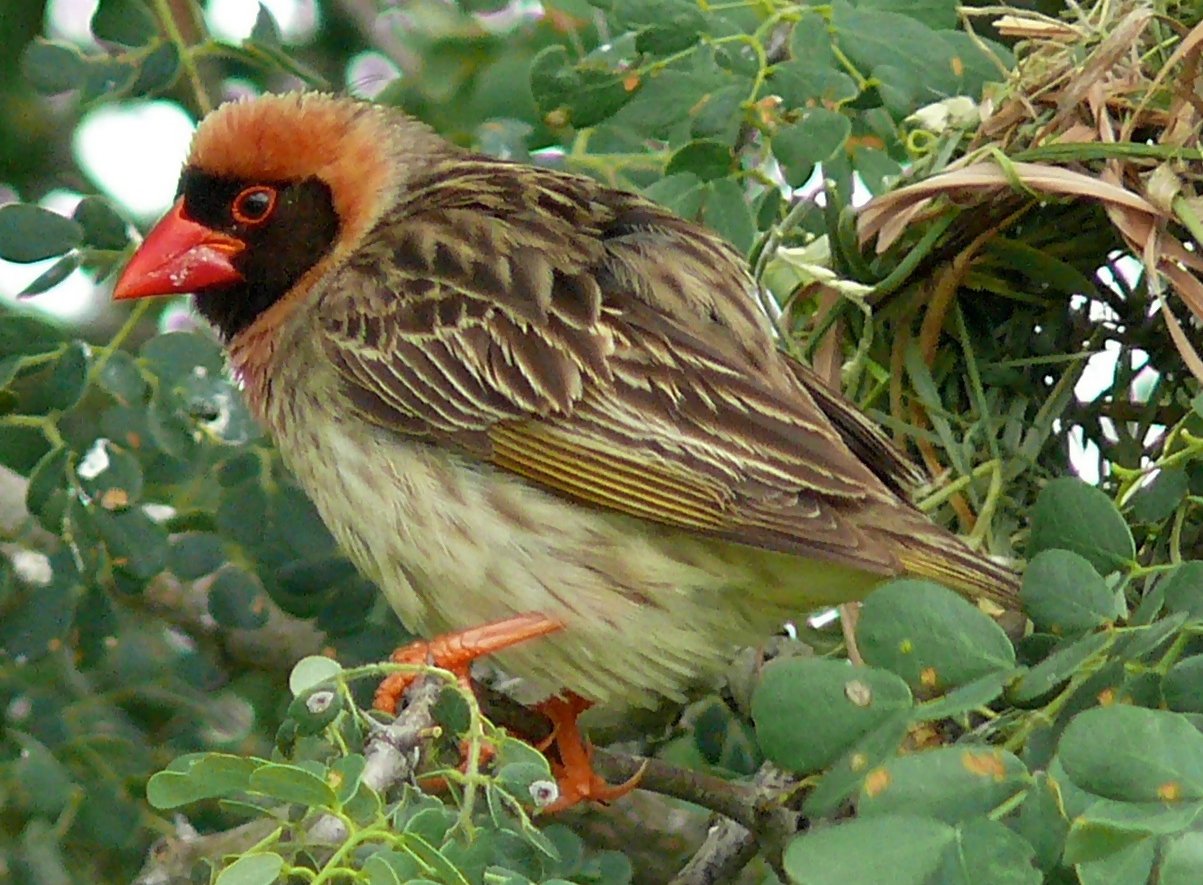
11 to 13 cm, with a heavy, conical bill that is red all year in the male. The breeding male usually has a black mask over forehead, face and throat, framed by a pink, red or pale buff hood that may extend over the breast; colouring is very variable, and some males have a white or buff face without black. The upperparts are buff with black streaks, the underparts pale with a pink or buff wash. The breeding female is streaky brown with a pale supercilium and a yellow to orange bill. Outside the breeding season both sexes have a red bill and streaky brown plumage with a pale supercilium.
Confusion species
The male Red-Headed Quelea (Quelea erythrops) has a black bill and a red head with only a dark throat. Cardinal Quelea (Quelea cardinalis) is smaller, with a uniform red hood reaching the breast and a dark bill. Females and non-breeding Southern Red Bishop (Euplectes orix) and other bishops closely resemble non-breeding Red-Billed Quelea, but have a horn-coloured bill. A flock can be recognised from afar by the enormous numbers and the rolling, synchronised manoeuvres.
Habitat
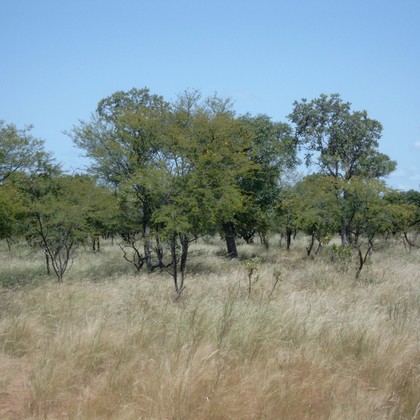
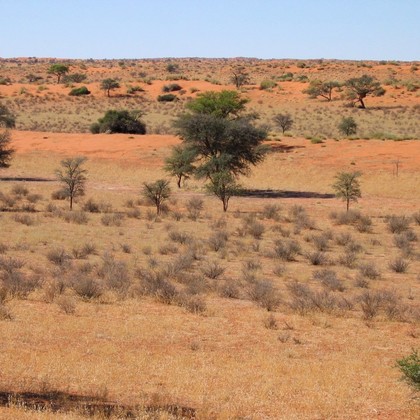
Dry and semi-arid savanna, thornveld, Kalahari sandveld, grassland and farmland, always within reach of drinking water. It eats mainly grass seeds and, on farmland, also sorghum, millet, wheat and rice; the young are fed on insects. It breeds in enormous colonies, sometimes of millions of nests, packed into thorn trees or reeds; the nest is a small, thin-walled grass ball built in two or three days, and the whole cycle from building to fledging takes about four weeks. It roosts in large gatherings in reeds or scrub.
Where the bird is most at home, classified by the vegetation units of southern Africa.
Range and movements
Across almost the whole region, most numerous in the drier savannas of Namibia, Botswana, Zimbabwe and northern South Africa; scarce or absent in the fynbos of the Western Cape, the Lesotho highlands and closed forest. Nomadic, and in some years present in huge numbers where it was absent before. Beyond the region in dry savannas from Senegal to Ethiopia and Somalia and south through East Africa.
- Resident
- Summer visitor (c. Oct–Mar)
- Winter visitor (c. Apr–Sep)
- Passage (Mar–Apr, Oct–Nov)
- dark = core range, pale = thinly spread
How and when to look
Sit at a waterhole in the late afternoon in Etosha, the Kalahari or Kruger: flocks come to drink in waves, form shifting clouds over the water and attract falcons and other raptors. A breeding colony in summer is unforgettable, with trees trembling with chatter and every branch full of nests.
Conservation status
Not threatened; abundant. It is regarded as one of the most serious agricultural pest birds in Africa; breeding colonies and roosts are controlled in several countries with poison, fire and explosives, which also affects other birds. Total numbers nevertheless remain enormous.
Scientific name
Quelea quelea | (Linnaeus, 1758)
Linnaeus described the species in 1758 as Emberiza quelea; because it was later moved to another genus, the author and year stand in brackets. The genus Quelea was introduced in 1850 by Reichenbach. The origin of Quelea is uncertain; Linnaeus gave no explanation. It may derive from medieval Latin qualea, 'quail', for the vast flocks, like the biblical quails. quelea repeats the genus name; Linnaeus gave no explanation. It may derive from medieval Latin qualea, 'quail', for the enormous flocks. The specimen the first description was based on came from Senegal (originally given in error as India).