All species › Passerines › Weavers › Southern Red Bishop
Southern Red Bishop | Euplectes orix
Grenadierwever | Obispo Rojo
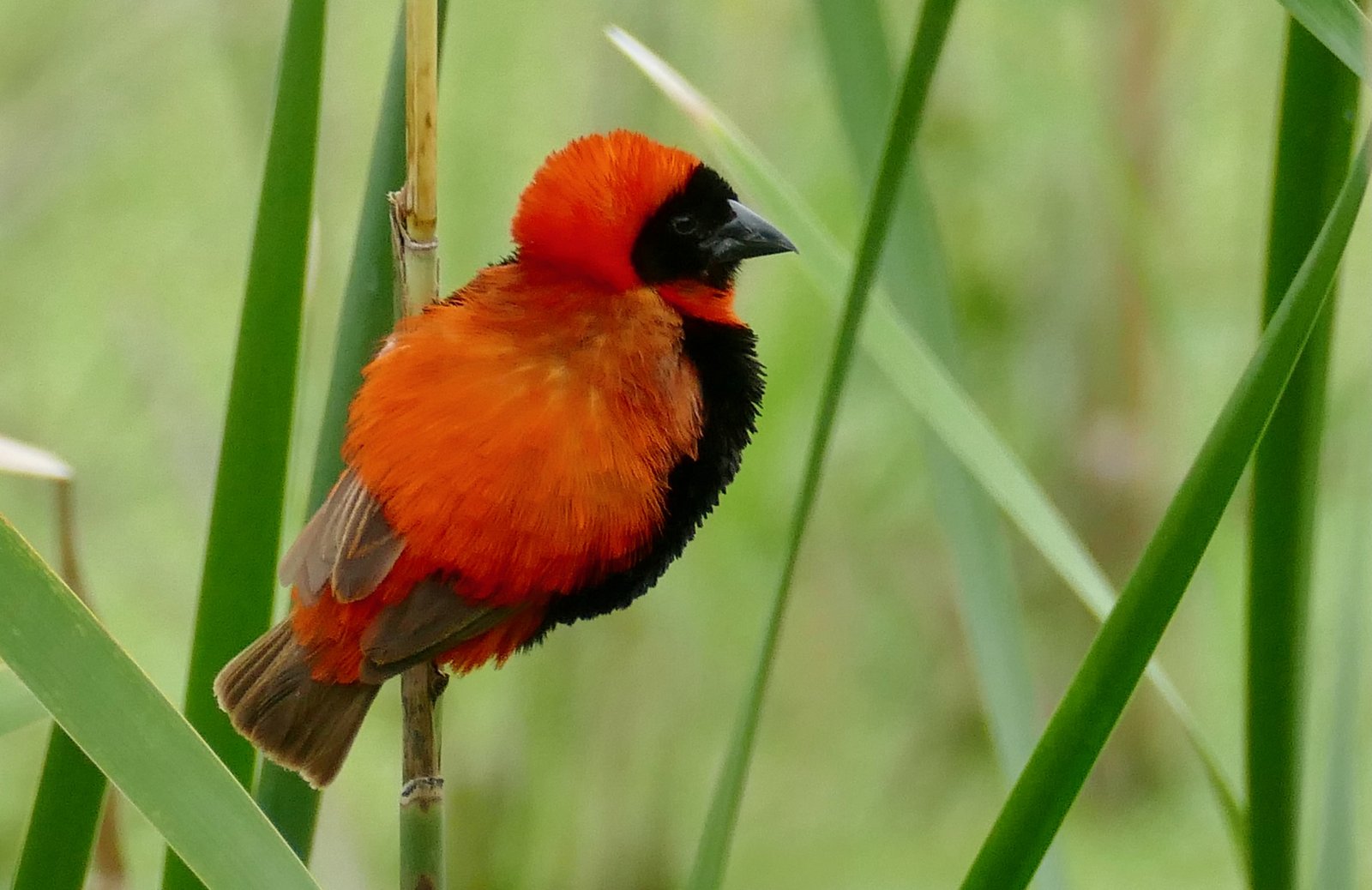
The Southern Red Bishop is the fiery red bishop of reedbeds and wet fields. The breeding male puffs his orange-red plumage into a ball and hovers, buzzing like a bumblebee, over the reeds. Outside the breeding season males and females wander together in large, plain brown flocks.
Voice
A fast, sizzling, buzzing song, roughly zik-zik-zik-zizizizizi, from a reed stem or during the bumblebee-like display flight with puffed-out plumage; also a sharp chik call.
Recording: African Bioacoustics Community — CC BY-NC-SA 4.0 · shortened to the first 60 s, mono · xeno-canto
Identification
10 to 11 cm, stocky. Bishops have no elongated tail feathers, so the breeding male is the same length as in non-breeding plumage. The breeding male is scarlet to orange-red with a black forehead, face and chin, a red throat and upper breast and a black lower breast and belly; the long red undertail coverts almost cover the short brown tail, and the rump is also red. Wings brown, bill black. The female is streaky brown above and buff below with fine streaks on breast and flanks, a pale supercilium and a horn-coloured bill. The non-breeding male resembles the female but is slightly larger and more heavily streaked.
Confusion species
Black-Winged Red Bishop (Euplectes hordeaceus) has a red crown without black forehead, black wings and buff undertail coverts. Zanzibar Red Bishop (Euplectes nigroventris) is smaller, with a red crown and wholly black underparts from throat to undertail. Females and non-breeding birds are barely separable from those of Yellow-Crowned Bishop (Euplectes afer) and other bishops; go by the males in the flock. Non-breeding Red-Billed Quelea (Quelea quelea) has a red bill.
Habitat
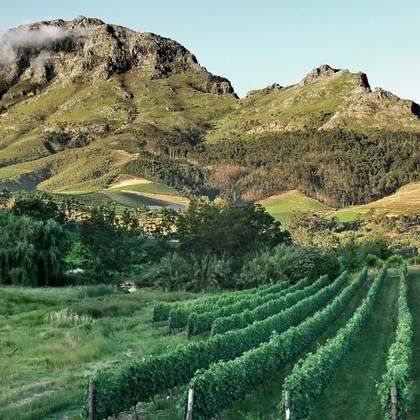
Reedbeds, bulrushes and tall grass along rivers, dams and vleis, and adjacent grain fields and sugarcane. Males are polygynous: each defends a small territory in the reeds in which he builds several nests for different females. The nest is an oval ball of grass and reed strips with a side entrance, woven onto reed stems. Outside the breeding season it forages in large flocks in fields and grassland, often with Red-Billed Quelea and other seedeaters.
Where the bird is most at home, classified by the vegetation units of southern Africa.

Range and movements
Widespread over almost the whole region: all of South Africa into the Western Cape, Lesotho, Eswatini, Zimbabwe, Botswana (mainly the east and north), Namibia along rivers and dams, Zambia, Malawi, Mozambique and Angola; absent only from the driest areas without open water. Beyond the region north to Tanzania, Kenya, Uganda and eastern DR Congo.
- Resident
- Summer visitor (c. Oct–Mar)
- Winter visitor (c. Apr–Sep)
- Passage (Mar–Apr, Oct–Nov)
- dark = core range, pale = thinly spread
How and when to look
From November to February at almost any reedbed or dam: the males sing from a prominent stem and perform their display flight with puffed-out plumage. In winter, flocks of brown birds on farmland often consist of Southern Red Bishops and Red-Billed Queleas mixed; then check the bill colour.
Conservation status
Not threatened; common, and increased in parts of South Africa through dams and irrigation. Regarded locally as a pest in grain farming, but far less so than the Red-Billed Quelea.
Scientific name
Euplectes orix | (Linnaeus, 1758)
Linnaeus described the species in 1758 as Emberiza orix; because it was later moved to another genus, the author and year stand in brackets. The genus Euplectes was introduced in 1829 by Swainson. Euplectes joins Greek eu 'fine, good' to New Latin plectes 'weaver'. orix comes from the Latin oryza, 'rice' — for a seed-eating bird of grain fields. The specimen the first description was based on came from interior of Africa (Angola).