All species › Tropicbirds › Tropicbirds › Red-Billed Tropicbird
Red-Billed Tropicbird | Phaethon aethereus
Roodsnavelkeerkringvogel | Rabijunco Etéreo
The Red-Billed Tropicbird is the largest and most heavily marked of the three tropicbirds, a white seabird of tropical waters with a red bill and two long white central tail streamers. Within the region it is a genuine rarity, found on pelagic trips or as a weakened bird on the coast.

Voice
Usually silent at sea. At the breeding site and sometimes in flight a high, grating scream, kreee-krrr-krrr, running into a fast rattle.
Recording: Jesse Fagan — CC BY-NC-SA 4.0 · converted to mono · xeno-canto
Identification
90–105 cm with streamers, about 46–50 cm without; the streamers can make up half the total length. White with fine, dense black barring on the mantle, back and upperwing coverts, so that the upperparts look greyish at distance. A broad black eye-stripe extends to the nape. The outer primaries and their coverts form a black wedge at the wingtip. The bill is bright coral red, the legs yellowish grey with black webs. Immatures lack streamers, have a yellowish bill with a dark tip and a black eye-stripe that meets across the nape as a collar. It flies high over the sea on fast, pigeon-like wingbeats mixed with glides, and plunge-dives from a great height.
Confusion species
White-Tailed Tropicbird Phaethon lepturus is smaller, with an unbarred white back, a yellow-orange bill and a conspicuous black diagonal bar across the inner wing. Red-Tailed Tropicbird Phaethon rubricauda has a red bill but almost wholly white wings, an unbarred back and thin red streamers. Immatures of all three are barred and much more alike; in this species look for the black nape collar and the large black wingtip.
Habitat
Open tropical and subtropical ocean, usually far offshore over warm, clear water. It hunts alone or in pairs for flying fish and squid, plunging into the water from 10–20 m up. It nests in rock crevices and under overhangs on steep, arid islands and cliffs.
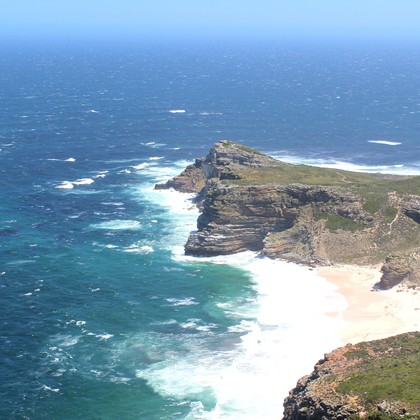
Where the bird is most at home, classified by the vegetation units of southern Africa.
Range and movements
Within the region a rare vagrant, with a handful of sightings and beached birds off Namibia and the Western Cape, and occasionally in the Mozambique Channel and off KwaZulu-Natal. Beyond the region it breeds in the tropical Atlantic (Cape Verde, St Helena, Ascension, the Caribbean), in the eastern Pacific, and in the Red Sea, Gulf of Aden and Persian Gulf.
How and when to look
The best chance is on pelagic trips from Cape Town or Lüderitz, especially in summer when warm water lies closer inshore, and along the coast after storms. Photograph both the upperwing and underwing: the barred back and black wingtip confirm the identification. Every sighting should be submitted to the national rarities committee.
Conservation status
Not globally threatened, but with a fairly small and scattered population estimated at a few thousand pairs. Introduced rats and cats on breeding islands, disturbance and egg collecting threaten colonies locally; within the region the species is too rare for these to matter.
Scientific name
Phaethon aethereus | Linnaeus, 1758
Linnaeus described the species in 1758 and placed it straight away in the genus where it still stands. He introduced the genus Phaethon in that same work. Phaethon goes back to the Greek phaethon 'sun, the shining one'. aethereus is Latin for 'heavenly', from aether 'the high, clear air'. The specimen the first description was based on came from Ascension Island.