All species › Tropicbirds › Tropicbirds › White-Tailed Tropicbird
White-Tailed Tropicbird | Phaethon lepturus
Witstaartkeerkringvogel | Rabijunco Coliblanco
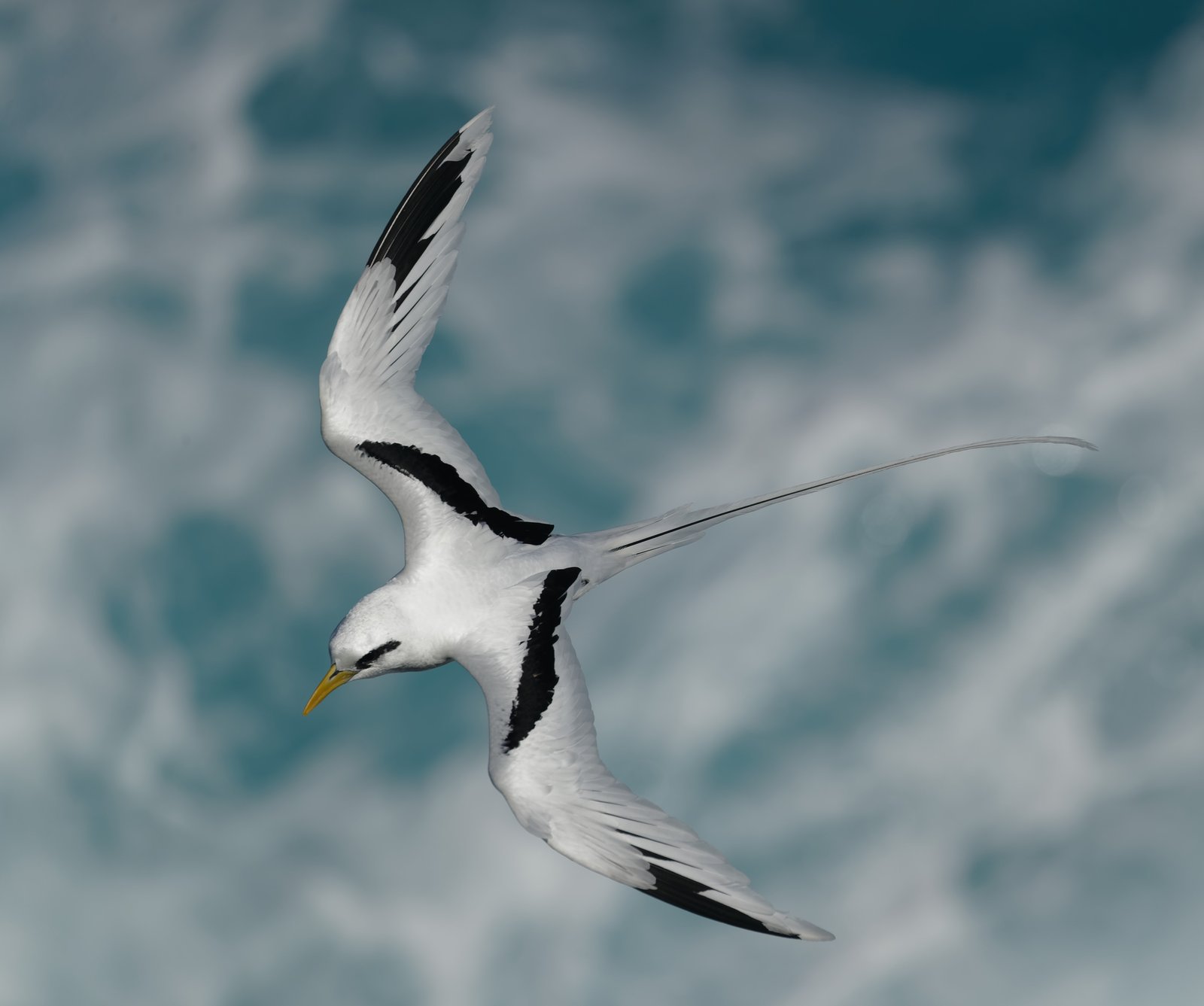
The White-Tailed Tropicbird is the smallest tropicbird and the most frequently seen of the three in the region. It is white with a striking black bar across the upperwing, a yellow-orange bill and two very long white tail streamers that ripple behind the bird in flight.
Voice
Usually silent at sea. At the breeding site a high, repeated tik-tik-tik or kek-kek-kek and a rasping krrree during group display flights.
Recording: Ross Gallardy — CC BY-NC-SA 4.0 · converted to mono · xeno-canto
Identification
70–82 cm with streamers, about 38–40 cm without; the streamers are relatively longer than in the other tropicbirds. Adults are white with an unbarred back. A broad black diagonal bar crosses the inner upperwing coverts and tertials, and the bases of the outer primaries form a black patch at the wingtip. A black stripe runs through the eye. The bill is yellow to orange, the legs greyish with black webs. Immatures are finely barred black above, lack the streamers and the black diagonal bar, and have a yellowish bill. It flies lightly and buoyantly on quick wingbeats, sometimes hovering briefly before a plunge-dive.
Confusion species
Red-Billed Tropicbird Phaethon aethereus and Red-Tailed Tropicbird Phaethon rubricauda are larger and heavier and have a red bill as adults; the former also has a barred back, the latter nearly white wings. Immatures are harder: young Red-billed is more coarsely barred and has a black collar across the nape. At distance a bird with broken streamers can suggest a tern, but the stocky build and fast, pigeon-like flight differ.
Habitat
Warm tropical ocean, often over deep water far offshore, sometimes closer to reefs and islands. It plunge-dives for flying fish, squid and small crabs. It nests in rock crevices, cliff holes and sometimes tree hollows on tropical islands.
Where the bird is most at home, classified by the vegetation units of southern Africa.

Range and movements
Within the region a scarce but regular visitor off Mozambique, mainly in the Mozambique Channel, and less often off KwaZulu-Natal; rarely further south along the Eastern Cape. After tropical cyclones birds have been found far inland, including in Zimbabwe and Malawi. Beyond the region it breeds in the tropical Indian Ocean (Europa, the Seychelles, the Mascarenes, the Comoros), the tropical Atlantic (Ascension, Fernando de Noronha, Bermuda, the Caribbean) and the Pacific.
- Passage (Mar–Apr, Oct–Nov)
- dark = core range, pale = thinly spread
How and when to look
Pelagic trips off southern Mozambique and around the Bazaruto Archipelago give the best chance, in the southern summer. The bird stands out from afar by its long, rippling streamers and the black bar across the wing. After severe cyclones also check inland lakes and dams.
Conservation status
Not globally threatened and the most numerous tropicbird. Colonies suffer locally from introduced rats and cats, the taking of eggs and chicks and disturbance by tourism, but the world population is considered stable.
Scientific name
Phaethon lepturus | Daudin, 1802
Daudin described the species in 1802 as Phaëton lepturus; because it was later moved to another genus, the author and year stand in brackets. The genus Phaethon was introduced in 1758 by Linnaeus. Phaethon goes back to the Greek phaethon 'sun, the shining one'. lepturus comes from the Greek leptos, 'slender', and oura, 'tail' — for the long, narrow central tail feathers. The specimen the first description was based on came from Mauritius.