All species › Tropicbirds › Tropicbirds › Red-Tailed Tropicbird
Red-Tailed Tropicbird | Phaethon rubricauda
Roodstaartkeerkringvogel | Rabijunco Colirrojo
The Red-Tailed Tropicbird is a heavy, satin-white tropicbird of the tropical Indian and Pacific Oceans, with a red bill and two thin red tail streamers. Within the region it is a scarce visitor to the Mozambique Channel; the nearest colony is on Europa Island.

Voice
Rarely heard at sea. At the breeding site a grating, rasping krrik and a rattling kek-kek-kek, mainly during display flights in which birds flutter backwards around each other.
Recording: AUDEVARD Aurélien — CC BY-NC-SA 4.0 · converted to mono · xeno-canto
Identification
78–81 cm with streamers, about 46 cm without; the red streamers are thin and often invisible at distance. The build is sturdy, with broad wings and a heavy chest. The plumage is pure white, with a soft pink flush in fresh birds. A black crescent runs through and behind the eye. The wings are almost wholly white; only the primary shafts and the centres of the innermost secondaries are black. The bill is red, the legs bluish grey with black webs. Immatures have a black bill, coarse black barring on the upperparts and no streamers. It flies on slow, powerful wingbeats and glides more than the other tropicbirds.
Confusion species
Red-Billed Tropicbird Phaethon aethereus also has a red bill, but a barred back, a black wedge at the wingtip and white streamers. White-Tailed Tropicbird Phaethon lepturus is smaller and slimmer, with a black diagonal bar across the inner wing, black at the base of the primaries and a yellowish bill. A high-flying white bird with no black wing pattern is almost always this species; immatures are told by the black bill.
Habitat
Open tropical ocean, often far offshore over deep, warm water; it avoids cool currents. It plunge-dives for flying fish and squid. It nests on the ground under shrubs or rocks on remote coral and volcanic islands.
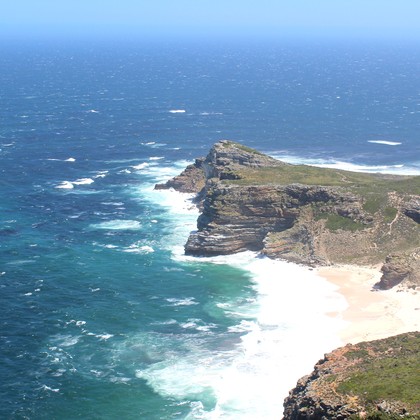
Where the bird is most at home, classified by the vegetation units of southern Africa.
Range and movements
Within the region a scarce visitor off Mozambique and KwaZulu-Natal, rarely further south to the Eastern Cape; weakened birds sometimes wash ashore after tropical cyclones. Beyond the region it breeds on islands in the tropical Indian Ocean (Europa, Aldabra, the Mascarenes, Christmas Island) and in the Pacific from Hawaii to eastern Australia and Polynesia; absent from the Atlantic.
How and when to look
The best chance is on pelagic trips off southern Mozambique, for example from Ponta do Ouro or Inhambane, in the southern summer. Scan high above the horizon: the bird often flies at great height and then stands out mainly by its all-white wings. After cyclones it is worth checking the beaches of KwaZulu-Natal.
Conservation status
Not globally threatened. On many islands it has declined sharply through introduced rats, cats and pigs and through the taking of birds for their tail feathers; with rat eradication several colonies are recovering.
Scientific name
Phaethon rubricauda | Boddaert, 1783
Boddaert described the species in 1783 as Phaeton rubricauda; because it was later moved to another genus, the author and year stand in brackets. The genus Phaethon was introduced in 1758 by Linnaeus. Phaethon goes back to the Greek phaethon 'sun, the shining one'. rubricauda comes from the Latin ruber, 'red', and cauda, 'tail' — for the two long red central tail feathers. The specimen the first description was based on came from Mauritius.