All species › Penguins › Penguins › King Penguin
King Penguin | Aptenodytes patagonicus
Koningspinguïn | Pingüino Rey
The King Penguin is the largest penguin in the world after the Emperor Penguin and one of the most striking birds of the sub-Antarctic islands. Within the region it breeds in large, noisy colonies on Marion and Prince Edward, and its breeding cycle is so long that a pair raises at most two chicks in three years.

Voice
In the colony a loud, trumpeting, fluting song, ah-ah-oooo, given with the bill stretched upwards; each bird has its own vocal rhythm by which partner and chick recognise it among thousands of others. Also short barking contact calls at sea.
Recording: Meena Haribal — CC BY-NC-SA 4.0 · shortened to the first 60 s, mono · xeno-canto
Identification
About 90–100 cm, standing upright. The upperparts are silvery grey, the underparts satin white, divided by a narrow black line along the flanks. The head and throat are velvety black, with a bright comma-shaped orange-yellow ear patch on each side, linked down the neck sides to the orange upper breast. The long, slightly decurved bill is black with an orange-pink plate on the lower mandible. The sexes are alike. Immatures resemble adults but have pale yellow ear patches and a greyish throat. Chicks wear a thick brown down for months and overwinter in crèches in the colony in this plumage.
Confusion species
Unmistakable within the region; the very similar Emperor Penguin does not occur. Gentoo Penguin Pygoscelis papua and Macaroni Penguin Eudyptes chrysolophus are much smaller and lack the orange ear patches. The brown downy chicks are sometimes taken for a different species by new visitors.
Habitat
It breeds on flat, gravelly coastal strips, beach flats and sheltered valleys near the sea, without a nest: the single egg is carried on the feet under a fold of belly skin. It forages in the open ocean up to hundreds of kilometres from the colony, mainly around the Antarctic Polar Front, diving to 300 m for lanternfish and squid.
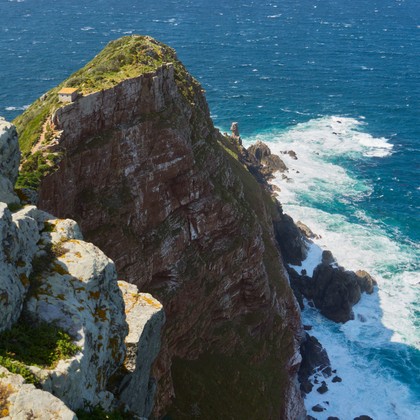
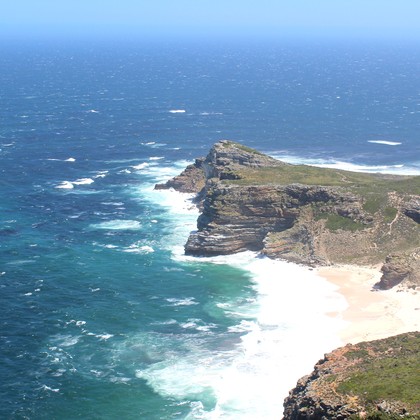
Where the bird is most at home, classified by the vegetation units of southern Africa.
Range and movements
Within the region it breeds only on the Prince Edward Islands, where tens of thousands of pairs nest in a series of colonies along the coasts of Marion and Prince Edward. On the South African mainland only a few weakened or beached vagrants are known. Beyond the region it breeds on the Crozet Islands, Kerguelen, Heard, Macquarie, South Georgia, the Falkland Islands and in Tierra del Fuego.
- Resident
- dark = core range, pale = thinly spread
How and when to look
Only seen on a visit to Marion, in practice during the annual relief voyage in April–May or on research work; the islands are a strictly protected nature reserve with no tourism. As the breeding cycle lasts more than a year, adults and brown chicks are almost always present in the colonies at the same time.
Conservation status
Not threatened; the world population has recovered strongly since the end of commercial hunting of penguins for oil and numbers more than a million pairs. The Marion colonies are stable to slightly declining. Warming of the Southern Ocean, shifting the Antarctic Polar Front southwards and lengthening foraging trips, is seen as the main future threat.
Scientific name
Aptenodytes patagonicus | Miller, 1778
Miller described the species in 1778 and placed it straight away in the genus where it still stands. He introduced the genus Aptenodytes in that same work. Aptenodytes comes from the Greek aptēn, 'unfledged, unable to fly', and dutēs, 'diver' — a 'wingless diver'. patagonicus means 'of Patagonia'; the name goes back to early sightings in the waters around southern South America, though the species hardly breeds there. The specimen the first description was based on came from not stated; South Georgia designated later.