All species › Passerines › Chats and flycatchers › Sickle-Winged Chat
Sickle-Winged Chat | Emarginata sinuata
Vlaktespekvreter | Colinegro Sudafricano
The Sickle-Winged Chat is a modest grey-brown chat of the open plains of the Karoo and highlands that spends much time running on the ground and is easily overlooked among the commoner Familiar Chats. Its English name refers to the sickle-shaped emargination of the outer primary, which cannot be seen in the field.

Voice
Mostly silent. The call is a soft chak or dry tik-tik. The song is a short, soft phrase of chattering and scratchy notes, sometimes with mimicry, often given from a low bush or in a brief song flight.
Recording: Lynette Rudman — CC BY-NC-SA 4.0 · converted to mono · xeno-canto
Identification
15 cm, a slim, upright chat with fairly long legs. The upperparts are grey-brown, the underparts pale grey-buff with a whitish throat and belly. The rump and tail base are pale orange-buff; the tail shows a dark T pattern formed by blackish-brown central feathers and a broad dark terminal band. The face is fairly plain, with pale lores and a pale eye-ring, lacking the rusty ear coverts of Familiar Chat. The wings are dark brown with pale edges. The sexes are alike; juveniles are lightly spotted. It runs fast over bare ground and flicks its wings less than related species.
Confusion species
Familiar Chat (Oenanthe familiaris) is darker brown, with a warmer rufous rump and tail and rusty ear coverts, and flicks its wings constantly; it prefers rocks and buildings to open plains. Karoo Chat (Emarginata schlegelii) is larger and greyer, with white tail sides and a grey rump. Tractrac Chat (Emarginata tractrac) is paler and dumpier, with a white rather than orange-buff rump and a shorter tail.
Habitat
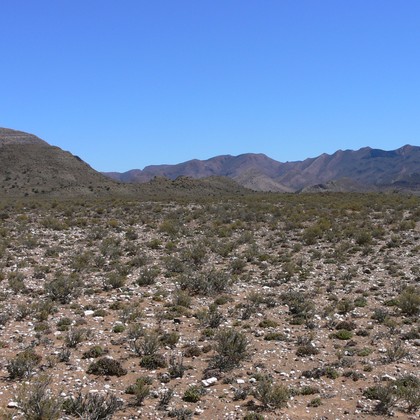
Open, flat to gently undulating karoo scrub plains, short-grazed grassland, renosterveld and fallow land, and in the highlands also montane grassland and rocky flats. It forages on the ground for insects, especially ants and beetles, using low shrubs, stones and posts as lookouts. The nest is placed in a hollow in the ground, under a stone or shrub.
Where the bird is most at home, classified by the vegetation units of southern Africa.


Range and movements
Near-endemic to the region: the Karoo and the interior of the Western, Eastern and Northern Cape, the Free State and highland Lesotho, and locally in southern Namibia. Birds from the Lesotho highlands and eastern Free State partly move to lower ground in winter. It occurs nowhere outside this region.
- Resident
- Winter visitor (c. Apr–Sep)
- Passage (Mar–Apr, Oct–Nov)
- dark = core range, pale = thinly spread
How and when to look
Look for it on open plains where Familiar Chats are scarce, for example in the eastern Karoo around Graaff-Reinet and on the plateau along the Sani Pass. Watch for a pale, upright bird that keeps running short distances over bare ground; the orange-buff rump shows best as it takes off.
Conservation status
Not threatened. The species is locally fairly common and its range is large. Overgrazing and conversion of plains to cropland can degrade habitat locally, but the population is considered stable.
Scientific name
Emarginata sinuata | (Sundevall, 1858)
Sundevall described the species in 1858 as Lusc[inia] sinuata; because it was later moved to another genus, the author and year stand in brackets. The genus Emarginata was introduced in 1896 by Shelley. Emarginata comes from the Latin emarginatus, 'emarginated, notched', for the greatly attenuated tip of the ninth primary of the Sickle-winged Chat, which in some specimens forms a small sickle. sinuata is Latin for 'curved, wavy' — probably for the sickle-shaped, notched outer primaries. The specimen the first description was based on came from Saldanha Bay, South Africa.