All species › Pelicans, herons and ibises › Herons and bitterns › Slaty Egret
Slaty Egret | Egretta vinaceigula
Sharpes reiger | Garceta Gorjirroja
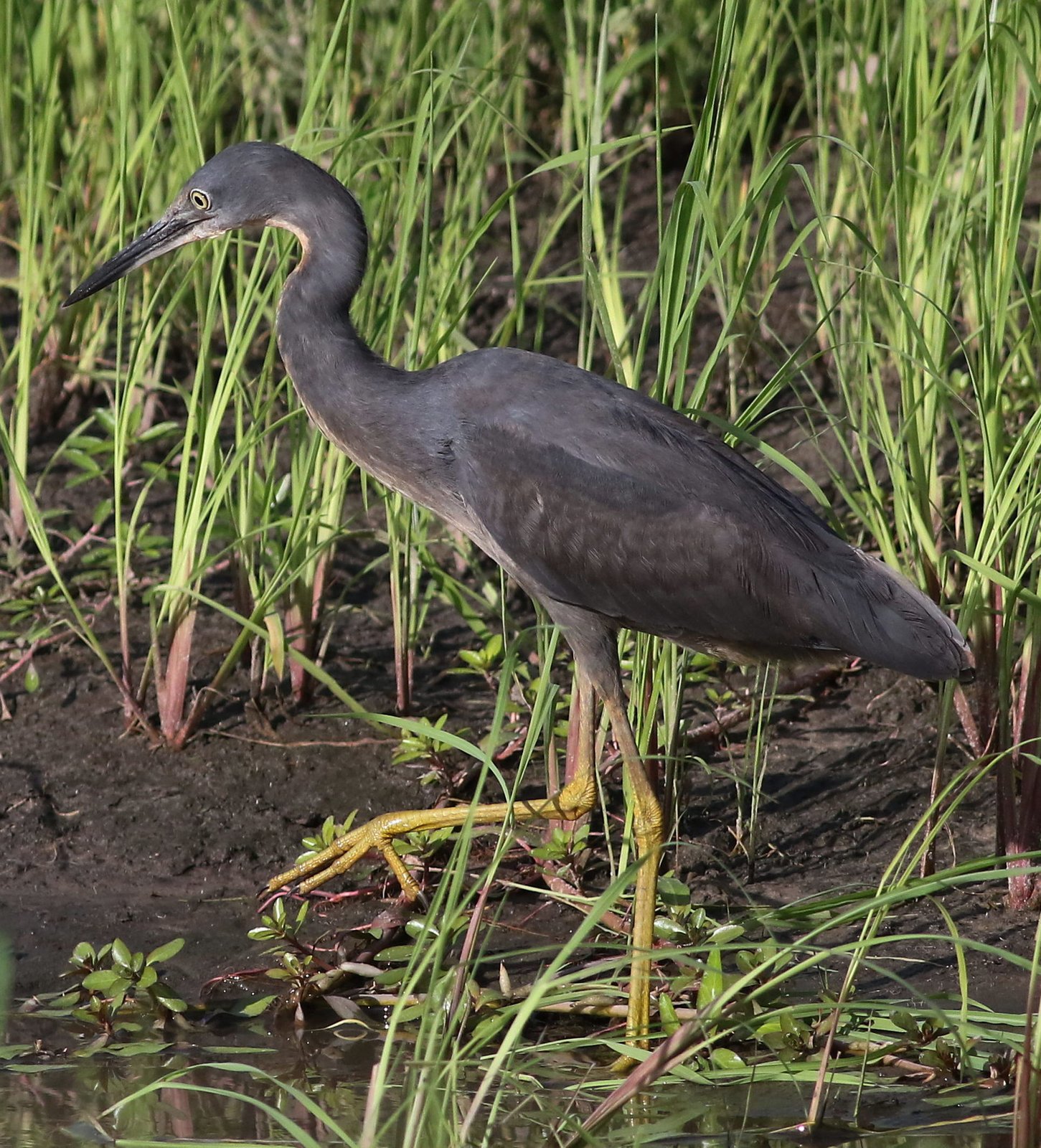
The Slaty Egret is a medium-sized slate-grey heron of the great floodplains at the heart of southern Africa. With a world population of at most a few thousand birds and a range that lies almost entirely within this region, it is one of the most sought-after species of the Okavango and the Zambian floodplains.
Voice
Largely silent. On take-off or at the colony a low, hoarse kraak and a soft guttural croak.
No recording with a suitable Creative Commons licence is available for this species yet.
Identification
About 60 cm, wholly dark slate-grey with a small but striking rufous to vinous throat and foreneck, which at distance often shows only as a warm smudge. The bill is black and slender. The legs are yellow-green to yellow, including the toes, and the lower legs are the best feature when the throat cannot be seen. In breeding plumage there are long grey plumes on the hindcrown, back and breast. The sexes are alike; juveniles are duller, with a paler rufous throat and greener legs. It hunts standing or walking slowly, often with the wings half spread.
Confusion species
Black Heron Egretta ardesiaca is deeper black, without a rufous throat, has black legs with yellow feet and hunts with the wings closed over its head like an umbrella, which the Slaty Egret does not do. Rufous-Bellied Heron Ardeola rufiventris is smaller and more compact, with rufous belly, wings and tail and a yellow bill base. A dark-plumaged Little Egret Egretta garzetta is extremely rare in the region and has black legs with yellow feet.
Habitat
Shallow, seasonally flooded grassland and the edges of floodplains, lagoons and channels with short vegetation, often where the water is just receding. It avoids deep open water and dense reedbeds. Food consists of small fish, frogs and aquatic insects, taken by walking slowly and striking quickly. It breeds in mixed heronries in trees and bushes over water.
Where the bird is most at home, classified by the vegetation units of southern Africa.

Range and movements
The core range lies in northern Botswana (Okavango Delta, Linyanti and Chobe) and in Zambia (Kafue Flats, Bangweulu, the Liuwa Plain and the western Zambezi floodplains). It also occurs in the Caprivi Strip of Namibia and in south-eastern Angola; rare along the Zambezi in Zimbabwe and a vagrant further south. Outside the region there are only scattered records, including in southern DR Congo and Tanzania.
- Resident
- Summer visitor (c. Oct–Mar)
- Winter visitor (c. Apr–Sep)
- Passage (Mar–Apr, Oct–Nov)
- dark = core range, pale = thinly spread
How and when to look
Best in the Okavango Delta and on the Kafue Flats at the end of the wet season and early in the dry season, when the water drops and the birds hunt on the flooded grassland. Look for a grey heron with yellow legs; a throat that glows rufous in good light confirms the identification. From a mokoro or boat in the shallow lagoons of the delta one can often get close.
Conservation status
Vulnerable according to the IUCN, with a small world population of a few thousand birds. The main threats are changes in flooding caused by dams and water abstraction, as on the Kafue Flats, drainage, grazing and fire on the floodplains, and disturbance at the few breeding colonies.
Scientific name
Egretta vinaceigula | (Sharpe, 1895)
Sharpe described the species in 1895 as Melanophoyx vinaceigula; because it was later moved to another genus, the author and year stand in brackets. The genus Egretta was introduced in 1817 by Forster. Egretta comes from Provençal aigrette, the name for the little egret, a diminutive of aigron 'heron'. vinaceigula comes from the Latin vinaceus, 'wine-coloured', and gula, 'throat' — for the wine-red throat. The specimen the first description was based on came from Potchefstroom, South Africa.