All species › Waders, gulls and terns › Sheathbills › Snowy Sheathbill
Snowy Sheathbill | Chionis albus
Zuidpoolkip | Picovaina de las Malvinas
The Snowy Sheathbill is a stocky, all-white shore bird with the build of a pigeon and the habits of a chicken. It breeds on the Antarctic Peninsula and the islands of the Scotia Sea and reaches the South African coast only as a vagrant, often after hitching a ride on a ship from the south.

Voice
Mostly silent away from breeding colonies. Hoarse, grating calls, a short kek or kaak, and during disputes and display a series of harsh cries with the head bobbed up and down.
Recording: Andrew Spencer — CC BY-NC-SA 4.0 · converted to mono · xeno-canto
Identification
34–41 cm. The plumage is snow-white. The short, thick bill is yellowish to pink with a dark tip and carries a horny sheath over the nostrils at its base; pink to yellowish fleshy caruncles sit around the eye and on the cheeks. The legs are short, sturdy and blue-grey to blackish, without webbing; a small spur sits at the bend of the wing. The sexes are alike, the male larger. Juveniles have a darker bill and fewer caruncles. It walks about like a chicken and flies with fast, pigeon-like wingbeats.
Confusion species
Black-Faced Sheathbill Chionis minor of the Prince Edward Islands has a black bill with a black sheath and a black face; it almost never reaches the mainland coast. A white or pale Rock Dove Columba livia has a thin bill and red legs and lacks the caruncles. A white domestic chicken or an albinistic gull can also cause confusion, but none combines the stocky build with the bill sheath.
Habitat
Rocky shores, beaches with stranded kelp, harbours and seal and penguin colonies. A scavenger and opportunist that steals eggs and chicks, intercepts food passed between adult penguins and their young, and searches carcasses, droppings, seaweed and refuse. On ships it lives on galley scraps, which explains the long journey north.
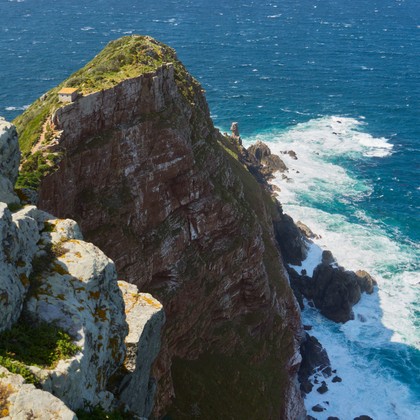
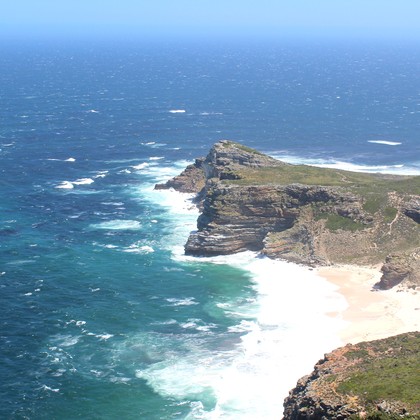
Where the bird is most at home, classified by the vegetation units of southern Africa.
Range and movements
Within the region an irregular vagrant to the coast of South Africa, with most records from the Western and Eastern Cape and a few from KwaZulu-Natal and Namibia; some birds have travelled on ships. It breeds on the Antarctic Peninsula, the South Shetland Islands, the South Orkney Islands and South Georgia, and moves in the southern winter to Patagonia and the Falkland Islands.
How and when to look
Records fall mainly in the southern winter and often concern birds in harbours such as Cape Town, Saldanha and Port Elizabeth (Gqeberha), sometimes staying for long periods. Check penguin colonies and the quays where fishing and research vessels from the Southern Ocean dock; the birds are tame and can be watched at close range.
Conservation status
Not threatened; the world population is estimated at a few tens of thousands of birds and is stable. The species depends on penguin and seal colonies and is thus sensitive to changes in the Antarctic food web. Research stations locally provide extra food.
Scientific name
Chionis albus | (Gmelin, 1789)
Gmelin described the species in 1789 as Vaginalis alba; because it was later moved to another genus, the author and year stand in brackets. The genus Chionis was introduced in 1788 by Forster. Chionis comes from the Greek chiōn, 'snow' — for the all-white plumage of these birds of subantarctic shores. albus is Latin for 'white' — for the snow-white plumage. The specimen the first description was based on came from Falkland Islands.