All species › Waders, gulls and terns › Sheathbills › Black-Faced Sheathbill
Black-Faced Sheathbill | Chionis minor
Klein ijshoen | Picovaina de las Kerguelen
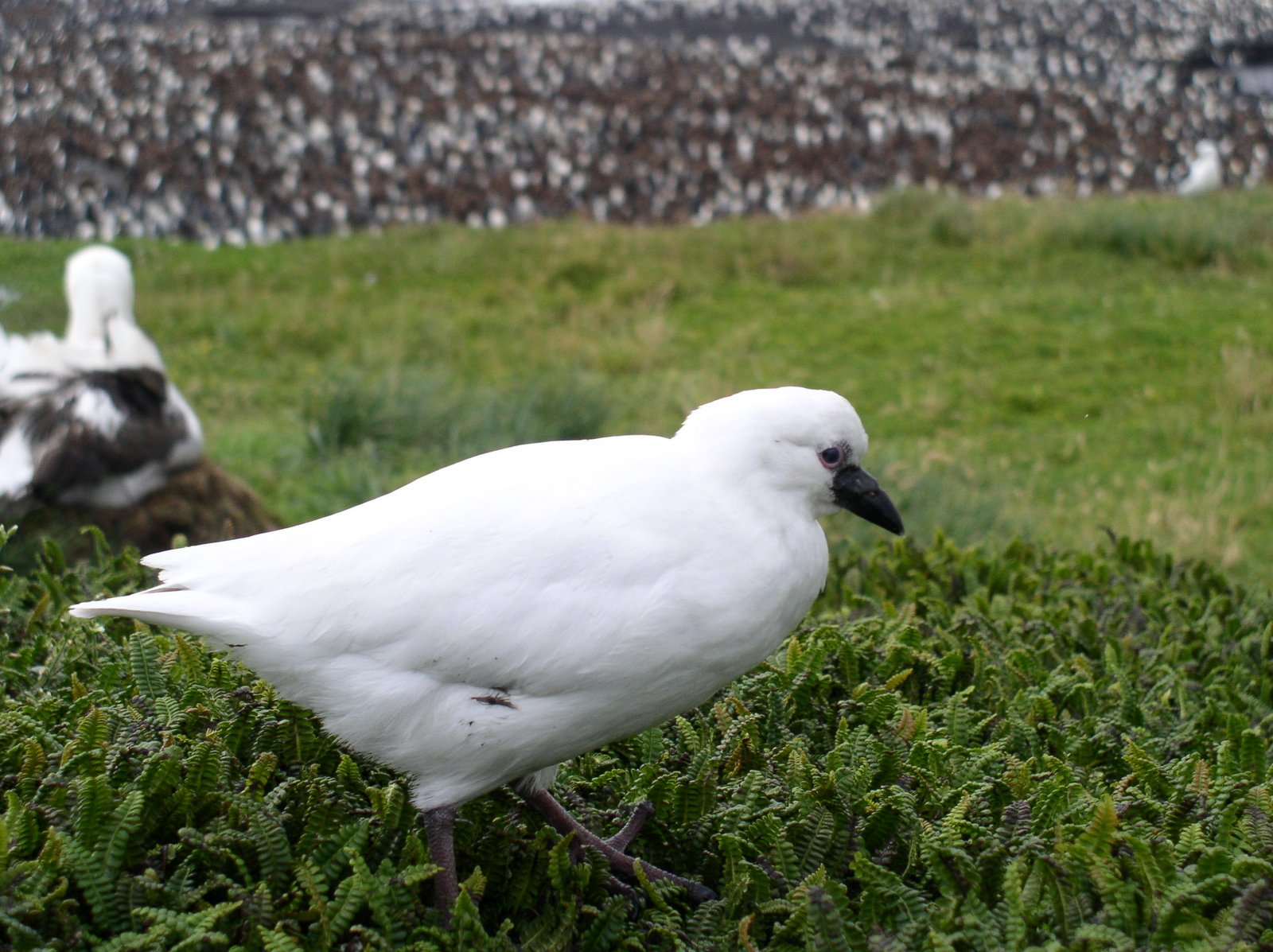
The Black-Faced Sheathbill is a white, stocky shore bird with a black face and a black bill. Within the region it breeds only on Marion and Prince Edward, the sub-Antarctic Prince Edward Islands that belong to South Africa; the species is resident and almost never reaches the mainland coast.
Voice
Hoarse, rasping calls, a short kek and a harsh kaa-kaa, given in disputes and display with the head bobbing and the wings half spread.
Recording: Hichem MACHOUK — CC BY-NC-SA 4.0 · shortened to the first 60 s, mono · xeno-canto
Identification
38–41 cm. The plumage is white. The short, thick bill is black and carries a black horny sheath at its base; the face around the eye has black to dark pink fleshy caruncles. The legs are short, sturdy and pink to greyish, without webbing; a spur sits at the bend of the wing. The sexes are alike, the male larger with larger caruncles. Juveniles have fewer caruncles and a brownish-black bill. It runs about briskly like a chicken and flies little and low.
Confusion species
Snowy Sheathbill Chionis albus has a yellow to pink bill with a dark tip and a pale face; that species reaches the mainland coast as a vagrant, not the Prince Edward Islands. On the islands themselves there is no other white, chicken-like land bird.
Habitat
Rocky shores, boulder beaches and the edges of penguin, fur seal and elephant seal colonies, up to a few hundred metres inland into the vegetation behind the coast. A scavenger and predator of the eggs and chicks of penguins and petrels, it also intercepts food passed between penguin parents and chicks and searches carcasses, droppings, afterbirths and invertebrates in kelp and moss. The nest lies in a rock crevice or a cavity among boulders, usually close to a penguin colony.
Where the bird is most at home, classified by the vegetation units of southern Africa.
Range and movements
Within the region only on the Prince Edward Islands (Marion and Prince Edward) in the southern Indian Ocean, more than 1,700 km south-east of the Cape of Good Hope, as the endemic subspecies marionensis. Elsewhere on the Crozet Islands, Kerguelen and Heard and McDonald. The species is barely known from the African mainland.
How and when to look
Only seen by visiting the research station on Marion, which is closed to ordinary visitors. For most birders the species thus remains an island bird; anyone on a voyage through the southern Indian Ocean calling at Crozet or Kerguelen will find it at every penguin colony.
Conservation status
Not threatened; the world population numbers a few thousand pairs and is stable. On Marion, feral cats put the species under pressure until their eradication around 1991; introduced House Mice still threaten its invertebrate food supply. Changes in penguin numbers feed directly into its food.
Scientific name
Chionis minor | Hartlaub, 1841
Hartlaub described the species in 1841 and placed it straight away in the genus where it still stands. The genus Chionis was introduced in 1788 by Forster. Chionis comes from the Greek chiōn, 'snow' — for the all-white plumage of these birds of subantarctic shores. minor is Latin for 'smaller' — this species is smaller than its relative, the Snowy Sheathbill. The specimen the first description was based on came from Kerguelen Islands.