All species › Waders, gulls and terns › Gulls and terns › Sooty Tern
Sooty Tern | Onychoprion fuscatus
Bonte stern | Charrán Sombrío
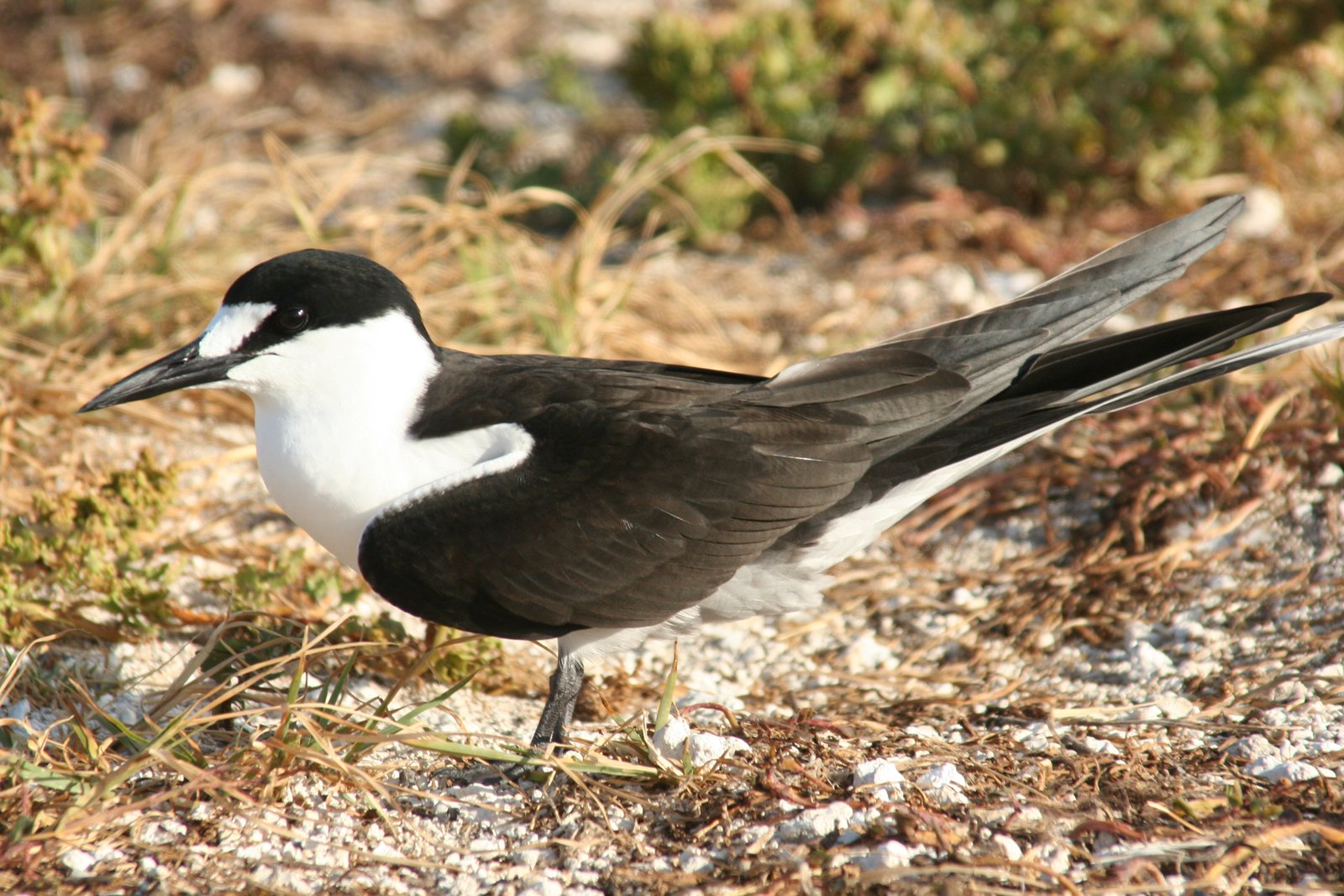
The Sooty Tern is a large, black-and-white oceanic tern that spends years continuously at sea, hardly ever settling on the water. It breeds in enormous colonies on tropical islands, including in the Mozambique Channel, and after cyclones regularly ends up on the coast of southern Africa and sometimes far inland.
Voice
A loud, nasal, three-part ker-wacky-wack, heard day and night over colonies and also often given at sea; also a high, short kraark.
Recording: AUDEVARD Aurélien — CC BY-NC-SA 4.0 · converted to mono · xeno-canto
Identification
About 43 cm, a large, slender tern with long, narrow wings and a deeply forked tail with long outer feathers. The upperparts, wings and tail are blackish, the crown black; a broad white forehead reaches above, but not behind, the eye. The underparts are white, the underwing white with broad black flight feathers. The outer tail feathers are white. Bill and legs black. Juveniles are very different: uniformly dark sooty brown with white spots on the mantle and wing coverts, a pale lower belly and undertail coverts, and a shorter fork.
Confusion species
Bridled Tern (Onychoprion anaethetus) is smaller and slimmer, with greyish-brown rather than black upperparts that are paler than the black cap, a pale hind collar and a narrow white forehead that continues as a supercilium behind the eye. Juvenile Sooty Terns resemble the Brown Noddy (Anous stolidus), but have a forked tail, white spots on the upperparts and a pale belly. Large black-capped terns such as Greater Crested Tern (Thalasseus bergii) have pale grey upperparts.
Habitat
Warm tropical ocean far beyond the continental shelf. It feeds in flocks over shoals of tuna and other predatory fish, picking small fish and squid from the surface without plunging into the water, and seldom sits on the sea. It breeds in dense colonies on flat, vegetated or bare islands.
Where the bird is most at home, classified by the vegetation units of southern Africa.


Range and movements
In the region an irregular visitor off Mozambique and KwaZulu-Natal, mainly in summer; after cyclones sometimes in large numbers along the coast, with scattered records far inland, as in Zimbabwe, Mpumalanga and Gauteng. Large colonies on Europa and Juan de Nova in the Mozambique Channel and in the Seychelles. Elsewhere breeding in all tropical oceans, in the Atlantic among others on Ascension.
- Summer visitor (c. Oct–Mar)
- Passage (Mar–Apr, Oct–Nov)
- dark = core range, pale = thinly spread
How and when to look
Best chances are a seawatch or pelagic trip off southern Mozambique or Zululand in summer, and especially the days right after a cyclone, when exhausted birds may appear along the coast and on inland lakes. Birds inland are almost always storm-driven; report them to the atlas project.
Conservation status
Not threatened; with many millions of pairs one of the most numerous seabirds in the world. Colonies on several islands have shrunk greatly through introduced rats and cats and through egg collecting, which still takes place on a large scale locally. Its dependence on tuna shoals makes the species sensitive to overfishing.
Scientific name
Onychoprion fuscatus | (Linnaeus, 1766)
Linnaeus described the species in 1766 as Sterna fuscata; because it was later moved to another genus, the author and year stand in brackets. The genus Onychoprion was introduced in 1832 by Wagler. Onychoprion comes from Greek onux 'nail, claw' and prion 'saw'. fuscatus is Latin for 'darkened', from fuscus 'dark', after the sooty upperparts. The specimen the first description was based on came from Santo Domingo.