All species › Waders, gulls and terns › Gulls and terns › Lesser Black-Backed Gull
Lesser Black-Backed Gull | Larus fuscus
Kleine mantelmeeuw | Gaviota Sombría
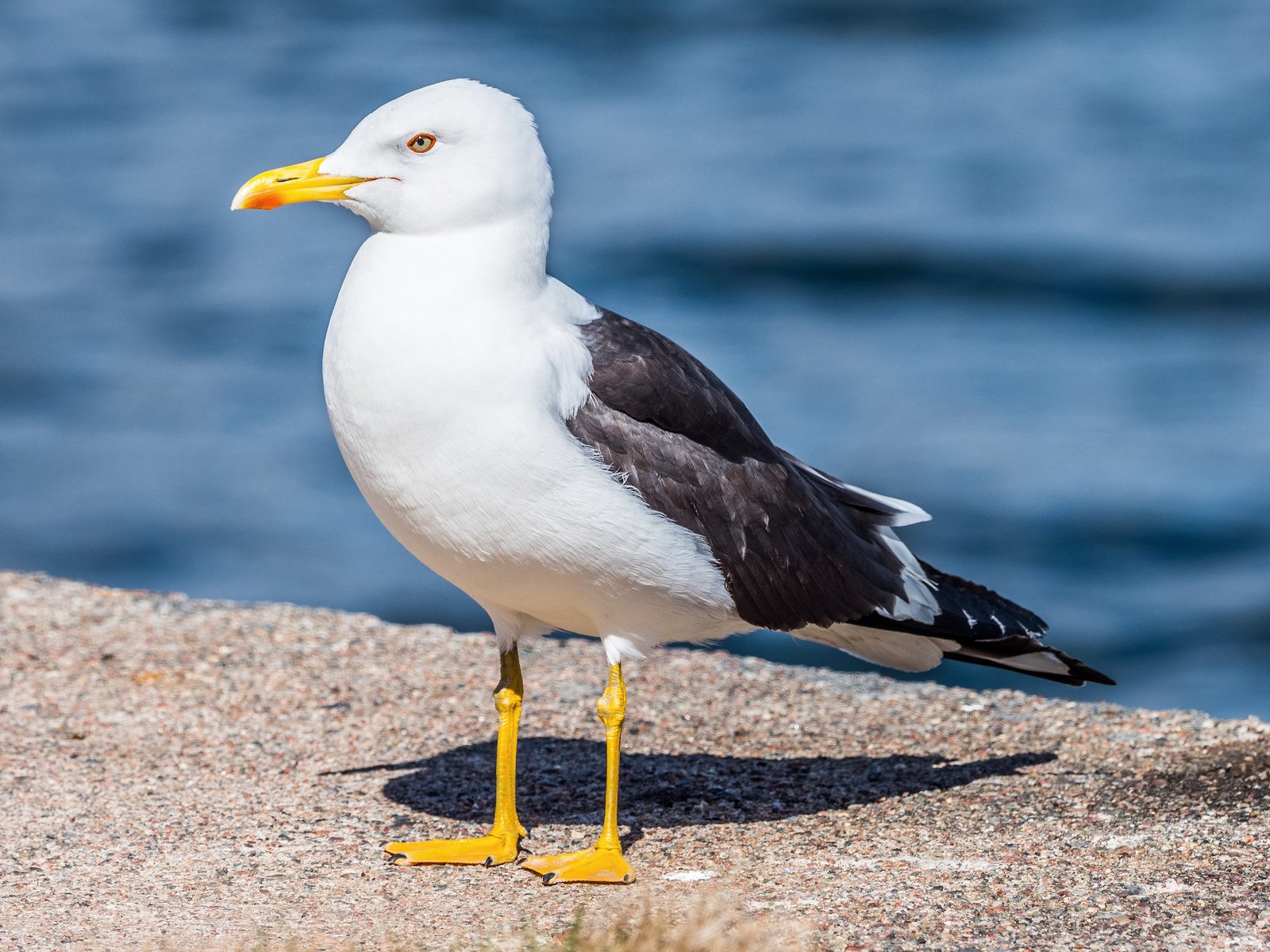
The Lesser Black-Backed Gull is a slim, long-winged large gull from northern Europe and western Siberia that migrates in small numbers as far as southern Africa. It is a scarce but regular summer visitor, mainly on the east coast and on large lakes in the north of the region; in the Western Cape it has to be separated from the much commoner Kelp Gull.
Voice
A deep, laughing kyow and a short ga-ga-ga; usually silent in the region.
Recording: Francesco Sottile — CC BY-NC-SA 4.0 · converted to mono · xeno-canto
Identification
51–61 cm. A large gull with long, narrow wings that project well beyond the tail, a fairly slender yellow bill with a red spot, a pale yellow iris and yellow legs. The mantle ranges from dark slate grey in the subspecies heuglini to almost black in the Baltic subspecies fuscus, the form seen most often in the region. In non-breeding plumage the head is finely streaked grey. Immatures are scaly dark brown, with a black bill, dark primaries without pale inner webs and a broad black tail band.
Confusion species
Kelp Gull Larus dominicanus is larger and bulkier, with a heavier bill, olive-grey legs, a dark eye, shorter wings and a broader white trailing edge to the wing. Sooty Gull Ichthyaetus hemprichii has a brown hood, a white collar and a two-toned greenish-yellow bill. Immature Lesser Black-Backed Gulls closely resemble young Kelp Gulls; look for the slimmer build, the longer wing projection and the finer bill.
Habitat
Estuaries, lagoons, harbours, sandbanks and beaches, and inland large lakes, reservoirs and rivers. It often rests among Grey-Headed Gulls and terns. It eats fish, crustaceans, insects and refuse.
Where the bird is most at home, classified by the vegetation units of southern Africa.


Range and movements
Scarce along the coast of Mozambique and KwaZulu-Natal, rarer south-west to the Western Cape and along the Namibian coast. Inland mainly on large waters in the north: Lake Kariba and the Zambezi in Zimbabwe and Zambia, Lake Malawi, the Okavango and the Makgadikgadi Pans in Botswana, and occasionally on the South African highveld. It breeds from Iceland and western Europe to northern Siberia; the eastern forms migrate via the Nile valley and the Rift Valley to eastern and central Africa.
- Summer visitor (c. Oct–Mar)
- Winter visitor (c. Apr–Sep)
- Passage (Mar–Apr, Oct–Nov)
- dark = core range, pale = thinly spread
How and when to look
The best chances are between October and April on Lake Kariba, the sandbanks of the Zambezi and along the coast at Maputo and Durban. A black-backed gull with yellow legs among Grey-Headed Gulls inland is almost certainly this species.
Conservation status
Not threatened; the world population is large and has increased in western Europe. The Baltic subspecies fuscus, which supplies many of the birds in the region, has however declined sharply through food shortage and pollution. Of no particular conservation significance in southern Africa.
Scientific name
Larus fuscus | Linnaeus, 1758
Linnaeus described the species in 1758 and placed it straight away in the genus where it still stands. He introduced the genus Larus in that same work. Larus is Latin, from Ancient Greek laros, and appears to have referred to a gull or another large seabird. fuscus is Latin for 'dark', black or brown, after the dark mantle and wings. The specimen the first description was based on came from Sweden.