All species › Hoopoes and hornbills › Hornbills › Southern Ground Hornbill
Southern Ground Hornbill | Bucorvus leadbeateri
Zuidelijke hoornraaf | Cálao Terrestre Sureño
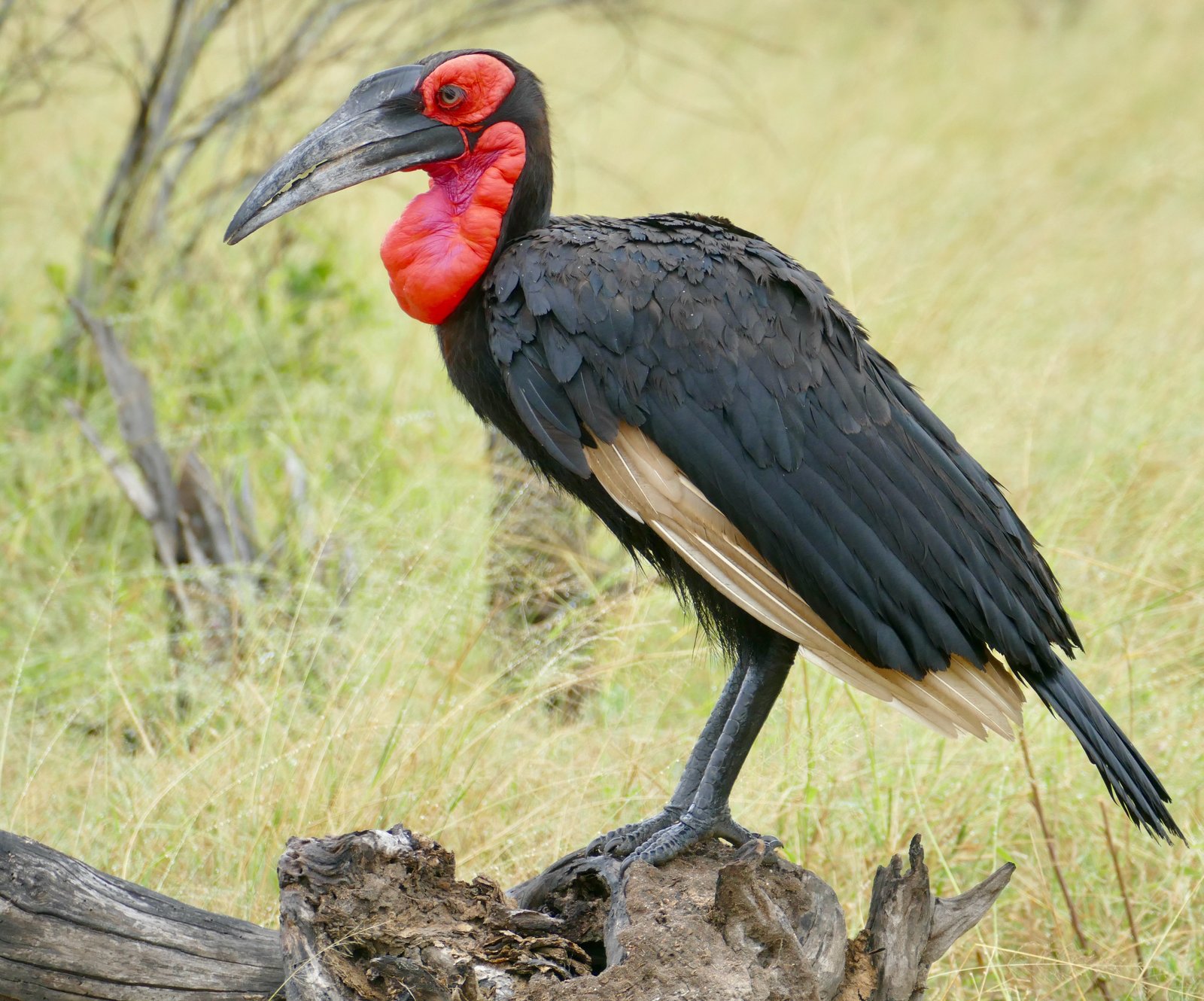
The Southern Ground Hornbill is the largest hornbill in Africa: a turkey-sized black bird that walks through the savanna at a measured pace in small groups. Its deep, booming call carries for kilometres and is one of the characteristic sounds of the African dawn.
Voice
A deep, booming oo-oo oo-oo-oo, especially before dawn, produced in chorus by the whole group; males and females call alternately at slightly different pitches. In still weather the sound carries 3 to 5 km and marks the group territory.
Recording: isaac kilusu — CC BY-NC-SA 4.0 · converted to mono · xeno-canto
Identification
About 95 cm, wholly black with a heavy, curved black bill bearing a low casque at the base. The bare skin around the eye and the inflatable throat pouch are bright red in the male; the female has a violet-blue patch on the throat. The iris is pale yellow and the eyelashes long and black. In flight the white primaries show, hidden in the perched bird. Juveniles are brownish-black with a smaller bill and dull yellowish-grey facial skin; the red appears only after several years. It walks with deliberate steps and flies heavily, alternating flapping and gliding.
Confusion species
No confusion is possible in the region. Abyssinian Ground Hornbill occurs only north of the equator. At long range a foraging group can suggest turkeys or Black Stork, but the heavy bill and red face are evident at once.
Habitat
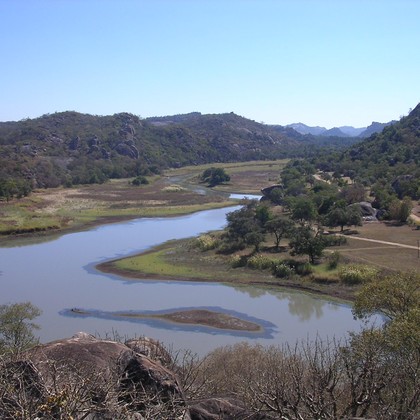
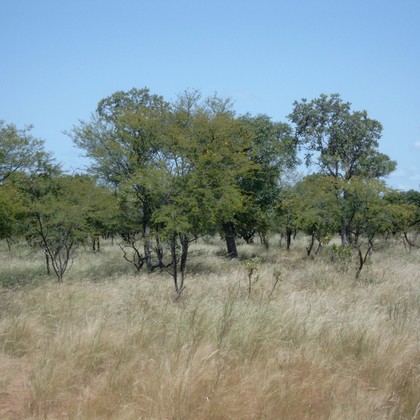
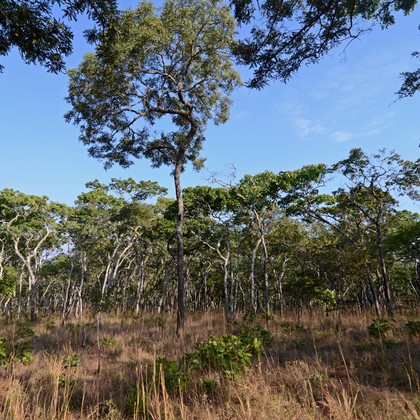
Open savanna and bushveld with short grass, miombo and other broadleaved woodland, grassland with scattered large trees and the edges of farmland. It forages on foot for insects, reptiles, amphibians, snails and small mammals, seized or dug out with the bill. It nests in large cavities in old trees or in rock faces.
Where the bird is most at home, classified by the vegetation units of southern Africa.
Range and movements
In the north and east of the region: Zambia, Malawi, Mozambique, Zimbabwe, northern Botswana, the Zambezi Region and north-eastern Namibia, Angola, Eswatini and eastern and north-eastern South Africa (Limpopo, Mpumalanga, KwaZulu-Natal and the Eastern Cape). Much reduced outside protected areas. Further north to Kenya, Burundi and the southern Democratic Republic of the Congo.
- Resident
- Summer visitor (c. Oct–Mar)
- Winter visitor (c. Apr–Sep)
- Passage (Mar–Apr, Oct–Nov)
- dark = core range, pale = thinly spread
How and when to look
Kruger and the large parks of Zimbabwe, Botswana and Zambia offer the best chances. Drive early and listen before sunrise for the booming chorus. Groups of two to ten birds walk slowly through short grass and along road verges and can be watched well from a vehicle.
Conservation status
Globally Vulnerable. The species breeds cooperatively and slowly: a group raises on average one young every nine years, and of the two eggs only the first chick survives. Threats are poisoning, persecution by people whose windows the birds attack because they take their reflection for an intruder, electrocution, trade for traditional medicine and the loss of large nest trees. In South Africa it is nationally Endangered; second chicks are hand-reared and released there and nest boxes are installed.
Scientific name
Bucorvus leadbeateri | (Vigors, 1825)
Vigors described the species in 1825 as Buceros Leadbeateri; because it was later moved to another genus, the author and year stand in brackets. The genus Bucorvus was introduced in 1830 by Lesson. Bucorvus is a blend of Buceros, the genus of Asian hornbills, and the Latin corvus, 'raven' — for the black, raven-like appearance. leadbeateri honours Benjamin Leadbeater (1760–1837), a London dealer in natural-history specimens. The specimen the first description was based on came from 'the northern interior of Africa' (inaccurate; not specified further).