All species › Trogons › Trogons › Bar-Tailed Trogon
Bar-Tailed Trogon | Apaloderma vittatum
Bandstaarttrogon | Trogón Montano
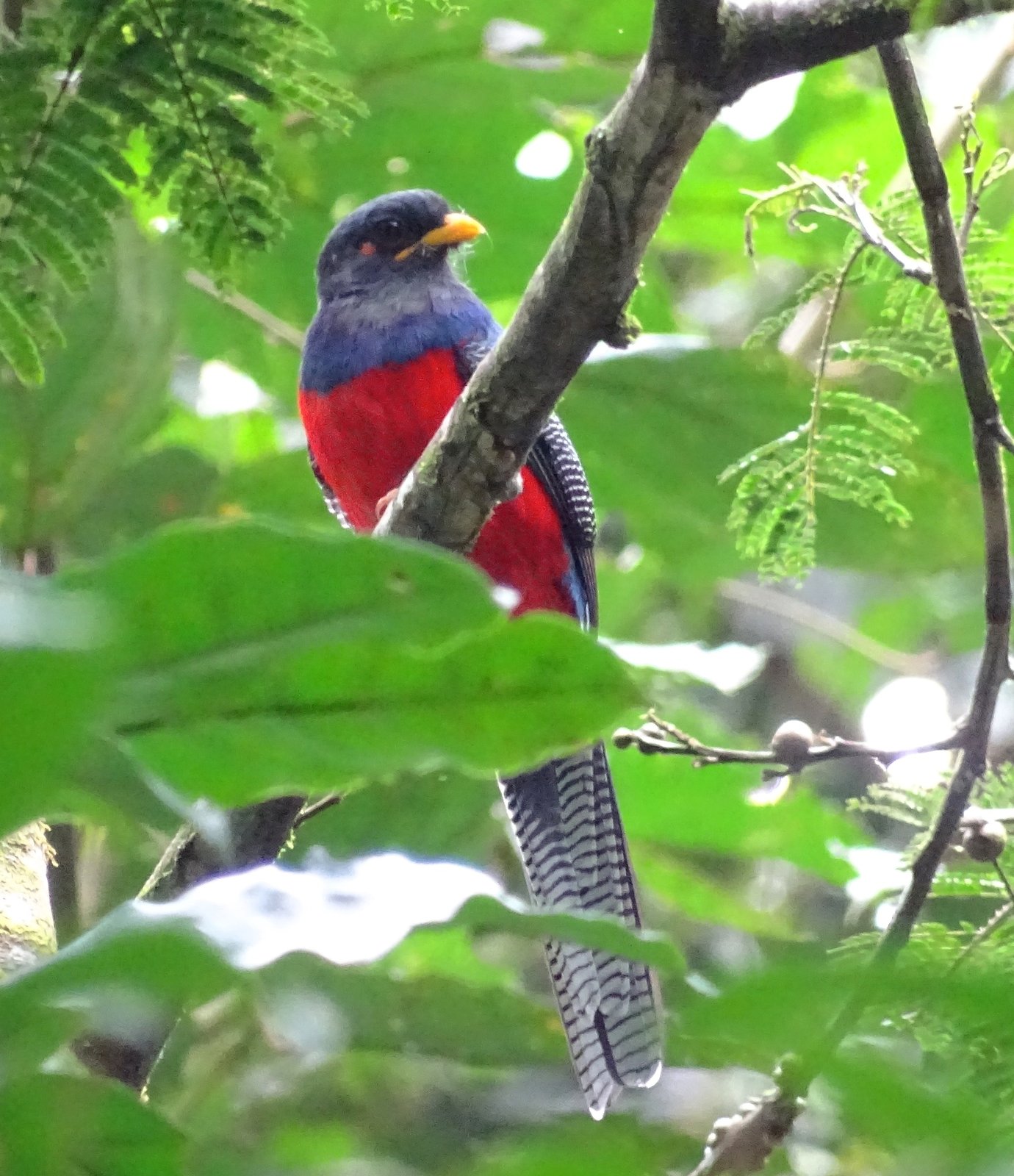
The Bar-Tailed Trogon is the trogon of Afromontane mist forest: smaller and darker than the Narina Trogon, and in the region confined to the highest forests of Malawi, adjacent north-eastern Zambia and a few isolated mountains in northern Mozambique. Like its relative it sits motionless for long spells in the middle storey of the forest.
Voice
A series of six to fifteen short, throaty, somewhat barking notes, kyow-kyow-kyow ..., swelling and accelerating, quite unlike the soft hoots of Narina Trogon. The female sometimes answers with a softer version. When disturbed a dry, rattling chrrr.
Recording: isaac kilusu — CC BY-NC-SA 4.0 · converted to mono · xeno-canto
Identification
27–30 cm. The male has a dark, glossy blue-black head and throat grading into metallic green on the breast, a crimson belly and a dark green back. There are bare, bright yellow skin patches below and behind the eye, and the yellow bill continues into a yellow gape. The underside of the tail is finely barred black and white, which shows best in side view and as the bird flies off. The female has a browner head and a rufous-brown to cinnamon throat and breast that fade into the red belly; her undertail is also barred. Juveniles are brownish with pale spots on the wing coverts. It flies in short undulating flights and sallies for insects from a fixed perch.
Confusion species
Narina Trogon Apaloderma narina is larger and brighter green, with a plain green head without yellow skin patches and bright white outer tail feathers instead of a finely barred undertail. In Malawi the two overlap in altitude; above about 1,500 m Bar-Tailed Trogon is by far the more likely. Voice is the quickest way to separate them.
Habitat
Moist Afromontane forest and mist forest, mostly between 1,500 and 2,500 m, especially old forest patches rich in mosses, lianas and dead trunks; it forages in the middle storey and lower canopy for caterpillars, grasshoppers and other insects. It nests in a cavity in a rotting trunk or stump.
Where the bird is most at home, classified by the vegetation units of southern Africa.

Range and movements
In the region only in the montane forests of northern and eastern Malawi (Nyika, Viphya, Dedza, Zomba, Mulanje and Thyolo), on the Zambian side of the Nyika and in the Mafinga Hills, and in northern Mozambique on Mount Namuli, Mount Mabu, Mount Chiperone and the Njesi Plateau. Beyond the region in the montane forests of East Africa from Tanzania to Kenya, Uganda and the Albertine Rift, and in isolation in Cameroon and on Bioko.
- Resident
- Summer visitor (c. Oct–Mar)
- Winter visitor (c. Apr–Sep)
- Passage (Mar–Apr, Oct–Nov)
- dark = core range, pale = thinly spread
How and when to look
The Chelinda forest and the Zovochipolo forest patches on the Nyika, or the forest near the lodge on the Zomba Plateau, in the early morning from September to December. Follow the barking call to below the calling bird and scan the horizontal branches; the male often turns so that only its dark back is visible.
Conservation status
Not globally threatened. In southern Africa, however, its range is small and fragmented, and the species depends on the last montane forest patches, which are shrinking through logging, agricultural expansion and fire. The small populations on the Mozambican mountains, such as Mount Namuli, are especially vulnerable.
Scientific name
Apaloderma vittatum | Shelley, 1882
Shelley described the species in 1882 as Hapaloderma vittatum; because it was later moved to another genus, the author and year stand in brackets. The genus Apaloderma was introduced in 1833 by Swainson. Apaloderma comes from the Greek apalos, 'soft, tender', and derma, 'skin' — for the strikingly thin, fragile skin of trogons, which tears easily when the bird is handled. vittatum is Latin for 'banded, ribboned' — for the finely barred tail. The specimen the first description was based on came from Mamboio, Tanzania.