All species › Trogons › Trogons › Narina Trogon
Narina Trogon | Apaloderma narina
Narinatrogon | Trogón Narina
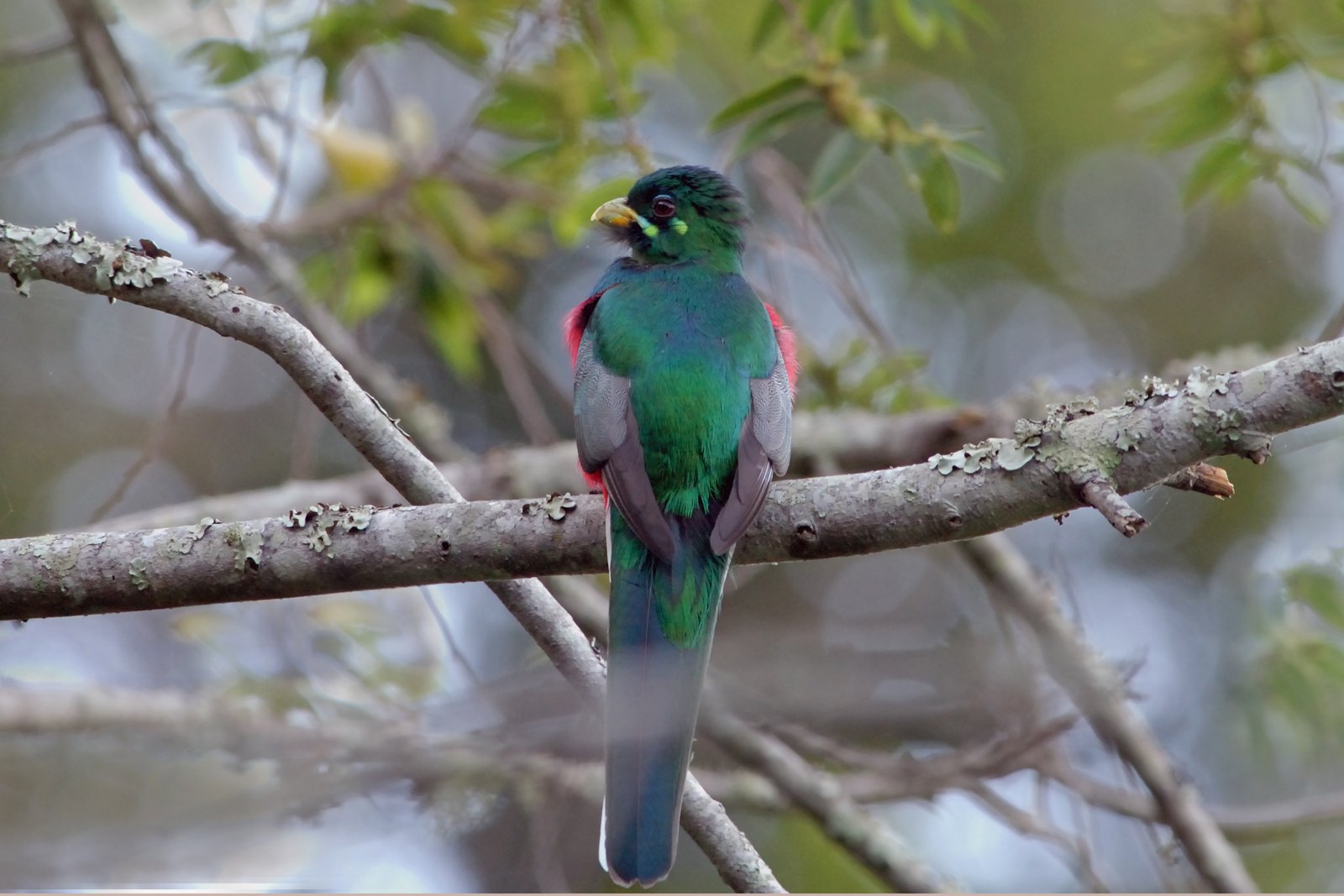
The Narina Trogon is metallic green above and crimson below, yet it perches so motionless and upright along a branch that it dissolves into the canopy. You hear it long before you see it: a series of soft, deep hoots from the middle storey of the forest. It is the only trogon across most of southern Africa.
Voice
A series of five to twelve soft, deep, hollow hoots: hoo ... hoo ... hoo ..., starting slowly, then speeding up and rising slightly, with a plaintive quality. The sound carries far but is hard to place, because the bird barely moves while calling. Most vocal from September to December, in the early morning. When disturbed it gives a short, hoarse kraa.
Recording: Rick Nuttall — CC BY-NC-SA 4.0 · shortened to the first 60 s, mono · xeno-canto
Identification
29–34 cm. The male is glossy metallic green on head, throat, breast, back and upper tail, with a crimson belly and undertail; the outer tail feathers are white and show clearly in flight. The bill is short, broad and yellowish green, with bare green to blue-green skin around the eye and gape. The female is duller: throat and breast are brownish cinnamon rather than green, and the red of the belly is paler. Juveniles are brownish with white spots on the wing coverts. Flight is short and undulating from branch to branch; when hunting, the bird sallies out for a caterpillar or insect and returns to the same perch.
Confusion species
Across most of the region this is the only trogon. In the montane forests of Malawi and northern Mozambique it is joined by Bar-Tailed Trogon Apaloderma vittatum, which has a finely black-and-white barred undertail instead of plain white outer tail feathers, and in the male a yellow bill continuing into a yellow gape.
Habitat
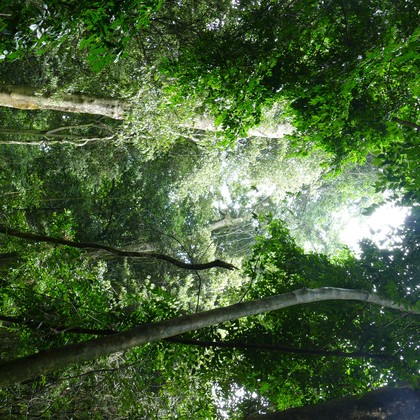
Evergreen forest, mist-belt forest, coastal dune forest and dense riverine woodland, locally also heavy miombo and thick bush. It forages in the middle storey and lower canopy, taking caterpillars, grasshoppers and beetles from leaves and bark from a fixed perch. It nests in a cavity in a dead trunk or branch.
Where the bird is most at home, classified by the vegetation units of southern Africa.

Range and movements
An eastern and southern forest belt: from the forests of the Eastern Cape north through KwaZulu-Natal, Eswatini and the escarpment forests of Mpumalanga and Limpopo, on through eastern Zimbabwe, Mozambique, Malawi and Zambia, and west along the riverine forests of the Okavango and the Caprivi into northern Namibia and Angola. Beyond the region it occurs across most of wooded Africa south of the Sahara.
- Resident
- Summer visitor (c. Oct–Mar)
- Winter visitor (c. Apr–Sep)
- Passage (Mar–Apr, Oct–Nov)
- dark = core range, pale = thinly spread
How and when to look
September to December, early in the morning, when the birds are calling. Walk a forest path, stop at a calling bird and scan the horizontal branches slowly: the green back is turned towards you and vanishes against the leaves, and the red only appears when the bird turns. As it flies off, watch for the white flash of the outer tail feathers.
Conservation status
Not threatened and widely distributed. It declines locally where coastal forest, riverine forest and mist-belt forest are felled or fragmented; small forest remnants stay occupied as long as dead trunks with nest cavities remain. No large-scale declines are recorded elsewhere in its range.
Scientific name
Apaloderma narina | (Stephens, 1815)
Stephens described the species in 1815 as Trogon Narina; because it was later moved to another genus, the author and year stand in brackets. The genus Apaloderma was introduced in 1833 by Swainson. Apaloderma comes from the Greek apalos, 'soft, tender', and derma, 'skin' — for the strikingly thin, fragile skin of trogons, which tears easily when the bird is handled. narina is a Khoikhoi word for 'flower'. The French explorer Levaillant, who described the species, took the name from a Khoikhoi woman who accompanied him on his travels. The specimen the first description was based on came from Knysna, Cape Province.