All species › Waders, gulls and terns › Gulls and terns › West African Crested Tern
West African Crested Tern | Thalasseus albididorsalis
Afrikaanse koningsstern | Charrán Real Africano
The West African Crested Tern is the large orange-billed crested tern of the West African coast, long treated as a subspecies of Royal Tern. After breeding many birds move south along the coast of the Gulf of Guinea, and some reach Angola; further south it soon becomes rare.
Voice
A rasping, rolling kree-rit, similar to that of Royal Tern.
Recording: Bram Piot — CC BY-NC-SA 4.0 · converted to mono · xeno-canto
Identification
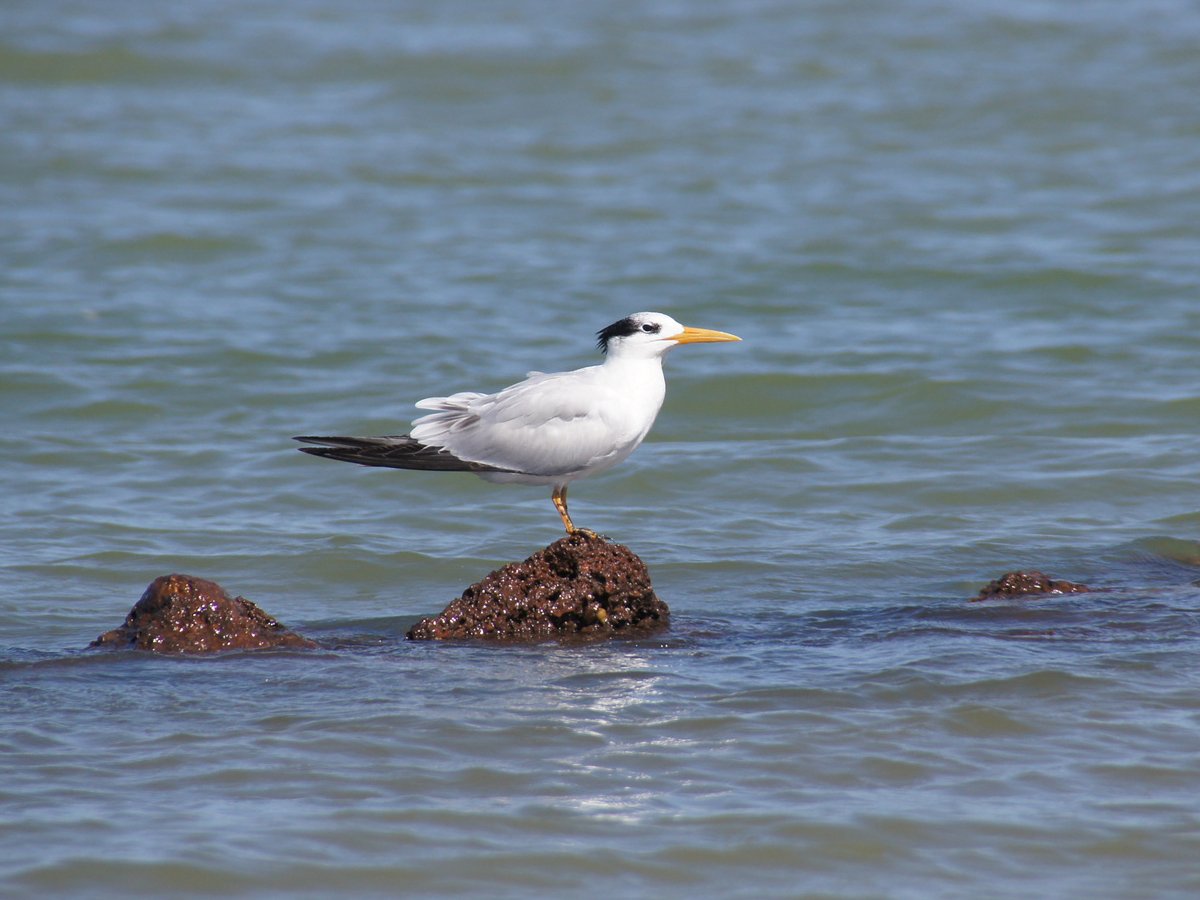
About 47 cm, large and sturdy but more slender than Royal Tern, with a long, fairly thin, orange to yellow-orange bill. The upperparts are very pale grey, the rump and tail white, so that the bird looks pale in flight. In breeding plumage it has a black cap with a shaggy crest; outside the breeding season the forehead is white and a black crest remains behind the eye. The outer primaries are pale below with a narrow dark trailing edge. The legs are black. Juveniles have a yellowish bill and dark markings on the coverts and tail.
Confusion species
Greater Crested Tern (Thalasseus bergii) has a yellow bill and clearly darker grey upperparts. Lesser Crested Tern (Thalasseus bengalensis) is smaller, with a grey rump and a shorter orange bill, and occurs mainly on the east coast. Caspian Tern (Hydroprogne caspia) has a massive red bill and dark undersides to the primaries. The American Royal Tern (Thalasseus maximus) is heavier-billed and slightly darker grey; see that species.
Habitat
Inshore waters, lagoons, estuaries and sandy beaches, often in mixed flocks with other terns at roosts near river mouths.
Where the bird is most at home, classified by the vegetation units of southern Africa.

Range and movements
Within the region mainly on the coast of Angola, south to Namibe province; rare in northern Namibia and a very rare vagrant as far as the Western Cape. It breeds in colonies on islands from Mauritania to Guinea, with the largest numbers on the Banc d'Arguin, in the Saloum delta and the Bijagós archipelago; outside the breeding season it spreads along the coast of West and Central Africa.
- Resident
- Summer visitor (c. Oct–Mar)
- Winter visitor (c. Apr–Sep)
- dark = core range, pale = thinly spread
How and when to look
The coast of Angola, especially around Luanda, Lobito and the lagoons near Namibe, is the best place, outside the West African breeding season. On the Namibian coast a pale orange-billed tern among the Greater Crested Terns at the roosts of Walvis Bay and Swakopmund may be this species; note bill colour and back tone in comparison with Greater Crested Tern.
Conservation status
Not assessed separately by the IUCN; it is included in Royal Tern (Thalasseus maximus, Least Concern). The world population is fairly small and concentrated on a handful of breeding islands, making the species vulnerable to egg collecting, disturbance, overfishing of shoaling fish and outbreaks of avian influenza, which hit colonies in West Africa in 2022 and 2023.
Scientific name
Thalasseus albididorsalis | (Hartert, 1921)
Hartert described the species in 1921 as Sterna maxima albididorsalis; because it was later moved to another genus, the author and year stand in brackets. The genus Thalasseus was introduced in 1822 by Boie. Thalasseus derives from Ancient Greek thalassa 'sea'. albididorsalis comes from the Latin albidus, 'whitish', and dorsalis, 'of the back' — for the pale back, lighter than in American Royal Tern. The specimen the first description was based on came from Baie du Lévrier near Cap Blanc, Mauritania.