All species › Waders, gulls and terns › Gulls and terns › Greater Crested Tern
Greater Crested Tern | Thalasseus bergii
Grote kuifstern | Charrán Piquigualdo
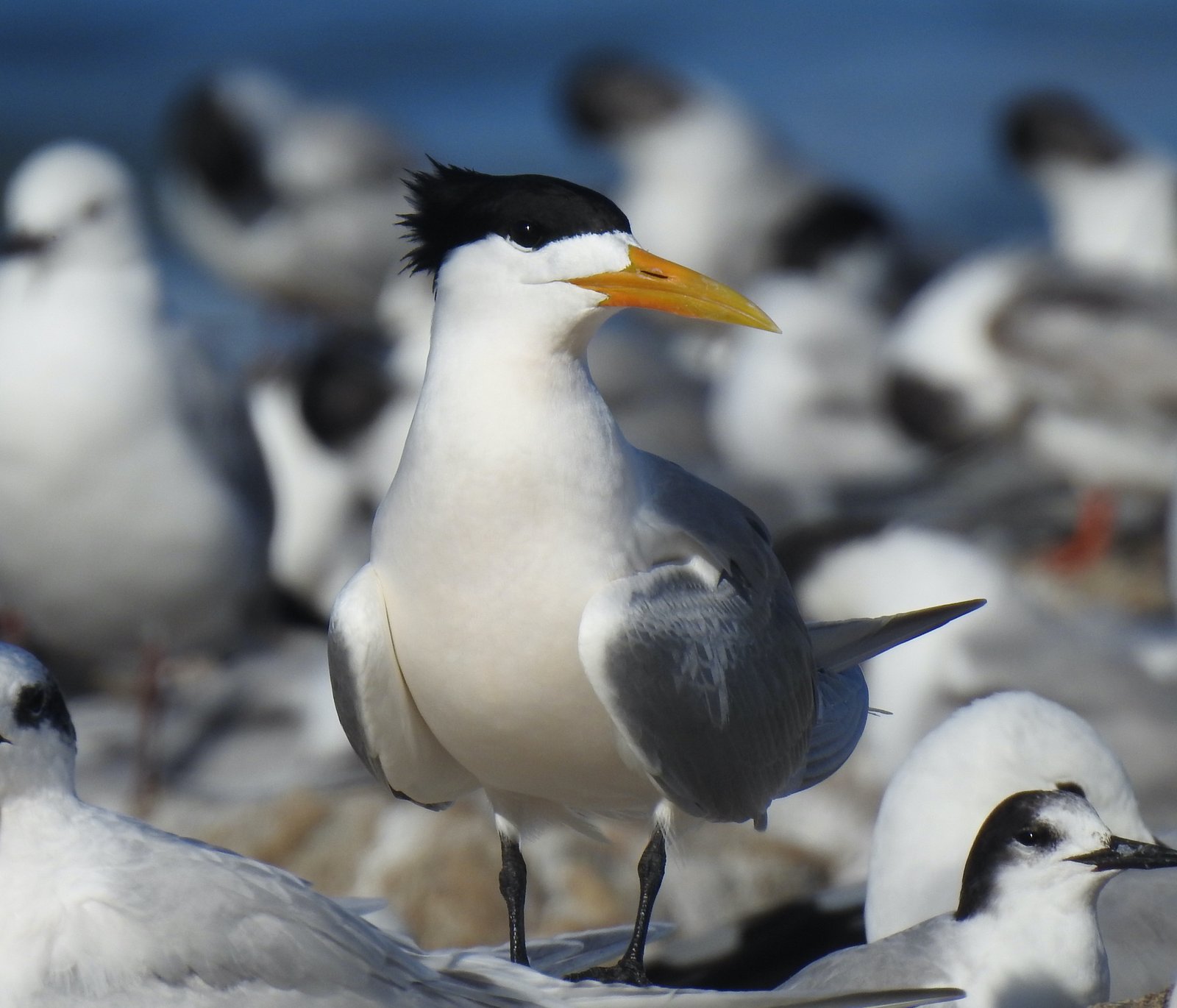
The Greater Crested Tern is the large, dark-backed tern with the thick yellow bill that is the most conspicuous tern along the entire coast of southern Africa. It breeds here in dense colonies on islands and coastal flats, and juveniles follow their parents along the coast begging for months.
Voice
A loud, rasping kree-eck, incessant and overlapping at the colony; juveniles beg with a high, whistled wee-u that can be heard at every roost along the coast.
Recording: Romuald Mikusek — CC BY-NC-SA 4.0 · converted to mono · xeno-canto
Identification
About 48 cm, clearly larger and heavier than Sandwich Tern, with long wings and a forked tail. The upperparts are dark slate-grey and the underparts white. The bill is thick, long and slightly drooping, lemon-yellow to greenish yellow. In breeding plumage the crown is black with a shaggy crest, but a narrow white band remains above the bill; outside the breeding season the forehead becomes broadly white and the crown speckled grey. The legs are black. Juveniles are scaled brownish grey above, with dark flight feathers and a duller yellow bill.
Confusion species
Sandwich Tern (Thalasseus sandvicensis) is smaller and much paler, with a black bill tipped yellow. Lesser Crested Tern (Thalasseus bengalensis) is smaller and paler grey, with an orange bill. Caspian Tern (Hydroprogne caspia) is larger still, with a massive red bill and dark undersides to the primaries. West African Crested Tern (Thalasseus albididorsalis) has an orange bill and a much paler grey back.
Habitat
Inshore waters, bays, harbours and estuaries, out to a few tens of kilometres offshore; rarely inland. It plunge-dives from a height for anchovy, sardine and other shoaling fish. It breeds on flat, bare parts of islands, on salt-works dykes and sometimes on roofs or other artificial sites, packed tightly in colonies of tens to thousands of pairs.
Where the bird is most at home, classified by the vegetation units of southern Africa.

Range and movements
Along the entire coast of the region, from Angola through Namibia and South Africa to Mozambique. In South Africa it breeds mainly on islands in the Western Cape (including Robben Island, Dassen Island and the islands of Saldanha Bay) and in Algoa Bay, in Namibia on the guano islands and on artificial platforms. The form enigma breeds around the Zambezi delta and on Madagascar. Beyond the region along the coasts of the Indian Ocean and the western Pacific, from the Red Sea to Australia.
- Resident
- Summer visitor (c. Oct–Mar)
- Passage (Mar–Apr, Oct–Nov)
- dark = core range, pale = thinly spread
How and when to look
Present all year at every coastal roost, such as the piers of Cape Town, Walvis Bay and river mouths. In the Western Cape it breeds in late summer and autumn, from February to June, unlike most seabirds here. Afterwards watch for young birds flying after their parents and begging; some adults are still feeding their young well into winter.
Conservation status
Not threatened. The South African population numbers a few thousand pairs and shifts from west to east with the movements of sardine and anchovy. Colonies are sensitive to disturbance, predation by gulls and outbreaks of avian influenza; most breeding islands are protected.
Scientific name
Thalasseus bergii | (Lichtenstein, 1823)
Lichtenstein described the species in 1823 as Sterna Bergii; because it was later moved to another genus, the author and year stand in brackets. The genus Thalasseus was introduced in 1822 by Boie. Thalasseus derives from Ancient Greek thalassa 'sea'. bergii honours the Prussian pharmacist and botanist Karl Heinrich Bergius, who collected the first specimens near Cape Town. The specimen the first description was based on came from the Cape of Good Hope.