All species › Owls › Barn owls › Western Barn Owl
Western Barn Owl | Tyto alba
Kerkuil | Lechuza Común
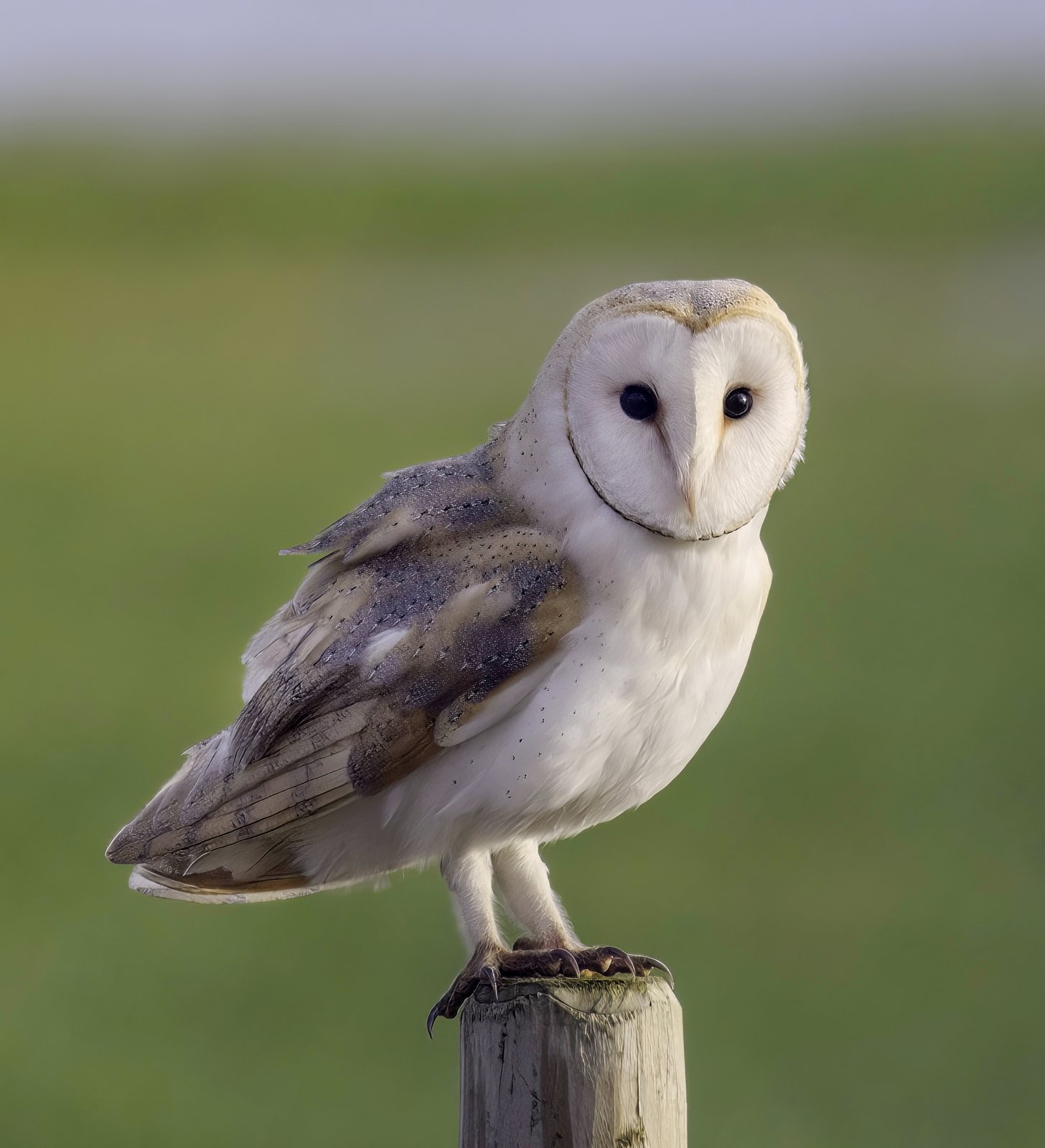
The Western Barn Owl is the pale, golden owl with the white heart-shaped face that occurs across much of the world. In southern Africa it is one of the commonest owls, on farms and in villages as well as in savanna, semi-desert and rocky country.
Voice
A drawn-out, hoarse and hissing screech, shrrrreeeeee, often in flight. Around the nest the young hiss and snore, khhhhh, and the adults make clicking sounds. No hooting.
Recording: Astrid Cervantes — CC BY-NC-SA 4.0 · converted to mono · xeno-canto
Identification
30–33 cm, wingspan 80–95 cm. The upperparts are golden-buff to orange-brown, overlaid with fine grey vermiculation and white and black speckles. The underparts are white to pale buff with a few small dark spots. The heart-shaped facial disc is white with a narrow orange-brown rim; the eyes are small and black. The legs are long and feathered, the toes grey. In flight the bird looks almost entirely white from below, with long wings and a short tail. The female is often slightly darker and more heavily spotted than the male.
Confusion species
The African Grass Owl Tyto capensis has dark chocolate-brown upperparts sharply contrasting with the pale underparts, longer legs, and lives on the ground in tall, damp grass. The Marsh Owl Asio capensis is uniformly brown, with a round face, dark eyes and buff primary patches. No other owl in the region is as pale.
Habitat
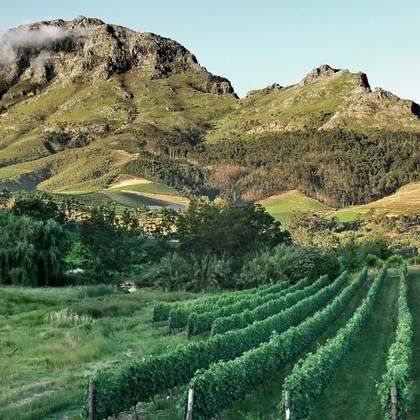
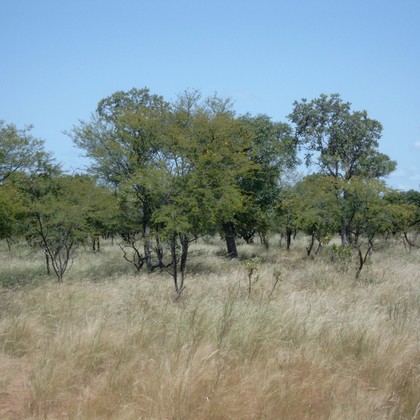
Almost any open or semi-open landscape with a suitable roost and nest site: farmland, savanna, thornveld, semi-desert, forest edge, villages and towns. It breeds and roosts in buildings, barns, hollow trees, mine shafts, wells, holes in riverbanks and rock crevices, at times in Hamerkop nests. It hunts mainly rodents, also shrews, birds, frogs and insects.
Where the bird is most at home, classified by the vegetation units of southern Africa.

Range and movements
Throughout the region, from the Cape and Lesotho to Angola, Zambia, Malawi and Mozambique, including the Namib and the Kalahari; common to abundant in farming areas. Beyond the region throughout Africa, in Europe and the Middle East; related forms occur in Asia, Australia and the Americas.
- Resident
- Summer visitor (c. Oct–Mar)
- Winter visitor (c. Apr–Sep)
- Passage (Mar–Apr, Oct–Nov)
- dark = core range, pale = thinly spread
How and when to look
At dusk on posts along farm roads and over fields, or at an old barn or silo with pellets and white droppings beneath. On night drives the bird often sits on fence posts in the beam. The long screech in the dark is often the first sign.
Conservation status
Not threatened, and widespread and common in the region. Road collisions, poisoning through rodenticides, drowning in reservoirs and loss of nest sites as old buildings are demolished matter locally; in parts of the region the species is also persecuted through superstition. Nest boxes are readily accepted and are used for natural pest control.
Scientific name
Tyto alba | (Scopoli, 1769)
Scopoli described the species in 1769 as Strix alba; because it was later moved to another genus, the author and year stand in brackets. The genus Tyto was introduced in 1828 by Billberg. Tyto comes from Ancient Greek tutō 'owl'. alba is Latin for 'white', after the white underparts and pale face. The specimen the first description was based on came from Friuli, Italy.