All species › Birds of prey › Secretarybird › Secretarybird
Secretarybird | Sagittarius serpentarius
Secretarisvogel | Serpentario
The Secretarybird is the only raptor that finds its prey on foot: on long legs it walks the grasslands day after day, killing snakes, lizards and rodents with rapid stamping blows. A spray of black, quill-like feathers stands out behind the head. Of all raptors this is the longest.

Voice
Mostly silent. At the nest and during display flight it gives a deep, guttural, frog-like growl: korr-korr, low and rolling, sometimes followed by a drawn-out groan. At the nest tree the pair also clatter their bills. Young beg with a high, thin piping.
Recording: Niall Perrins — CC BY-NC-SA 4.0 · converted to mono · xeno-canto
Identification
125–150 cm tall, wingspan almost two metres. Pale grey with black flight feathers, black 'trousers' on the thighs and bare orange-red facial skin. Up to twenty long black crown plumes stand behind the head and are raised in excitement. The legs are very long and pinkish grey, with short, blunt toes. The two central tail feathers project far beyond the rest. The sexes are alike; the male averages longer crown plumes and tail feathers. Juveniles have yellow rather than red facial skin, are browner in tone and have shorter central tail feathers. In flight the broad wings, far-projecting tail feathers and trailing legs stand out; the bird soars well and climbs high on thermals.
Confusion species
On the ground no other raptor in the region can be confused with it. High overhead a soaring Secretarybird can suggest a crane or a stork; the two long central tail feathers and the black trailing edge of the wing settle it. Blue Crane lacks the black flight feathers and the projecting tail feathers and has a short tail.
Habitat
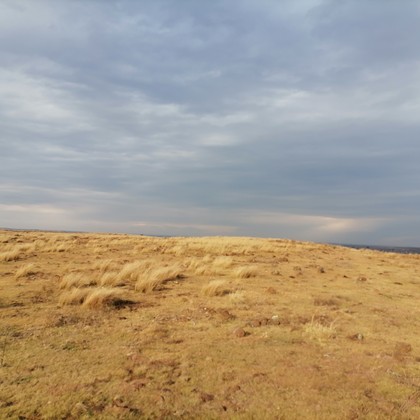
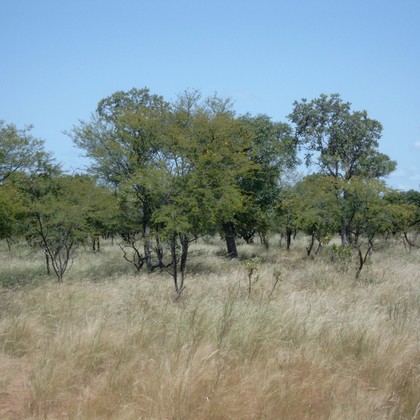
Open grassland, savanna with scattered trees, the Karoo and lightly wooded plains; it avoids closed forest, dense bush and true desert. The nest is a broad platform of sticks on top of a flat-crowned thorn tree, usually three to seven metres above the ground.
Where the bird is most at home, classified by the vegetation units of southern Africa.
Range and movements
Thinly spread over almost the whole region: most of South Africa outside the forests and the wettest coastal belt, Eswatini and the margins of Lesotho, and on through Botswana, Namibia, Zimbabwe, Zambia, Malawi, Mozambique and Angola. Beyond the region it occurs across the entire savanna belt of Africa south of the Sahara, from Senegal to Ethiopia and Somalia.
- Resident
- Summer visitor (c. Oct–Mar)
- Winter visitor (c. Apr–Sep)
- Passage (Mar–Apr, Oct–Nov)
- dark = core range, pale = thinly spread
How and when to look
Drive along open grassland and savanna early in the morning and late in the afternoon; the bird walks steadily with its head down and covers twenty to thirty kilometres a day, so it turns up on an open plain rather than at a fixed spot. Members of a pair walk tens of metres apart. Watch the stamping: the bird strikes with one foot in rapid succession and jumps back. In display the pair perform a swinging, pendulum-like flight with loud growls.
Conservation status
Endangered on the Red List; raised from Vulnerable in 2020 after a rapid decline across the entire range. The causes given are conversion of grassland to cropland and timber plantations, bush encroachment of savanna through overgrazing and altered fire regimes, collisions with power lines and fences, disturbance at the nest, and in parts of Africa capture for trade and traditional use. A national action plan for the species is running in South Africa.
Scientific name
Sagittarius serpentarius | (Miller, 1779)
Miller described the species in 1779 as Falco serpentarius; because it was later moved to another genus, the author and year stand in brackets. The genus Sagittarius was introduced in 1783 by Hermann. Sagittarius is the Latin word for 'archer', for the long, black ornamental feathers on the nape that recall a bundle of arrows, or for the stiff, striding gait with which the bird walks through grass. serpentarius is Latin for 'of serpents, snake-hunter', for the habit of killing snakes by stamping on them. The specimen the first description was based on came from Cape of Good Hope.