All species › Pelicans, herons and ibises › Herons and bitterns › White-Backed Night Heron
White-Backed Night Heron | Calherodius leuconotus
Witrugkwak | Martinete Encapuchado
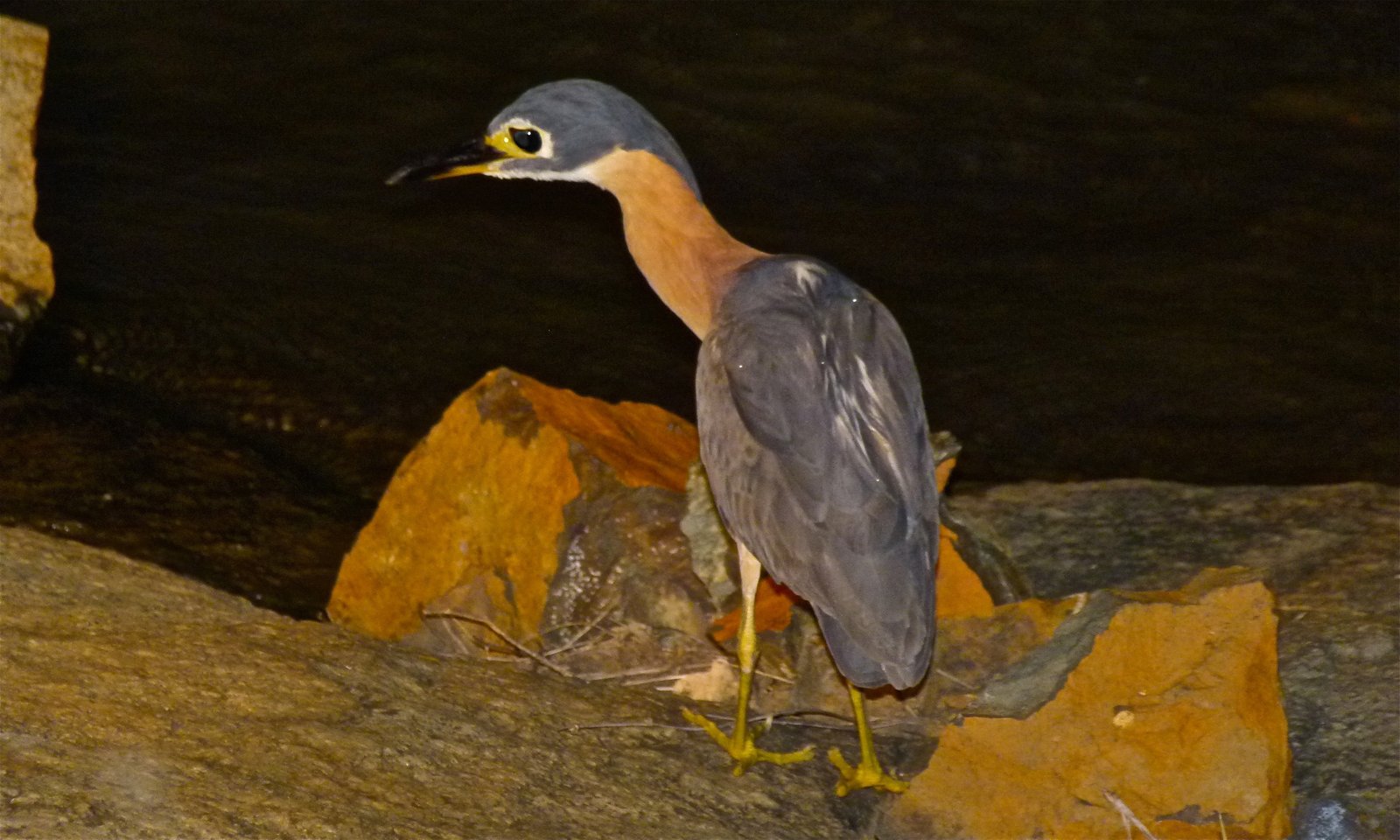
The White-Backed Night Heron is a shy, nocturnal heron of wooded riverbanks, with a black head, huge eyes and a white patch on the back that shows only in flight or when preening. By day it hides in dense bankside growth and is rarely seen.
Voice
Usually silent. When disturbed or in flight a deep, raw kraak or taak; soft rasping sounds at the nest.
No recording with a suitable Creative Commons licence is available for this species yet.
Identification
50–55 cm. Stocky, with a large head and a short, heavy black bill. Head and short crest are black; the very large dark brown eye is surrounded by conspicuous pale yellow to white bare skin. The throat is white, the neck and breast rufous to chestnut, the belly dirty white. The back and wings are dark slaty brown, with a white patch in the middle of the back usually hidden by the scapulars. The legs are yellow-green and fairly short. Juveniles are brown with white spots on the wing coverts and paler streaks below. It flies with the neck retracted on fast, deep wingbeats, low over the water.
Confusion species
The Black-Crowned Night Heron Nycticorax nycticorax is larger and paler, with a grey neck, grey wings, a black mantle and a red eye, and lives in more open marshland. Juvenile Black-crowned resemble juvenile White-backed but have an orange eye and a longer, yellow-based bill. The Striated Heron Butorides striata is smaller, with a grey neck, a green-grey back with pale feather edges and no white eye-ring.
Habitat
Rivers and streams with dense overhanging bankside vegetation, wooded islets, mangroves and shaded shores of lakes and dams. It hunts mainly at dusk and at night from a low branch or at the water's edge, taking fish, frogs, crabs and aquatic insects. The nest is a platform of sticks low in a tree or bush over the water.
Where the bird is most at home, classified by the vegetation units of southern Africa.


Range and movements
Local and scarce in the north and east of the region: the Okavango and Chobe in Botswana, the Caprivi and Kavango in Namibia, the Zambezi and eastern Zimbabwe, Zambia, Malawi, Mozambique and Angola; in South Africa along the rivers of Kruger and the lowveld of Mpumalanga and Limpopo, in Eswatini and KwaZulu-Natal, south to the rivers of the eastern Eastern Cape. Beyond the region across western, central and eastern Africa.
- Resident
- Summer visitor (c. Oct–Mar)
- Winter visitor (c. Apr–Sep)
- Passage (Mar–Apr, Oct–Nov)
- dark = core range, pale = thinly spread
How and when to look
Take a boat at dusk along the wooded banks of the Okavango or the Chobe, or check under overhanging branches at rivers in Kruger such as the Sabie. A torch after dark picks up the large eyes. By day it pays to scan the shade beneath riverside trees patiently from a boat.
Conservation status
Not threatened, but probably often overlooked because of its secretive habits. In South Africa it is nationally listed as Vulnerable through the loss of riverine forest, erosion, dam building and disturbance of rivers.
Scientific name
Calherodius leuconotus | (Wagler, 1827)
Wagler described the species in 1827 as Ardea Leuconotus; because it was later moved to another genus, the author and year stand in brackets. The genus Calherodius was introduced in 1855 by Bonaparte. Calherodius appears to combine the Greek kalos, 'beautiful', and erōdios, 'heron' — 'beautiful heron'. leuconotus comes from the Greek leukos, 'white', and nōtos, 'back' — for the white back patch, visible in flight. The specimen the first description was based on came from Senegambia.