All species › Tubenoses › Southern storm petrels › White-Bellied Storm Petrel
White-Bellied Storm Petrel | Fregetta grallaria
Witbuikstormvogeltje | Paíño Ventriblanco
The White-Bellied Storm Petrel is a black-and-white storm petrel of warmer subtropical waters than its black-bellied relative. In the Atlantic it breeds on Tristan da Cunha and Gough, and from there birds occasionally reach the waters off southern Africa.
Voice
Silent at sea. In the breeding colony at night a high, whistling piping, similar to that of Black-Bellied Storm Petrel.
No recording with a suitable Creative Commons licence is available for this species yet.
Identification
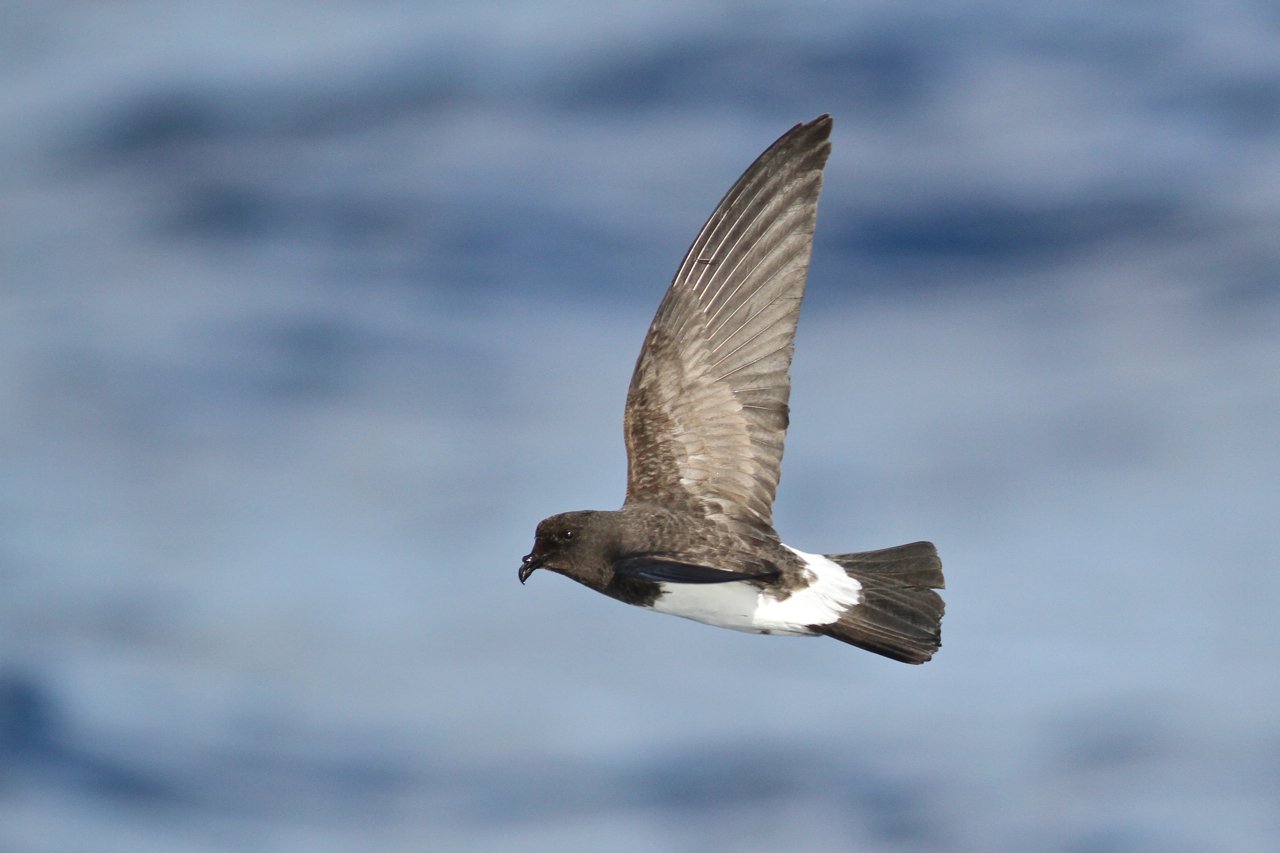
About 20 cm. Head, breast and upperparts are blackish-brown, the back slightly paler and browner with pale feather edges, and the rump is white. The underparts are wholly white from the breast down, including the undertail coverts, and sharply demarcated from the dark breast. The underwing has a white centre with black margins. The tail is square and the feet do not or barely reach beyond the tail tip. The sexes are alike. The flight is like that of Black-Bellied Storm Petrel: low and swerving, with leaps in which the bird pushes off the water with its feet.
Confusion species
Black-Bellied Storm Petrel (Fregetta tropica) has a black central stripe across the belly, black undertail coverts, a more uniformly black back and feet projecting just beyond the tail; a narrow or broken belly stripe can, however, be overlooked. White-Faced Storm Petrel (Pelagodroma marina) has a white face with a dark eye-stripe, grey upperparts and a dark underwing.
Habitat
Subtropical open ocean far beyond the continental shelf, often over warmer water than Black-Bellied Storm Petrel. Feeds on small crustaceans, small squid and fish larvae at the surface. Breeds in rock crevices and burrows on remote oceanic islands.
Where the bird is most at home, classified by the vegetation units of southern Africa.
Range and movements
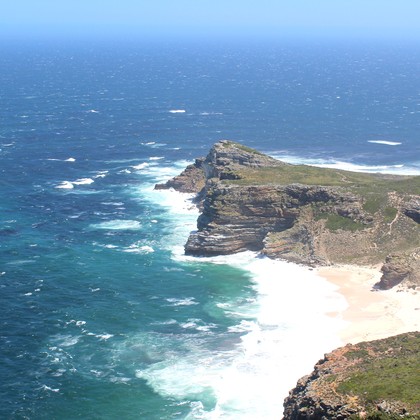
A rare visitor to the waters of the region, usually far offshore off the west and south coasts of South Africa and off Namibia, exceptionally in the Mozambique Channel. Breeds in the South Atlantic on Tristan da Cunha and Gough, and elsewhere on Lord Howe, the Kermadec Islands and islands off Chile and in French Polynesia.
How and when to look
Only to be expected on trips well beyond the shelf edge, for example from Cape Town to the trawlers or the tuna grounds. Any black-and-white storm petrel with a white belly should be photographed well: the colour of the undertail coverts and the presence or absence of a belly stripe decide the matter.
Conservation status
Not threatened globally, but the breeding populations on most islands are small. Introduced rats, mice and cats have wiped out or reduced colonies; on Gough house mice are a serious threat. Lights on ships and settlements attract birds at night.
Scientific name
Fregetta grallaria | (Vieillot, 1818)
Vieillot described the species in 1818 as Procellaria grallaria; because it was later moved to another genus, the author and year stand in brackets. The genus Fregetta was introduced in 1855 by Bonaparte. Fregetta derives from the French frégate, 'frigate(bird)'. Bonaparte coined the name in 1855. grallaria comes from the Latin grallarius, 'stilt-walker' — for the long legs with which the bird patters over the water surface. The specimen the first description was based on came from Australia (not specified).