All species › Carnivores › Cats › African Wildcat
African Wildcat | Felis lybica
Afrikaanse wilde kat | Felis lybica
The African wildcat is the wild ancestor of the domestic cat. It lives across much of Africa, the Arabian Peninsula and south-west and Central Asia to India and China. The Mammal Diversity Database treats it as a separate species, split from the European wildcat (Felis silvestris); the type locality is near Gafsa in Tunisia. Within the guide area it lives in North Africa and the Levant, and the wildcats of Corsica, Sardinia and Crete are assigned to this species. The greatest threat is hybridisation with domestic cats.
Tracks
It marks with urine and with droppings in prominent places near trails, on trees, vegetation and boulders, sometimes with anal-gland secretion added. Trees and saplings are scratched with the forepaws. In the United Arab Emirates a radio-collared female used 42 different dens in fourteen months, all dug by red foxes. Mating is accompanied by loud screeching and yowling.
Identification
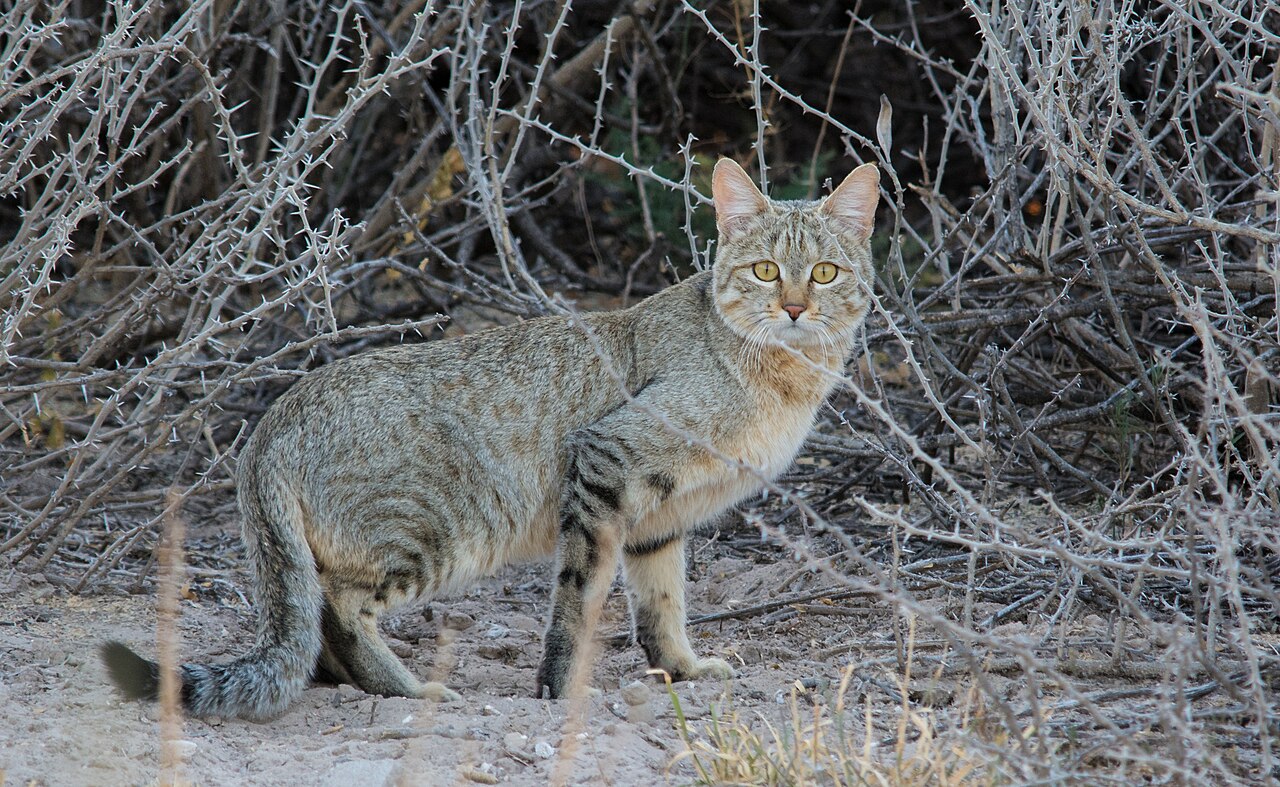
A slender, long-legged cat, larger than a domestic cat but smaller than the European wildcat. The coat is short and highly variable, grey to reddish, with or without small spots; the hairs have a pale band and a black tip, giving a finely speckled look. Spots often merge into transverse stripes, especially on the legs. The tail is long and thin, tapering, with two or three blackish rings and a black tip. The ears are rounded and widely spaced, with short dark tufts and a bright red-brown back. Chin white, underparts pale orange-buff to whitish, a dark line along the spine, black soles. Animals from dry regions are paler and sandier than those from humid regions. Its long forelegs make it sit almost vertically upright.
Similar species
The domestic cat is the main and fundamental confusion, since the two interbreed and hybrids are intermediate. The European wildcat is larger and heavier and has a broad, bushy tail rather than a thin, tapering one. The jungle cat is larger, unspotted, with long ears with black tufts and a shorter tail. The caracal is larger, unspotted, with a short tail and large ears with black backs and long tufts.
Habitat
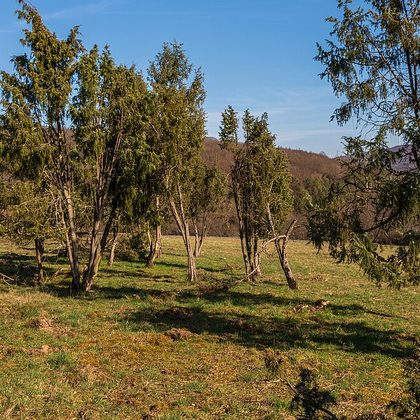
A wide range of habitats from sea level to about 3000 m; it is absent from tropical rainforest and from areas with less than 100 mm annual rainfall. Cover for hunting and resting is important. In Israel it prefers open Mediterranean woodland in hilly terrain. It also occurs on the outskirts of villages and towns, where it comes into contact with domestic cats. Desert margins, savanna and farmland are used as well.
Where the animal is most at home, classified with EUNIS — the European standard for habitats.




Distribution
Most of Africa outside the rainforest and central Sahara, the Arabian Peninsula, and south-west and Central Asia to India, Mongolia and China. Within the guide area: Morocco, Algeria, Tunisia, Libya and Egypt, the Levant (Israel, Lebanon, Syria, Jordan), and Corsica, Sardinia and Crete. Ancient and modern DNA shows that Sardinian wildcats are more closely related to North African wildcats than to domestic cats: people brought wildcats to the island, and the Sardinian animals do not descend from feral early domestic cats.
- Native
- dark = core range, pale = thinly spread
Way of life
According to most sources strictly nocturnal; where undisturbed, animals are sometimes seen in the early morning and late afternoon. In most of Africa food is chiefly mice and rats, supplemented by larger prey such as springhares and rabbits; it also takes poultry. Animals are solitary and territorial. In the northern Sahara breeding takes place in winter. After a gestation of 56 to 65 days usually two or three (at most five) kittens are born in a concealed place: a hollow tree, a burrow, a rock crevice or dense grass. Kittens emerge at one month, learn to hunt at three to four months and are independent at five to six months; females mature at ten months.
Where and when to look
In the guide area records are scarce; most come from Israel. Separating a wildcat with certainty from a domestic cat or a hybrid is possible only with good photographs of tail, legs and backs of the ears, and ultimately with DNA.
Conservation status
Least Concern (LC, 2022) globally, with an unknown trend. Regionally it is assessed as Near Threatened on the Arabian Peninsula and in Morocco. Hybridisation with domestic cats is regarded as one of the main threats and is widespread throughout the range. Animals are also killed for taking poultry, and some are killed by dogs. It is listed on CITES Appendix II.
Scientific name
Felis lybica | G. Forster, 1780 (GBIF: Felis silvestris)
G. Forster described the species in 1780 and placed it straight away in the genus where it still stands. Felis is the Latin word for 'cat'; the Romans also used it of martens and polecats. lybica means 'Libyan'; to the ancients Libya was not modern Libya but all of North Africa west of Egypt, and Forster described the animal from Tunisia. The specimen the first description was based on came from Tunisia.