All species › Hedgehogs, shrews and moles › Shrews › Alpine shrew
Alpine shrew | Sorex alpinus
Bergspitsmuis | Musaraña Alpina
The Alpine Shrew lives in damp, stony places in the uplands and high mountains of central and south-eastern Europe. It is recognised by its evenly dark grey fur and a tail as long as head and body together, longer than in any other European Sorex. Genetically it stands apart: it has no close relatives among living shrews and is regarded as an ancient relict, placed in its own subgenus, Homalurus. Its range consists of scattered mountain islands, and at their edges populations have disappeared.
No photograph of a living wild animal of this species with a suitable Creative Commons licence exists. Do you have one that meets the rules? Send it in.
Tracks
No signs are known that are specific to the Alpine Shrew. Droppings, runs in moss and footprints do not differ noticeably from those of other Sorex species. The species is recorded by live-trapping or from owl pellets collected in montane forest. In pellets, Sorex jaws and skulls are recognisable by their red-brown tooth tips; identifying them as this species requires measurements and the shape of skull and jaw, and a specialist key.
Identification
A medium-sized Sorex with uniformly dark grey to ash-black fur, sometimes with a faint brown tinge; back, flanks and belly are almost the same colour, so the three-toned pattern of the Common Shrew is absent. The decisive character is the tail, about as long as head and body: sharply bicoloured, dark above and nearly white below, covered with short stiff hairs that form no tuft at the tip. In adults the tail hair wears away until it is almost naked. The pale upper surface of the fore and hind feet also contrasts sharply with the dark body. The tooth tips are red-brown, as in all Sorex. The karyotype is usually 2n = 56 (sometimes 54 or 58). Head-body 6.2 to 7.7 cm, tail 6.0 to 7.5 cm, hind foot 12 to 17 mm, weight 5.5 to 11.5 g.
Similar species
In the hand the Alpine Shrew can be named with confidence, because the ratio of tail to body decides it: in the Alpine Shrew the tail is about as long as head and body, in the other Sorex species of its habitat clearly shorter. The Common Shrew (Sorex araneus) and the Valais Shrew (Sorex antinorii) of the Alps have a tail of about half to two-thirds of head-body length and a three-toned coat. The Eurasian Pygmy Shrew (Sorex minutus) is much smaller and browner, with a thick, hairy tail. The Water Shrew (Neomys fodiens) and Mediterranean Water Shrew (Neomys milleri) often live along the same mountain streams; they are also dark, but have a pale, sharply demarcated belly, swimming fringes on the feet and usually a keel under the tail. White-toothed shrews (Crocidura) have white teeth, prominent ears and long scattered hairs on the tail. An animal glimpsed briefly among stones cannot be identified to species; tail length has to be judged in the hand or on a sharp photograph.
Habitat
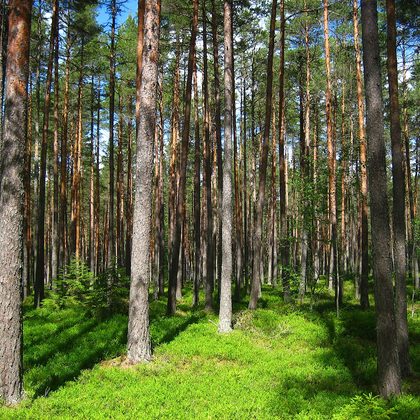
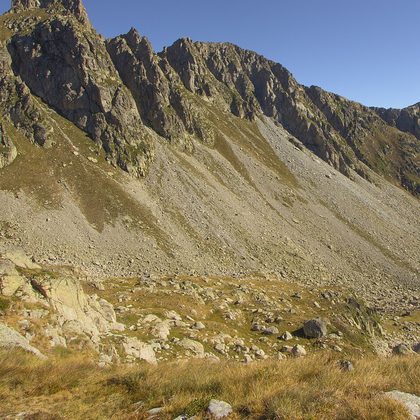
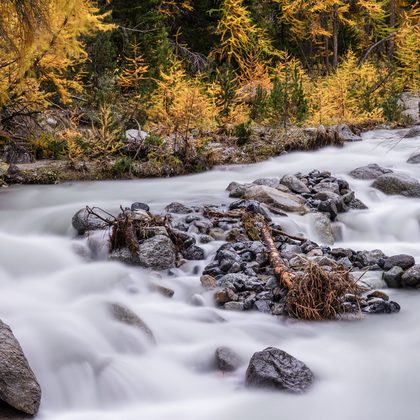
Damp, cool places with plenty of stones or dead wood in montane forest and above: stony forest streams, screes, moss-covered boulders, banks of mountain brooks and open, sparsely wooded or scrubby slopes up to above the tree line. In denser forest it uses fallen trunks and other woody debris for cover; it sometimes lives in dry-stone walls between pastures. It occurs only where humidity is high or moderate and avoids dry ground, even where stones are plentiful. It is found from about 200 to 2,500 m, mainly in the montane forest belt.
Where the animal is most at home, classified with EUNIS — the European standard for habitats.



Distribution
A European endemic with a fragmented range in the mountains: the Alps from south-eastern France and Switzerland to Austria, northern Italy and Slovenia, the uplands of central and southern Germany and south-western Czechia, the Dinaric mountains to northern Albania and Serbia, and the Carpathians from Czechia, Slovakia and southern Poland to western Ukraine and Romania. Three subspecies are recognised: S. a. alpinus in the Alps and Dinaric mountains, S. a. tatricus in the Carpathians and S. a. hercynicus in the Harz, where the species is presumed extinct. The isolated population in the Pyrenees is also considered lost; the last records there date from the early twentieth century, those from the Harz from its second half.
- Native
- dark = core range, pale = thinly spread
Way of life
Little has been recorded on its daily rhythm; as in other Sorex species, short sleep periods alternate with active spells round the clock, with the longest activity at night. It lives on the ground, among and under stones, and climbs well: captive animals have been seen using the long tail as a support and climbing higher than other shrews. Its food is relatively large invertebrates: earthworms, snails and slugs, and centipedes and millipedes more often than insects, supplemented by ground beetles, earwigs and fly larvae. It does not hibernate; without food an animal survives only a few hours. Breeding runs from May to October, with usually four to seven young per litter after a gestation of about three weeks. Overwintered animals breed and then die; they do not survive a second winter. Females born the same year sometimes breed as well. Indirect evidence points to a solitary, territorial life.
Where and when to look
The Alpine Shrew is rarely seen in the open. The best chance is along a mossy, stony stream in montane forest or at the foot of a damp scree slope, at dusk and at night. A shrew appearing among the stones that is clearly dark grey with a tail that looks as long as its body is almost certainly this species; with such a sighting, try to take a photograph showing the whole tail. When dissecting owl pellets from montane forest, a skull of this species is a valuable find, because in many places the distribution map rests on old records. In most countries live-trapping shrews is only allowed under licence.
Conservation status
Near Threatened (NT, 2023) on the IUCN Red List. The reason lies in the structure of its range: the species is tied to damp, stony places, and that strict preference makes its distribution fragmented, with populations separated from each other, such as the Dinaric from the Carpathian. Isolated marginal populations are the most vulnerable; those of the Pyrenees and the Harz have presumably already gone. Because the species needs cool, damp ground, anything that dries out mountain streams and forest floors or clears them of stones and dead wood works against it. It is listed on Appendix III of the Bern Convention.
Scientific name
Sorex alpinus | H. R. Schinz, 1834
H. R. Schinz described the species in 1834 and placed it straight away in the genus where it still stands. Sorex is the Latin word for a shrew. alpinus is Latin for 'of the Alps'. The specimen the first description was based on came from Switzerland, Uri.