All species › Rodents › Squirrels and marmots › Anatolian ground squirrel
Anatolian ground squirrel | Spermophilus xanthoprymnus
Spermophilus xanthoprymnus | Spermophilus xanthoprymnus
Spermophilus xanthoprymnus is the ground squirrel of Anatolia, in Turkish gelengi. It lives in the short-grass steppe of the plateau, from Konya and Aksaray to Erzurum. It is among the best-studied species of the genus, because its hibernation has been measured for years with transmitters: females stay underground for nearly seven months, males about six weeks less. Since 2019 it has been listed as Near Threatened.
Tracks
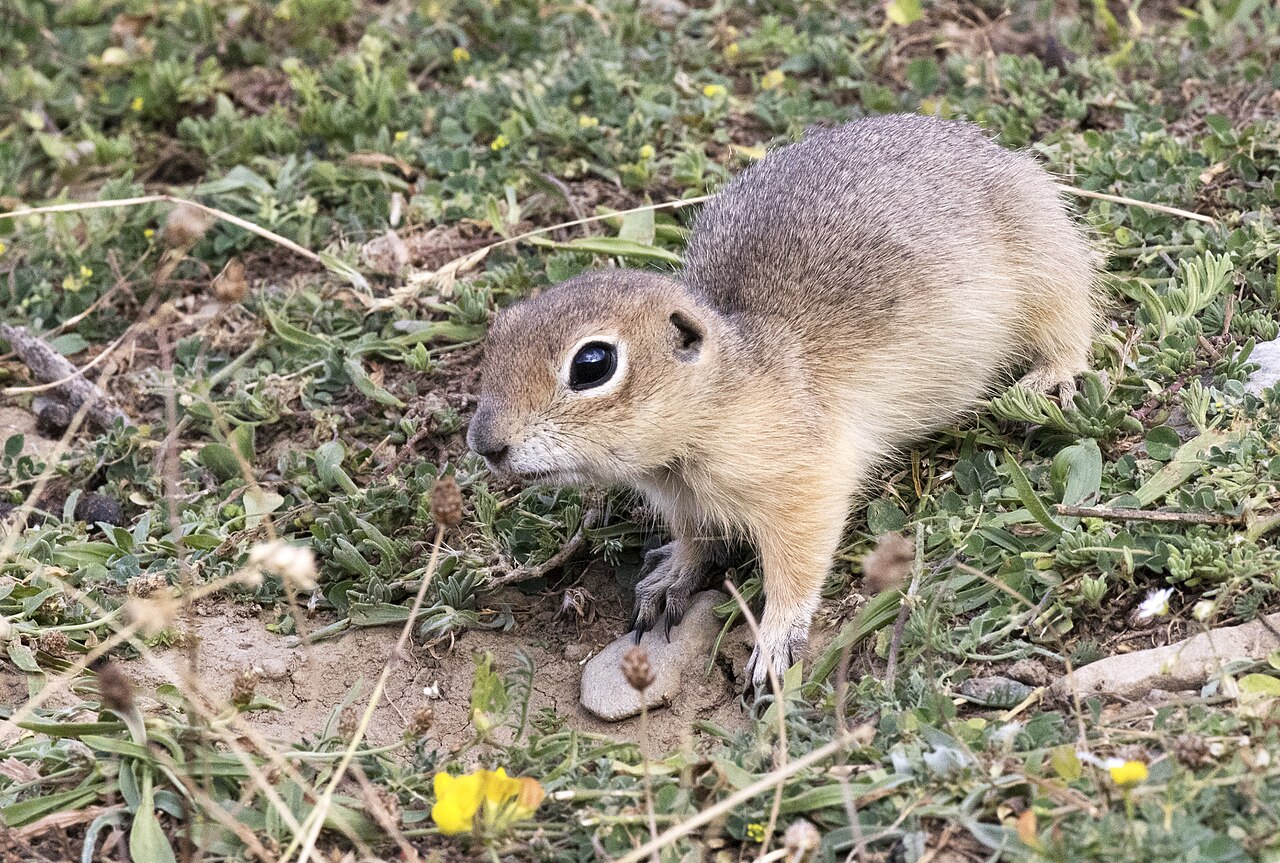
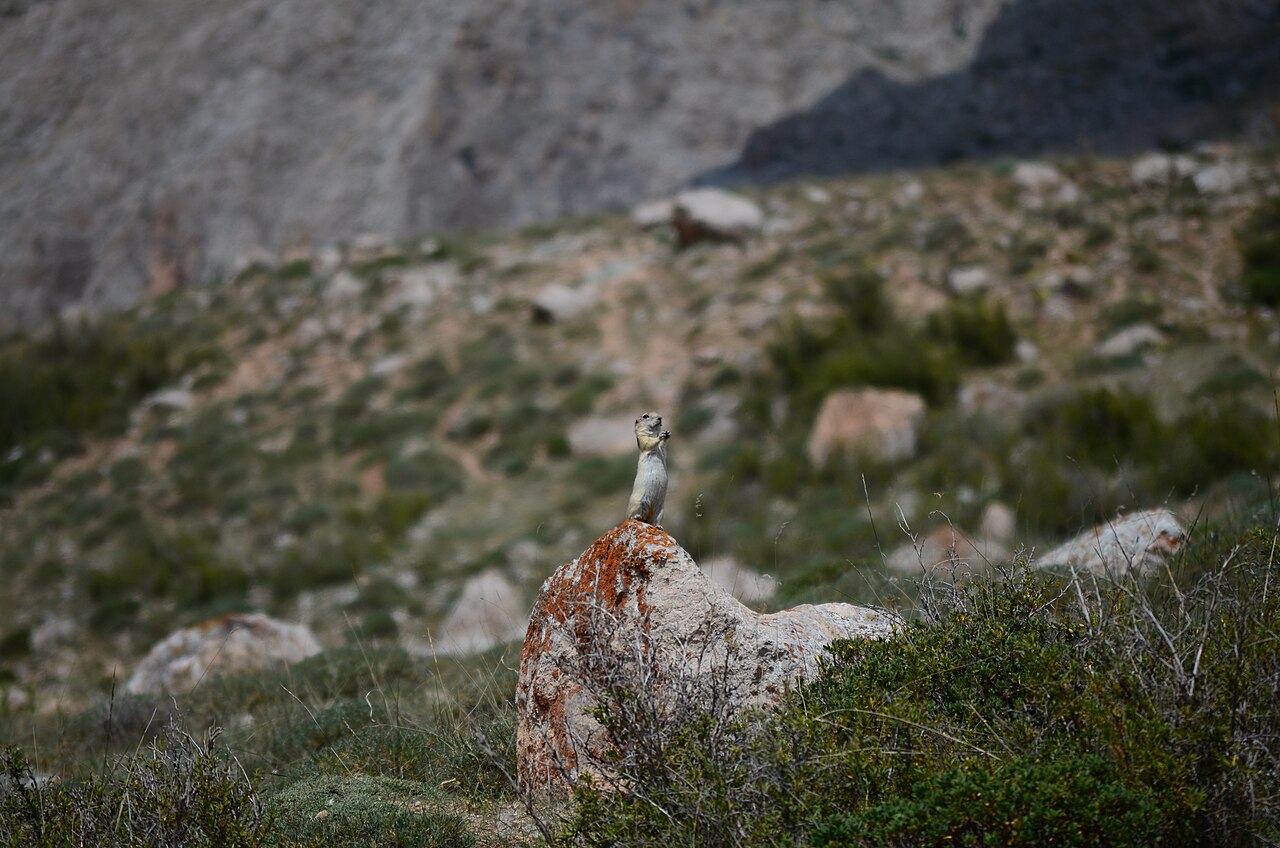
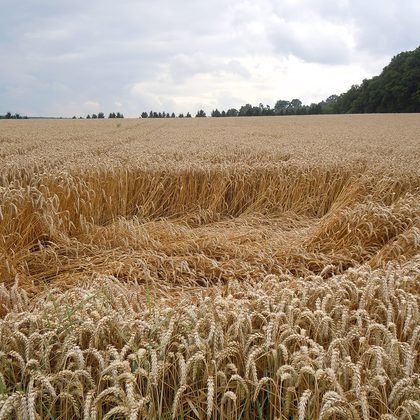
The main sign is the colony. On the bare plateau the burrow entrances, five to eight centimetres across, are visible from the road: round holes in the turf with a low fan of pale excavated soil in front, by the dozen on a grazed field. Around the entrances the vegetation is grazed down to bare ground, and around that lies a ring of shorter, more flower-rich grass than in the rest of the field; on the margins of cereal fields, which the species also inhabits, these bare rings are clearly visible among the crop. Narrow worn paths run between the entrances. On stony slopes the entrances lie beside loose blocks, which are used as lookouts and are worn smooth. From mid-August the entrances are plugged from within and the colony appears abandoned; in September no fresh signs can be found. Droppings are small, dark and dry and lie scattered. The alarm call is a sharp, short whistle given from the burrow rim.
In its habitat
Head close-up

Identification
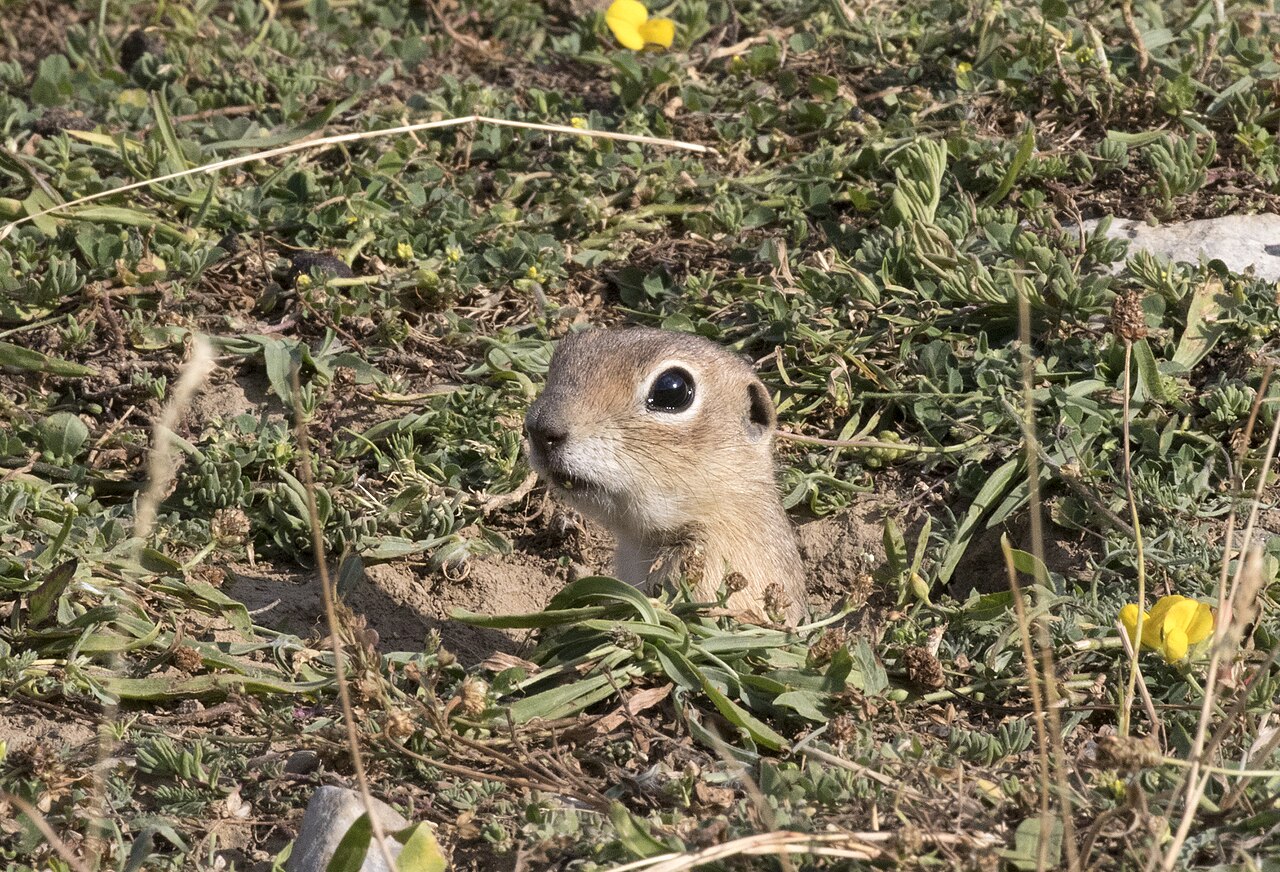
Head-body 14.5 to 23.3 cm, tail 3 to 7 cm, weight 172 to 312 g; males are clearly heavier than females, and weight nearly doubles in the course of the summer. The back is uniform buff to ochre with a fine pale speckling, without spots and almost without mottling. The head is rounded, with large dark eyes and very small rounded ears. Around the eye is a distinct narrow white ring, and chin and throat are sharply white against the yellow chest; at close range this is the most useful character. Belly and inner sides of the legs are pale yellowish white. The tail is short and thin, coloured like the back above, without a black fringe.
Similar species
Range is decisive. This is the ground squirrel of the Anatolian plateau, from the plains of Konya and Aksaray via Kayseri and Niğde to the highlands of Erzurum, and on into Armenia and north-western Iran, between 800 and 2,900 m. Only one other species in this area resembles it, and it lives further south and higher: S. taurensis, in the western and central Taurus above a thousand metres. The two have never been found together; the nearest localities lie more than a hundred kilometres apart. In appearance taurensis has a redder back, a longer tail and a longer hind foot; this species is greyer and yellower and has a shorter tail. The European souslik occurs in Turkey only in European Thrace, west of the Bosphorus, and nowhere overlaps with this species; the four other European sousliks live north of the Black Sea and the Caucasus. Outside the genus, the Caucasian Squirrel is arboreal with a long bushy tail, the Persian Jird (Meriones persicus) and the blind mole-rats are nocturnal or subterranean, and the jerboas of the same plains become active only after sunset.
Habitat
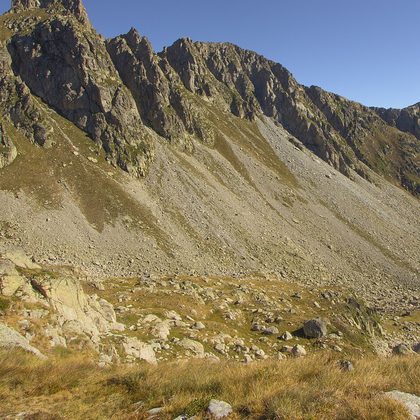
Short-grass steppe on the Anatolian plateau, wormwood and tragacanth steppe, rolling rocky mountain slopes and the margins of cereal fields, roughly between 800 and 2,900 m. Like all sousliks the species depends on deep, dry soil and low vegetation. It tolerates farming better than the European souslik and inhabits narrow strips between fields, fallow land and grazed slopes; cereal fields are used for feeding but not inhabited. In the highlands of eastern Anatolia it occurs up into the alpine meadows.
Where the animal is most at home, classified with EUNIS — the European standard for habitats.


Distribution
The range comprises Anatolia: the central plateau of Konya, Aksaray, Kayseri, Niğde and Sivas and the highlands of Erzurum and Kars, with extensions into western Armenia and north-western Iran, and a few isolated populations in the south, near Antalya and on the Çukurova plain. The range lies entirely in Asia; the species does not reach the Bosphorus. On the Anatolian plateau it is still widespread, but in recent decades it has disappeared from the lowest and flattest parts, which were ploughed first.
- Native
- dark = core range, pale = thinly spread
Way of life
The species is strictly diurnal and above ground from March to September; for the rest of the year it hibernates, and more is known about hibernation in this species than in the other European sousliks. Adult males go underground on average on 31 August and emerge on 14 February, 168 days in total; females go underground on 11 August and do not emerge until 10 March, 212 days in total, nearly seven months and thus more than half the year. During hibernation bouts of deep torpor, in which body temperature drops by more than ten degrees, alternate with brief arousals; the entrance is plugged from within. Males emerge about ten days before the females and are then already in breeding condition. The mating period lasts three to four weeks; after 25 to 26 days' gestation three to nine young are born, four to seven on average, weighing less than seven grams at birth and weaned at 45 to 50 days. There is one litter a year. The species lives in colonies in which each adult has its own burrow system, and eats grasses, herbs, seeds, bulbs and tubers, supplemented with grasshoppers and beetles. Predators are fox, stone marten, stoat, steppe polecat, Long-legged Buzzard and Saker Falcon.
Where and when to look
The best period is mid-March to late June, between seven and eleven in the morning, on the plateaux of central Anatolia. Known sites are the steppe near Ulukışla and the Aladağlar near Niğde, the Sultansazlığı plain south of Kayseri and the surroundings of Tuz Gölü. Drive slowly along field tracks, watch for the bare rings with pale earth in the short-grazed turf, stop and wait with the engine off. Saker Falcon and Long-legged Buzzard hunt at the same sites. After mid-August the females are no longer above ground, and after late August the males are not either; in September all animals are hibernating.
Conservation status
Near Threatened (2019). The estimated decline is twenty to twenty-five per cent in ten years. The main causes are the conversion of steppe to cereal fields and the expansion of irrigation in central Anatolia. Where ploughing takes place the colony disappears, and the narrow margins that remain are too small to support a lasting population. In addition, the species is regarded as a pest of grain and is locally poisoned, and the lower parts of the plateau are drying out. The species is still numerous and widespread, which makes the decline difficult to detect: individual colonies disappear, not whole areas. It is an important prey species: in central Anatolia Saker Falcon and Long-legged Buzzard depend on it directly, and changes in its numbers are reflected in their breeding success within a few years.
Scientific name
Spermophilus xanthoprymnus | (E. T. Bennett, 1835)
E. T. Bennett described the species in 1835 as Citillus Xanthoprymna; because it was later moved to another genus, the author and year stand in brackets. Spermophilus is Greek, from sperma, 'seed', and philos, 'loving': the seed-lover, after the food the animal carries to its burrow in its cheek pouches. xanthoprymnus is Greek for 'yellow-rumped', from xanthos, 'yellow', and prymnos, 'hindmost', after the yellow wash over rump and hind legs. The specimen the first description was based on came from Türkiye, Erzurum.