All species › Even-toed ungulates › Bovids › Arabian Gazelle
Arabian Gazelle | Gazella arabica
Farasangazelle | Gazella arabica
The Arabian gazelle (Gazella arabica) is the gazelle of the Arabian Peninsula. Its Dutch name refers to the Farasan Islands in the Red Sea, the type locality. Within the guide area the species lives only in the southern Arava valley in Israel, as a relict population of a few dozen animals inside a fenced part of the nature reserve near Yotvata. There it is known as the acacia gazelle.

Tracks
The track is a small, pointed, two-toed slot that cannot be told from that of the dorcas gazelle in the field. Territorial males build dung middens at fixed spots in their territory, used for years. Under acacias, lower branches are browsed up to the height a gazelle reaches standing on its hind legs.
Identification
A slender gazelle with a long neck and long legs. The back, neck and outer legs are brown to grey-brown; the belly, inner legs and ears are white. The head has a dark band down the middle of the face, bordered on each side by a broad white stripe from the eye to the muzzle. Both sexes carry horns; those of the male are longer, thicker and ringed, those of the female short and thin. The tail is short and black. No reliable published body measurements have been found for this species; the related mountain gazelle weighs 16 to 30 kg.
Similar species
In the southern Arava the dorcas gazelle lives in the same area and even inside the same enclosure. The dorcas gazelle is smaller and paler, sandy rather than brown, with a less dark facial pattern. The mountain gazelle (Gazella gazella) of northern and central Israel looks almost identical; the two species were separated only in 2013 by genetic study. In the field the location decides: a gazelle of this type in the southern Arava is the Arabian gazelle, one in Galilee, the Golan or on Mount Carmel is the mountain gazelle.
Habitat
Dry plains and low hills with scattered acacia trees, grassland, shrubland and desert. In the Arava the species lives on a hyper-arid plain with about 35 mm of rain a year, where Vachellia raddiana and V. tortilis form the food base, with low shrubs such as Hammada and Anabasis between them.
Where the animal is most at home, classified with EUNIS — the European standard for habitats.
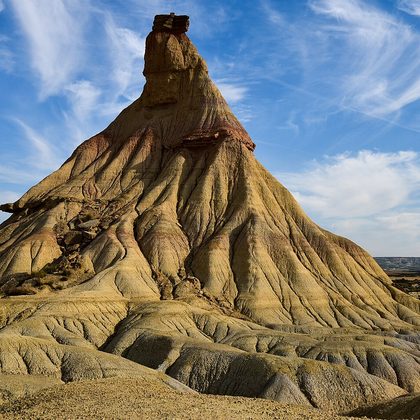
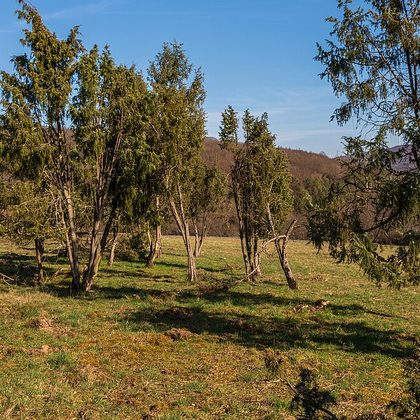
Distribution
The range covers Saudi Arabia, Yemen, Oman and the United Arab Emirates; a population has been introduced on the Iranian island of Faror. In the 1990s Oman held about 13,000 animals, mostly in the Jiddat al-Harasis; numbers there have since fallen steeply through poaching. Saudi Arabia holds 1,500 to 1,700 animals, about 1,000 of them on the Farasan Islands. The guide area touches only the north-western edge of the range: in the southern Arava in Israel several hundred animals lived in 1948. The population of the northern Arava was wiped out by illegal hunting between 1956 and 1963. In 2019 the remaining group at Yotvata consisted of 30 animals, inside a 3.5 km² enclosure built in 2006.
- Native
- dark = core range, pale = thinly spread
Way of life
The Arabian gazelle is active in the early morning and the evening and chews the cud in the shade during the midday heat. Its food is mainly the leaves, flowers and pods of acacias and other woody plants; grass plays a smaller role. To feed higher in a tree the gazelle stands on its hind legs. Gestation lasts five to six months and a single young is born. In the Arava the survival of the young depends strongly on predation and temperature. The Arabian wolf is the main predator: in Israel the number of gazelles varied from year to year with the number of wolf encounters.
Where and when to look
The group at Yotvata lives inside an enclosure; ask the Israeli nature authority about access to the reserve. Gazelles on the open acacia plains of the southern Arava outside this area are dorcas gazelles. Search in the first hours after sunrise, when the animals feed under and around the acacias, and check the colour of the back and the facial pattern of every gazelle.
Conservation status
Vulnerable (VU, 2017). The number of mature animals fell from about 12,000 in 2008 to 5,000 to 7,000 in 2016. Causes are illegal hunting, capture of young animals for the trade, building development, competition with livestock, rising temperatures and predation by wolves. In Israel the Yotvata enclosure was breached during floods in 2012 and 2013; wolves then killed about 40 gazelles before the fence was repaired in June 2013. Inside the enclosure the species competes with the dorcas gazelle for acacia leaves, after which part of the dorcas gazelles were moved elsewhere.
Scientific name
Gazella arabica | (H. Lichtenstein, 1827)
H. Lichtenstein described the species in 1827 as Antilope arabica; because it was later moved to another genus, the author and year stand in brackets. Gazella goes back through French and Spanish to Arabic ghazāl, 'gazelle'. arabica means 'Arabian', after the Arabian Peninsula; Lichtenstein described the animal from a specimen from the Farasan Islands in the Red Sea. The specimen the first description was based on came from Saudi Arabia, Farasan.