All species › Even-toed ungulates › Bovids › Arabian oryx
Arabian oryx | Oryx leucoryx
Arabische oryx | Orix de Arabia
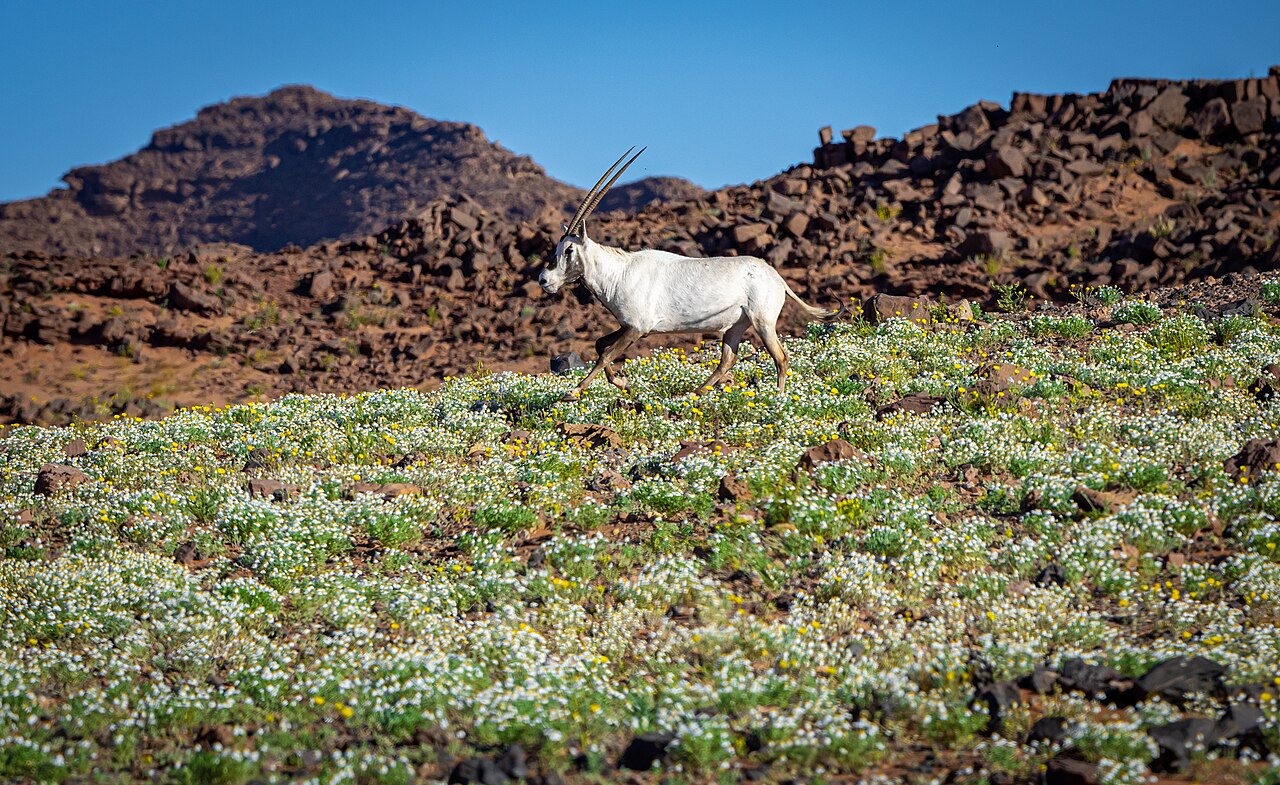
The Arabian oryx (Oryx leucoryx) is a white antelope of the gravel and sand plains of the Arabian Peninsula. The last free-living animal was killed in 1972; since the early 1980s the species has been reintroduced with captive-bred animals. In the guide area the Arabian oryx lives in southern Israel and on the Arabian Peninsula, including Saudi Arabia and Jordan.
Tracks
The slot is large for an animal of this weight, with broad, splayed halves that sink little into sand. In the hot months the animals lie under acacias and shrubs during the day; shallow scraped resting hollows with droppings can be found there. On open gravel plains tracks and trails are clearest after rain, when the ground is soft.
Identification
A medium-sized antelope of about 160 cm head-body length, 81 to 102 cm shoulder height and about 65 to 70 kg; some figures are higher. The tail is 45 to 60 cm long and ends in a dark tuft. The coat is almost entirely white and reflects sunlight; the underside of the body and the legs are brown to blackish brown. The head carries dark markings on forehead, nose and cheeks, and a dark band marks the junction of head and neck. There is a distinct hump above the shoulders. Both sexes carry long, straight or slightly curved, ringed horns of 50 to 68 cm.
Similar species
The only other oryx in the guide area is the scimitar-horned oryx (Oryx dammah), which lives in fenced reserves in Tunisia and Morocco in North Africa; the two species do not occur together anywhere. The scimitar-horned oryx has horns curved backwards like a sabre and a reddish-brown neck; the Arabian oryx has straight horns and a white neck with a dark head. Gazelles, such as the Dorcas gazelle in the same area in Israel, are much smaller, sand-coloured and have shorter, lyre- or S-shaped horns.
Habitat
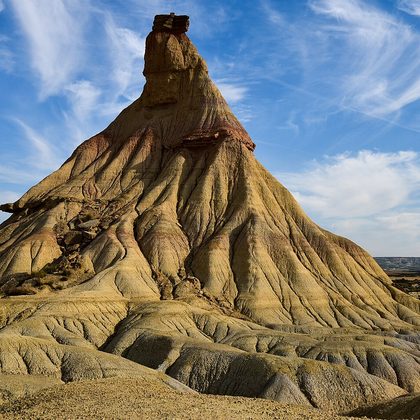
Gravel plains and plains of hard sand in the desert, with scattered grasses, shrubs and acacias. The animals follow the rain, because new vegetation appears there, and therefore use very large areas.
Where the animal is most at home, classified with EUNIS — the European standard for habitats.
Distribution
Formerly most of the Arabian Peninsula, north to Jordan, Syria and Iraq. After extermination in the wild in 1972 the species has been reintroduced since 1980, first in Oman and then in Saudi Arabia, Israel, Jordan and the United Arab Emirates. In Saudi Arabia one of the largest populations lives in the fenced Mahazat as-Sayd protected area of more than 2000 km²; the 'Uruq Bani Ma'arid protected area held 116 animals in 2024. In Oman the population of the Arabian Oryx Sanctuary fell from 450 animals in 1996 to 65 in 2007. In Israel a free-living population occupies the Arava and the southern Negev; most records in the guide area come from there.
- Native
- dark = core range, pale = thinly spread
Way of life
The Arabian oryx is active in the cool hours. In summer it lies in the shade during the day and forages in the evening, at night and in the early morning. It eats grasses, especially Stipagrostis, as well as buds, herbs, fruits, tubers and roots. It can go for weeks without drinking and lets its body temperature rise during the day, which limits water loss through evaporation. The animals detect rainfall from a great distance and move towards it; one herd in Oman used an area of 3000 km². Herds usually number 2 to 15 animals of both sexes, sometimes up to a hundred, with a hierarchy settled by threat postures. Gestation lasts 8.5 to 9 months; a single calf is born and is weaned after about 3.5 months. The Arabian wolf is the only natural predator of adults.
Where and when to look
In Israel, search the southern Arava in the early morning and late afternoon, when the animals graze on the open plains; in the middle of the day they lie in the shade and are hard to see. The Hai-Bar reserve near Yotvata also keeps a herd in an enclosure. Do not leave roads and tracks in the desert without preparation and enough water.
Conservation status
Vulnerable (VU, 2017). Hunting, carried out with motor vehicles from the 1930s onwards, exterminated the Arabian oryx in the wild in 1972. The species has been reintroduced with animals from breeding programmes, and in 2011 it was the first species to be moved from Extinct in the Wild to Vulnerable. In 2016 about 1220 animals lived in the wild, 850 of them mature, and 6000 to 7000 in captivity. Most wild animals live in fenced areas. Threats are poaching, habitat loss and drought. In Oman the Arabian Oryx Sanctuary became in 2007 the first site ever removed from the UNESCO World Heritage List, after 90 per cent of it was opened to oil prospecting.
Scientific name
Oryx leucoryx | (Pallas, 1777)
Pallas described the species in 1777 as Antilope leucoryx; because it was later moved to another genus, the author and year stand in brackets. Oryx is Greek oryx, 'pickaxe', from oryssein, 'to dig'; the Greeks already used the word of a North African antelope, after its pointed horns. leucoryx is Greek for 'white oryx', from leukos, 'white', and oryx; older authors applied the name to the addax as well, which long caused confusion. The specimen the first description was based on came from Arabian Peninsula.