All species › Even-toed ungulates › Bovids › Bison bonasus
Bison bonasus | Bos bonasus
Wisent | Bison bonasus
The European bison or wisent (Bos bonasus, often also Bison bonasus) is the heaviest wild land animal in Europe. The species became extinct in the wild: the last animal in the Białowieża Forest was shot in 1921, the last in the western Caucasus in 1927. All living wisent descend from a small number of zoo animals. Through reintroductions more than 12,000 wisent were alive again at the end of 2024, almost 10,000 of them in the wild, in a large number of countries in eastern and central Europe and beyond.
Tracks
The track is large and round, with two broad halves, and resembles that of cattle. The dung consists of pats. Wisent strip bark from trees and shrubs and browse twigs and shoots; in forests with many wisent, stripped trunks and browsed shrubs are a clear sign. They take dust baths in bare, churned hollows and rub against tree trunks, leaving hair behind.
Identification
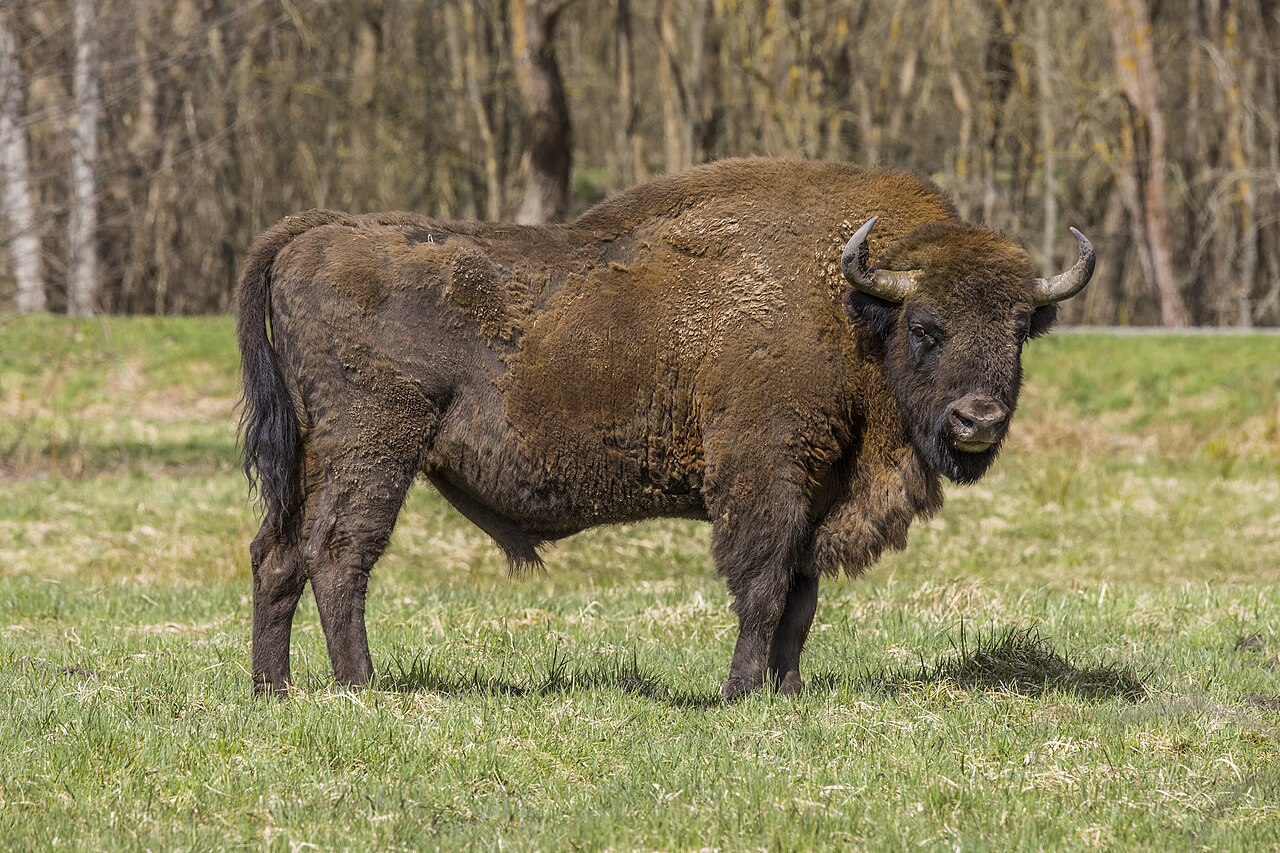
A very large bovine with a high shoulder hump. Bulls have a head-body length of 280 to 330 cm, a shoulder height of 180 to 210 cm and a weight of 615 to 920 kg; cows are 240 to 290 cm long, 169 to 197 cm high and weigh 424 to 633 kg. The tail is 30 to 92 cm long, with a tuft. The coat is dark to golden brown, longer on the head, neck and forequarters, with curly hair on the forehead and a short beard. The head is carried higher than in the American bison, and the hindquarters are more powerful. Both sexes carry short horns curving outwards and upwards with forward-pointing tips.
Similar species
Domestic cattle, especially dark, shaggy breeds grazing in nature reserves, are the most frequent confusion at a distance; they lack the high shoulder hump and the beard, and the back is straight. The American bison is kept in Europe in enclosures and on farms; it carries its head lower, has a heavier mane on the head and forelegs and smaller hindquarters.
Habitat
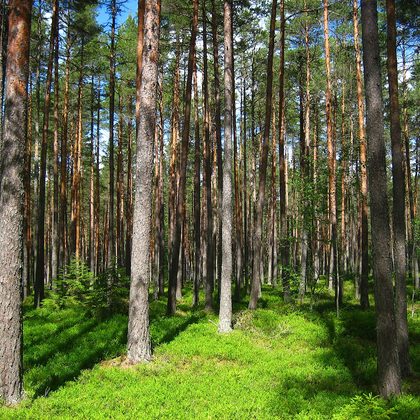
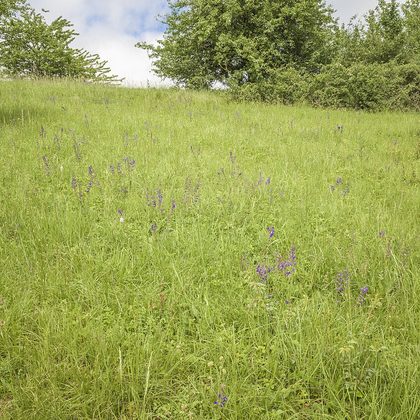
Broadleaved and mixed woodland with clearings, grassland and woodland edges, in lowlands and mountains; on the North Sea coast also dunes with woodland and scrub. The wisent needs open grassy places within or next to the forest, and in many areas it is given supplementary food in winter.
Where the animal is most at home, classified with EUNIS — the European standard for habitats.




Distribution
The largest populations live in Poland (3,060 animals in May 2025; in all more than a quarter of the world population), Russia (3,073) and Belarus (2,927), with the Białowieża Forest on the Polish–Belarusian border as the core area. Smaller populations live in Germany (643, including in the Rothaargebirge), Ukraine (480), Romania (451), Lithuania (339), Slovakia, the Netherlands, Denmark and Spain, among others. In the Netherlands wisent have roamed the Kraansvlak in Zuid-Kennemerland since 2007 and also the Maashorst. Two breeding lines are distinguished: the Lowland line, going back to seven animals of the lowland form, and the Lowland-Caucasian line, which carries genetic material of the extinct Caucasian form.
- Native
- dark = core range, pale = thinly spread
Way of life
Wisent live in herds of on average eight to thirteen animals, made up of cows with calves and young animals; the cows lead the herd and decide where it grazes. Adult bulls live alone or in small groups and join the herds in the rut. The food is mainly grasses, sedges and herbs, supplemented by shoots, twigs, bark and leaves of trees and shrubs. The rut falls from August to October; after a gestation of about 264 days a single calf is born. Wisent are active by day; they spend about 30 per cent of their time feeding and 60 per cent resting. Despite their weight they jump a three-metre stream or a two-metre fence from a standstill.
Where and when to look
The Białowieża Forest is the best-known area; in winter the animals are best found in clearings and meadows at the forest edge in the early morning. Other suitable areas are the Bieszczady in south-eastern Poland, the Rothaargebirge in Germany and the Kraansvlak and the Maashorst in the Netherlands, where walking routes run through the range. Keep a wide distance and never walk between a cow and her calf.
Conservation status
Near Threatened (NT, 2020), after earlier assessments as Vulnerable and, in 1996, as Endangered. At the end of 2024 there were 12,209 wisent worldwide, of which 9,762 in the wild, 1,725 in enclosures and 722 semi-wild; in 2024 the number rose by 8.4 per cent. The main problem is the narrow genetic base: all animals descend from a handful of founders, and genetic variation continues to decrease. This makes the species susceptible to diseases such as foot-and-mouth disease and leads to inbreeding effects. Many populations are small and isolated; conflicts with agriculture and forestry limit expansion.
Scientific name
Bos bonasus | Linnaeus, 1758 (GBIF: Bison bonasus)
Linnaeus described the species in 1758 and placed it straight away in the genus where it still stands. Bos is the Latin word for 'ox, head of cattle', cognate with Greek bous. bonasus is Greek bonasos, in Aristotle the name of a wild ox of Paeonia, identified with the wisent. The specimen the first description was based on came from Poland, Białowieża.