All species › Hedgehogs, shrews and moles › Moles and desmans › Balkan Mole
Balkan Mole | Talpa stankovici
Balkanmol | Topo Balcánico
The Balkan Mole is a mole of the southern Balkans; its range extends from the mountains around Lakes Ohrid and Prespa to the coast of Albania, western Greece and Corfu. It was described in 1931 as a subspecies of the Roman Mole, but is not close to it genetically; it is an old Balkan species of its own whose place in the mole family tree is still unsettled. Within its range it is the larger mole species; the Common Mole occurs there only rarely.
No photograph of a living wild animal of this species with a suitable Creative Commons licence exists. Do you have one that meets the rules? Send it in.
Tracks
The Balkan Mole digs like the other moles and throws up molehills, which cannot be told from those of other moles. In the high mountains it tunnels through the root mats of mat-grass and bilberry, so hills also appear in thin, vegetated mountain pastures. No other signs have been described for this species. Within the range the molehill is in practice the only sign: a fresh line of molehills on a mountain pasture in the Pelister range or in a field on Corfu belongs, within the known range, to this species or to the Blind Mole, and which of the two cannot be seen from the hill.
Identification
A medium-sized to large mole of the familiar build: cylindrical body, digging spades, velvety coat. The fur is blackish, the feet greyish, and the eyes are covered by skin, with no open lid slit. Males measure 12.3 to 14.3 cm head-body and weigh 61 to 96 grams, females 12.1 to 12.9 cm and 48 to 69 grams; males average 20 per cent heavier. Animals from the coastal plain of southern Montenegro are clearly smaller, weighing 35 to 51 grams. The skull has a broad rostrum and large molars. Two subspecies are recognised: the nominate form in the mountains of western North Macedonia and adjacent north-western Greece, and montenegrina in the coastal lands further west and south.
Similar species
In the field the moles of the Balkans can barely be told apart by appearance, and locality is the first criterion. The Blind Mole (Talpa caeca) shares part of the range and also has covered eyes, but is smaller and lighter, with a narrower snout; where both occur in the same region they seldom live at exactly the same spot. The Common Mole (Talpa europaea) has a small open eyelid slit; within the range of the Balkan Mole the Common Mole occurs only rarely. The Roman Mole (Talpa romana), of which it was once called a subspecies, lives only in Italy and does not apply here. The Balkan blind mole-rats (Nannospalax) also push up soil; they are rodents without digging spades, with broader, lower heaps of coarse clods. Certain identification of a dead animal rests on skull and teeth or on DNA.
Habitat
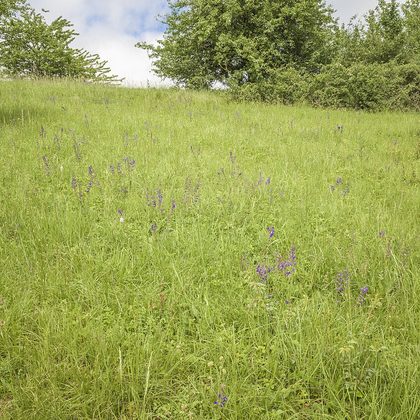
Farmland, pastures, alpine grassland, road verges, sandy dunes and woodland, from near sea level to about 2300 m. Its area thus spans both the coastal plains of Montenegro and Albania and the high mountain pastures of North Macedonia and north-western Greece, where the animals dig in the root zone of mat-grass and bilberry. As with all moles, it needs soil deep enough to dig and rich enough in earthworms.
Where the animal is most at home, classified with EUNIS — the European standard for habitats.



Distribution
An endemic species of the southern Balkans. The nominate form lives in western North Macedonia and the adjacent mountains of north-western Greece; the type locality lies at about 1000 m in the Pelister range near Bitola. The subspecies montenegrina occupies the coastal plains of southern Montenegro and adjacent Albania, and further central and southern Albania, western Greece into the northern Peloponnese, and the island of Corfu. The species is possibly known from Kosovo. Within this area its range overlaps with that of the Blind Mole.
- Native
- dark = core range, pale = thinly spread
Way of life
Little is known of its way of life; what there is matches that of the other moles. Stomach contents have held mainly earthworms. The young are presumably born in February and early March; 2 to 4 embryos per litter have been counted, and young of 30 grams already move independently through the burrow system. No data have been published on daily rhythm, home range or social organisation. Like all moles, it does not hibernate.
Where and when to look
Anyone seeing molehills in the mountains around Lakes Ohrid and Prespa, on the Albanian coastal plain or on Corfu is probably looking at the work of the Balkan Mole or the Blind Mole. A dead animal is the best chance of an identification. Weigh it and measure head-body length: an animal over 70 grams does not fit the Blind Mole. Check the eye with a lens; an open eyelid slit points to the Common Mole and is an exception within this species' range. Note the exact locality; in this group it is the most important identification datum.
Conservation status
Least Concern (LC, 2024). The range is fairly small, but includes farmland, pastures and mountain country where the species occurs in many places. No specific threats have been described. Few data are available on the size and trend of its populations.
Scientific name
Talpa stankovici | V. E. Martino & E. V. Martino, 1931
V. E. Martino & E. V. Martino described the species in 1931 and placed it straight away in the genus where it still stands. Talpa is the Latin word for 'mole'. stankovici honours the Serbian biologist Siniša Stanković (1892–1974), the student of Lake Ohrid and a pioneer of nature conservation in Yugoslavia. The specimen the first description was based on came from North Macedonia, Magarevo.