All species › Hedgehogs, shrews and moles › Moles and desmans › Roman Mole
Roman Mole | Talpa romana
Romeinse mol | Topo Romano
The Roman Mole is a large mole, as heavy as a big Common Mole, and one of the southern European moles whose home range, daily rhythm and use of space have been measured in the field and in captivity. It is endemic to central and southern Italy. It was long treated as a subspecies of the Common Mole, but its closest relative is the much smaller Blind Mole.
No photograph of a living wild animal of this species with a suitable Creative Commons licence exists. Do you have one that meets the rules? Send it in.
Tracks
The Roman Mole digs tunnels and throws the soil up as molehills, which cannot be told from those of other moles. Because each animal has its own well-defined home range, the hills appear in separate groups, each belonging to one mole. In the summer drought activity drops and fewer fresh hills appear. No other signs have been described.
Identification
A large, heavy mole, slightly larger than the Common Mole, with a head-body length up to 16 cm and a weight of 61 to 134 grams; males average 18 per cent heavier than females. It looks like the Common Mole, but the eyelids are grown shut so that the eye lies beneath the skin, and the tail is more cylindrical, less conical. The fur is black. Females have four pairs of nipples. The skull is large and massive, with a heavy rostrum and heavy upper molars; teeth are often missing — over a third of animals lack one to four upper premolars. The pelvis is of the caecoid type.
Similar species
Three moles live in Italy, and locality and size are the first clues. The Common Mole (Talpa europaea) replaces the Roman Mole north of Umbria; it has a small open eyelid slit, a more conical tail and a lighter skull. The Blind Mole (Talpa caeca), its closest relative, lives in the Apennines and also has covered eyes, but is much smaller and lighter — up to about 65 grams against up to 134 — and keeps mainly to higher mountain country. A dental difference, the two-cusped mesostyle of the first upper molar, can only be seen on the skull. On the peninsula itself, a large mole with covered eyes south of Umbria is as a rule this species.
Habitat
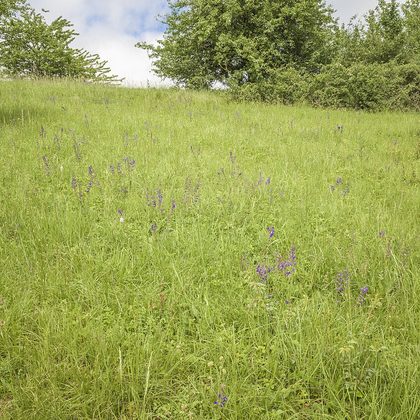
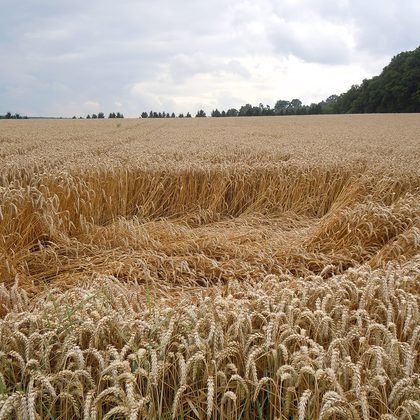
A wide range: sand dunes, arable land, olive groves, meadows and pastures, broadleaved woodland and mountain pastures, from sea level to 1500 m, exceptionally 2000 m. Higher in the Apennines it is replaced by the Blind Mole. Habitat suitability modelling has shown that the species occupies only a limited part of the area it could in principle inhabit. Densities in central Italy are around 2 to 2.3 animals per hectare, in pasture and in olive groves.
Where the animal is most at home, classified with EUNIS — the European standard for habitats.




Distribution
Endemic to central and southern Italy, north into Umbria and south into Calabria. North of Umbria the Common Mole takes over. The type locality is Ostia near Rome. On Sicily the species is presumed extinct: the last record dates from 1885.
- Native
- dark = core range, pale = thinly spread
Way of life
The Roman Mole lives strictly underground and is solitary and territorial. Home ranges are sharply bounded; those of females, and of males and females, may overlap, but two moles never use the same patch at the same time, and the core of each range is exclusive. Males have larger ranges (averaging around 3100 to 4300 m²) than females (around 1700 to 2800 m²); size and position shift with the season, and overlap is greater where food is more plentiful. The daily rhythm is a regular alternation of rest and activity of three to four hours each: females are mainly active from 06:00 to 12:00 and 15:00 to 21:00 and rest before sunrise and around midday; in the breeding season females synchronise their rest periods, while the males' rhythm becomes less regular. Unlike in the Common Mole, males do not travel far in search of females. Pregnant females with 2 to 3 embryos have been caught in April. The diet is opportunistic: mainly earthworms, insect larvae and molluscs, with more insect larvae in the dry months when earthworms become scarce.
Where and when to look
In central and southern Italy any molehill in the lowlands and hills is as a rule the work of this species. Look in pastures, olive groves and dune areas along the Tyrrhenian coast in autumn, winter and spring, when the soil is moist and the hills fresh. Because the animals are active by day, the morning or late afternoon is the time to wait patiently for the soil on a fresh hill to move. A dead animal with grown-over eyelids weighing over 70 grams is, within Italy, a Roman Mole.
Conservation status
Least Concern (LC, 2024). The species is widespread in central and southern Italy and occurs in several protected areas. The mole is regarded and controlled as a pest in farming, and in areas of intensive arable cultivation numbers may decline locally. On Sicily the species has not been found since the nineteenth century.
Scientific name
Talpa romana | O. Thomas, 1902
O. Thomas described the species in 1902 and placed it straight away in the genus where it still stands. Talpa is the Latin word for 'mole'. romana is Latin for 'Roman'; Thomas described the animal from the neighbourhood of Rome. The specimen the first description was based on came from Italy, Rome.