All species › Hedgehogs, shrews and moles › Shrews › Bicolored Shrew
Bicolored Shrew | Crocidura leucodon
Veldspitsmuis | Musaraña Bicolor
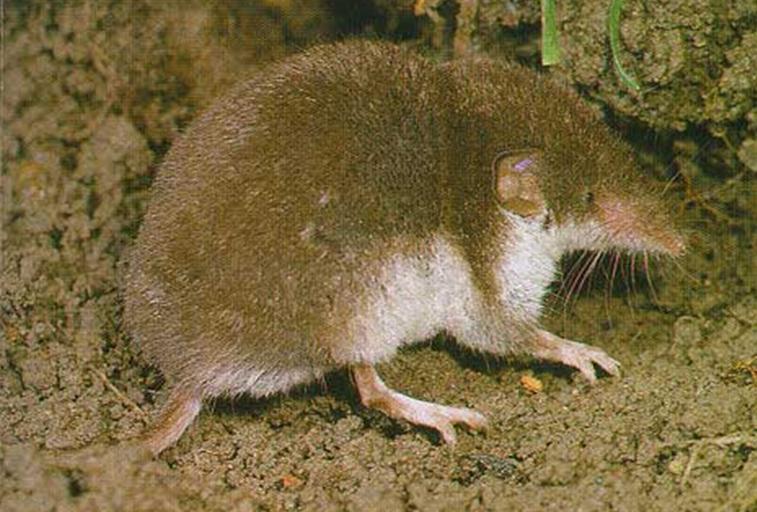
The Bicolored Shrew is the only white-toothed shrew in Europe that can be reliably named on appearance. In the other species of the genus the greyish-brown back colour shades gradually into the paler belly; the Bicolored Shrew has a straight, sharp line along the flank between the dark upper parts and the white under parts. That character is decisive, so that for this species, unlike most of its relatives, no DNA analysis is needed.
Tracks
In an animal of eight grams the signs are small but can be found. The dropping is two to four millimetres long, dark grey to black, pointed at both ends and glossy with finely ground insect remains; it is left at a set place in a run, under a plank, a stone or a sheet of corrugated iron. The runs are half a centimetre to a centimetre and a half wide and go through the litter layer, under the turf and along the foot of walls and field margins; they are narrower than a vole's. A print of barely a centimetre, with five toes on both fore and hind foot, registers only in very fine damp silt. The species makes high, shrill, rapidly repeated squeaks during disputes and while foraging. The main source for this species is the pellet of Barn Owls and Little Owls. Almost all knowledge of its distribution in the Netherlands comes from pellet analysis, and the known distribution therefore largely coincides with the places where Barn Owl pellets are collected. In winter the Bicolored Shrew moves into haystacks, barns and brash piles, and an old hayrick is then a suitable place to look for droppings and runs.
Head close-up

Identification
A solidly built, medium-sized shrew with the ordinary characters of the genus — pure white teeth with no red-brown tips, a long mobile snout, minute eyes, ears standing clear of the fur, and a tail with long projecting bristle hairs among the short ones. The distinguishing feature is the pattern: the back is greyish-brown to dark brown in adults and light grey in juveniles, and that dark mantle does not run down onto the flank but stops in a sharp line, below which belly and lower flank are white to pale grey. The tail carries the same division, dark above and pale below. In juveniles of some subspecies the flank is greyish and red-tinged and the mantle is indistinct; then only size is left. Head-body 5.9 to 7.2 cm, tail 3.1 to 4.1 cm and thus less than half the head-body length, weight 5.9 to 11.1 grams.
Similar species
The Greater White-toothed Shrew (Crocidura russula) is the species it shares western and central Europe with, and it is about the same size but has no division at all: its back colour shades gradually across the flank into the greyish white of the belly, without a line. Side by side the difference is obvious; in a single animal the flank must be viewed square on from the side, because the line can only be judged in that view. The Lesser White-toothed Shrew and its recent splits, Crocidura fimbriata foremost, are smaller and finer built and likewise have no boundary; those splits cannot be separated from one another in the field, so an animal without the line cannot be identified beyond Crocidura. The red-toothed shrews (Sorex) have red-brown tooth tips, ears buried in the fur, a three-toned coat with a distinct flank band, and a tail without projecting bristles. Savi's Pygmy Shrew (Suncus etruscus), at a couple of grams, is unmistakably smaller. In a half-grown animal, and in one that is wet or dirty, the line can vanish, and in an owl pellet the character is gone altogether.
Habitat
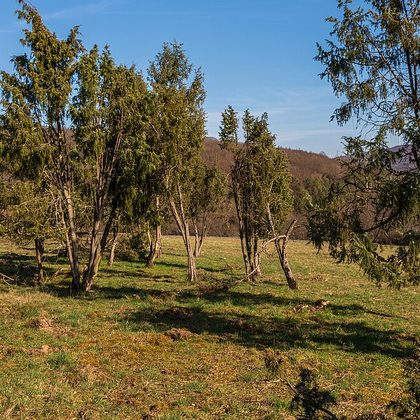
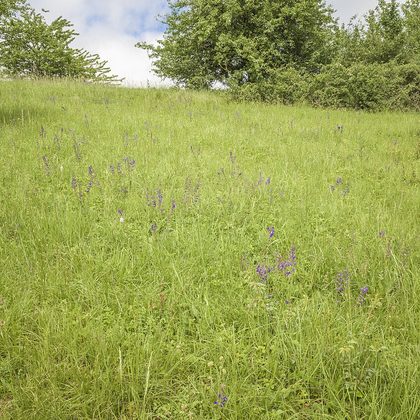
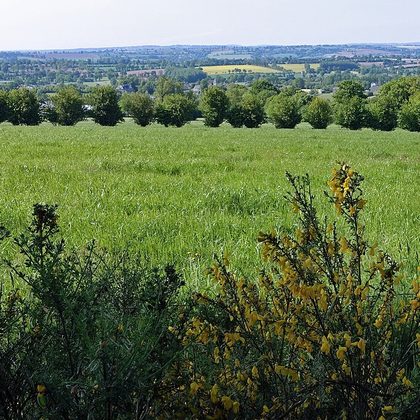
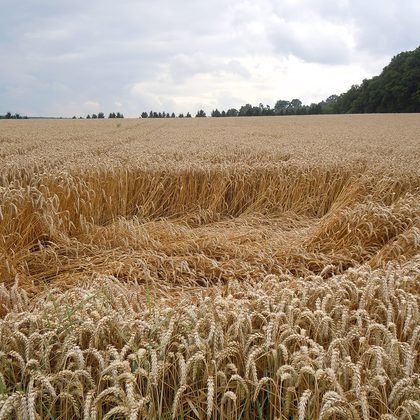
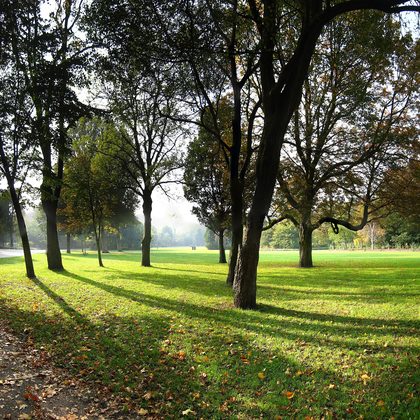
The Bicolored Shrew lives in open, warm, dry country and not in woodland. It inhabits herb-rich steppe and dry to moderately damp grassland with a well-developed permanent sward, field margins, dykes, verges, rough corners, hedgerows and shelterbelts, stone heaps and rock outcrops, and gardens, orchards and farmyards. Haystacks and brash piles are used especially in winter. It avoids wet ground and closed woodland; in Turkey and Iran it does occur in dry deciduous forest, and there chiefly where its competitor Crocidura gueldenstaedtii is absent. In the Alps it reaches about a thousand metres.
Where the animal is most at home, classified with EUNIS — the European standard for habitats.


Distribution
The Bicolored Shrew occurs from north-eastern France and the Netherlands eastwards through central and south-eastern Europe into western Russia, and on across the Caucasus, Turkey and the Levant to northern Iran. It is widespread in the Balkans and Italy; it is absent from the Iberian Peninsula, most of France, and Britain and Ireland. The Spanish name musaraña bicolor has been applied in older literature to Iberian animals that belong to other species. In the Netherlands the species is rare, with three separate cores: Zeeuws-Vlaanderen, north-eastern Overijssel and south-eastern Drenthe, each in small-scale sandy farmland, on dykes, along arable fields and in verges. Pellet series spanning three decades suggest a slight expansion in the west of Zeeuws-Vlaanderen, possibly helped by milder winters; in the north-east the picture is unclear, partly because fewer pellets are now collected. It is one of the two white-toothed shrews of the Netherlands, the other being the Greater White-toothed Shrew.
- Native
- dark = core range, pale = thinly spread
Way of life
The Bicolored Shrew is active in short bouts round the clock, with clear peaks at twilight: shortly after sunset and shortly before dawn. It is least active by day. The diet is beetles, March fly larvae, millipedes, molluscs and harvestmen; it can handle larger beetles than other shrews of its size. The nest is a ball of dry grass on the ground, in a dense tussock or under a bush. Breeding runs from early April to late September, with three to eight embryos per litter and six on average; animals born in spring often breed in the same year. Gestation lasts about thirty days. It does not hibernate, being too small to do so, and stays active all winter; the shrinking of skull and brain known in the red-toothed shrews (Sorex) as Dehnel's phenomenon has not been established in the white-toothed shrews. This genus saves energy in a different way: by dropping into short, shallow torpor on cold nights and by sharing a nest with several others. The young show caravanning: when disturbed, each grips the fur of the one in front and the first grips the mother's. A Bicolored Shrew seldom lives beyond eighteen months.
Where and when to look
The species is rarely seen running; it is usually detected in other ways. The first is the pellet: Barn Owl pellets from within the range are picked apart and the jaws with white teeth set aside. The second is the domestic cat: a large share of Dutch records consists of animals brought in by a cat; a photograph from the side, with the flank in view, allows identification. The third is chance: on a summer evening along a dyke or field edge squeaking animals can sometimes be heard in the verge and seen crossing by torchlight. An animal in the hand is checked for the flank line and then released at once; shrews cannot survive hours without food.
Conservation status
Least Concern (LC, 2021) across its range, but the species is scarce almost everywhere. Even in the areas with the highest densities — Crimea, including the Kerch Peninsula, and south-eastern Dagestan — it is no more than the fifth species in the small-mammal community and makes up less than five per cent of captures. It is on the Red Lists of Ukraine and Moldova, on that of the Voronezh region in Russia, and is listed as Vulnerable on the Dutch Red List. The species is threatened by the same factors as small-scale farmland: the loss of herb-rich verges, dykes and field margins, flailing and complete annual mowing of what remains, the clearing of brash piles and stone heaps, and the conversion of permanent grassland to arable. It is also easily overlooked: without pellet analysis it goes unrecorded, and where no Barn Owl breeds that source of information is missing. Conservation therefore requires both the retention of rough margins and continued pellet analysis.
Scientific name
Crocidura leucodon | (Hermann in E. A. W. von Zimmermann, 1780)
Hermann in E. A. W. von Zimmermann described the species in 1780 as Sorex (leucodon); because it was later moved to another genus, the author and year stand in brackets. Crocidura is Greek, from krokys, genitive krokydos, 'flock of wool, nap', and oura, 'tail', after the long loose hairs standing out among the short ones on the tail. leucodon is Greek for 'white-tooth', from leukos, 'white', and odous, 'tooth', after the unpigmented teeth that set the white-toothed shrews apart from the red-toothed Sorex. The specimen the first description was based on came from France, Bas Rhin.