All species › Hedgehogs, shrews and moles › Shrews › North African White-toothed Shrew
North African White-toothed Shrew | Crocidura pachyura
Crocidura pachyura | Crocidura ichnusae
Crocidura pachyura is the white-toothed shrew of Sardinia, Ibiza and Pantelleria, and of north-eastern Algeria and Tunisia: a North African species that was brought to the islands by people in antiquity. In two hundred years it has borne three names. The name pachyura was long used for another species, Savi's Pygmy Shrew, until Küster's specimen from Cagliari was found to belong to this shrew. Because that name is older than ichnusae, it passed to this species.
Tracks
No signs specific to this species have been described; what follows applies to the genus and has not been tested on these islands. The dropping is two to four millimetres long, dark, pointed and glossy from chitin remains, and lies under a stone, roof tile or plank. The runs are half a centimetre to one and a half centimetres wide and pass through the litter, under dead wood and between the stones of dry walls; small round openings at the foot of such walls belong with them. The print is barely a centimetre long, with five toes on fore and hind foot, and is visible only in very fine, damp silt. The call consists of high, shrill, rapidly repeated squeaks. As for the whole group, pellets of Barn and Little Owls yield more data than other methods: on Sardinia and Ibiza they are the main source for improving distribution maps, and the only way to establish whether the species is still present at sites where it was collected long ago.
Identification
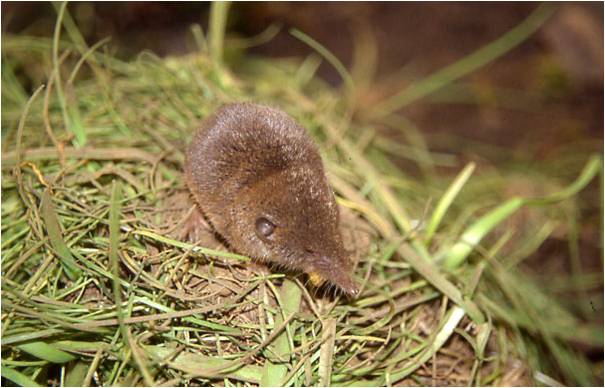
Medium-sized and externally almost indistinguishable from the Greater White-toothed Shrew. The back is dark brown, the belly somewhat paler, with a gradual transition and no dividing line. The tail is proportionally short, the same colour as the back, and carries along its whole length the long, projecting tactile hairs of the genus; the ears project above the fur and the teeth are pure white. Head-body length 6.2 to 7.8 cm, tail 3.0 to 4.0 cm, ear about 9 mm, hind foot 11 to 13 mm. No data of its own have been published for weight. The established differences lie in the skull and cannot be used in the hand: the profile of the braincase is flatter than in the Greater White-toothed Shrew, and the X-shaped crest on the underside of the braincase has longer posterior than anterior arms. The karyotype is 2n = 42 with FN = 66 to 70.
Similar species
External characters are not conclusive; identification rests on locality. The Greater White-toothed Shrew (Crocidura russula) is the sister species and cannot be distinguished by appearance; the two species differ in chromosomes and DNA, and crosses have restricted fertility in the second generation, but neither is visible in the field. The ranges do not overlap: on Sardinia, Ibiza and Pantelleria the Greater White-toothed Shrew has not been recorded, and on the Iberian and Italian mainland and on Mallorca and Menorca this species has not. Identification therefore follows locality. The only other shrew on Sardinia is Savi's Pygmy Shrew (Suncus etruscus): a few grams, a much smaller head and a proportionally long tail, and not to be confused with this species. Sorex species with red-brown tooth tips are absent from all three islands. In North Africa identification is more difficult, because more Crocidura species occur side by side and even the limits of the range are uncertain; there at least examination of the skull is needed, and DNA analysis is conclusive.
Habitat
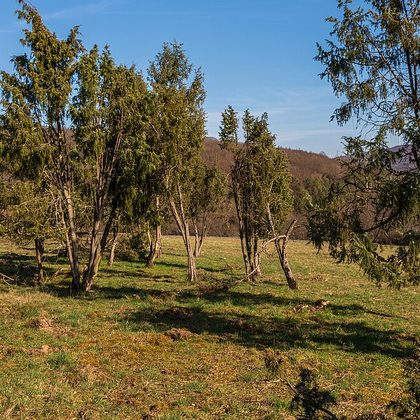
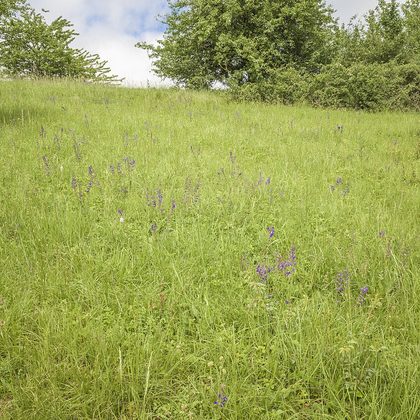
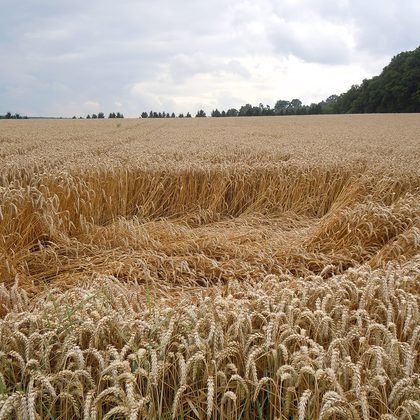
The ordinary landscape of the Mediterranean islands: pasture and grassland, fields and field margins, low scrub, gardens, and especially old agricultural terraces with dry stone walls, where cover, warmth, moisture and insects occur together. From sea level to eight hundred to a thousand metres. Nothing more has been recorded; for a species with such a small range this is an important gap in knowledge. Nothing is known about density, preferences within this landscape or whether the species seeks out or avoids the proximity of people.
Where the animal is most at home, classified with EUNIS — the European standard for habitats.


Distribution
Four separate areas: Sardinia, Ibiza, Pantelleria and, in North Africa, north-eastern Algeria and Tunisia, where the limits of the range are uncertain. This distribution pattern is explained by introduction: the species is native to North Africa and was brought to the islands by people in antiquity, like many other small mammals of the Mediterranean region. The type locality is Cagliari on Sardinia, for which a lectotype was designated in 2007. The centre of the range lies outside Europe; the three European populations each live on a relatively small island. In Spain the species occurs only on Ibiza. In older literature the species appears as Crocidura ichnusae or as the subspecies Crocidura russula ichnusae; Sardinian animals also as sarda, Ibizan animals as ibicensis (Crocidura ibicensis or Crocidura russula ibicensis) and those of Pantelleria as cossyrensis. None of these names belongs to the Greater White-toothed Shrew.
- Native
- dark = core range, pale = thinly spread
Way of life
Nothing has been published on the way of life of this species: not on daily rhythm, diet, breeding or social organisation. What follows applies to the group and has not been established for this species. White-toothed shrews are active in short bouts throughout the twenty-four hours, with the emphasis on night and twilight; they eat small invertebrates (insects and their larvae, spiders, woodlice, centipedes, worms and small snails), each day half to all of their own weight. There is no hibernation: an animal of seven grams is too small for it, and the shrinking of the skull known in the red-toothed shrews (Sorex) as Dehnel's phenomenon has not been established in this genus. Instead they enter short torpor on cold nights and share a nest. Caravanning by the young (each young grips the fur of the one in front, the first that of the mother) has been observed in several species of the genus but has not been reported in this species. A Crocidura seldom lives longer than one and a half years.
Where and when to look
Every reliable record of this species has value. On Sardinia and Ibiza search along old terrace walls, in neglected olive and almond groves and along field margins, in the wet season from November to March, after dark with a torch; the sharp squeaking is usually heard before the animal is seen. Lay a plank or roof tile on a rough patch and lift it every few weeks. The most productive method is dissecting pellets at Barn Owl nests in churches, towers and abandoned farms. Photograph and measure any animal seen or caught (head-body, tail, hind foot and weight) and publish the data; a weight series for this species has never been published.
Conservation status
Least Concern (LC, 2021); this assessment rests on few data. Very little is known about the species and it appears to be scarce. No major threats have been identified; the main risk factor is the highly restricted range, divided between three islands and a strip of North African coast. With such a restricted range the assessment may change as more data become available: on an island of this size the loss of terraces and dry walls, the clearing of stone heaps and rough ground, insect control in orchards and feral cats have more impact than on the mainland. First, data are needed: densities, a reliable distribution map for each island, the limits of the North African part of the range, and the series of body measurements that is still lacking.
Scientific name
Crocidura pachyura | (Küster, 1835)
Küster described the species in 1835 as Sorex pachyurus; because it was later moved to another genus, the author and year stand in brackets. Crocidura is Greek, from krokys, genitive krokydos, 'flock of wool, nap', and oura, 'tail', after the long loose hairs standing out among the short ones on the tail. pachyura is Greek for 'thick-tailed', from pachys, 'thick', and oura, 'tail'. The specimen the first description was based on came from Italy, Sardinia.