All species › Hedgehogs, shrews and moles › Shrews › Greater white-toothed shrew
Greater white-toothed shrew | Crocidura russula
Huisspitsmuis | Musaraña Gris
In western Europe the Greater White-toothed Shrew is one of the commonest white-toothed shrews and often lives close to people: in sheds, cellars, compost heaps and garden walls. Animals killed by cats are regularly found on pavements and doorsteps. For a shrew the species is unusually social: it is monogamous, and in winter several animals share one nest.

Tracks
The most frequent clue is a sound: a high, shrill, rapidly repeated squeaking under a shed floor or behind a compost heap, usually when two animals meet. It can be heard from April to October in gardens and farmyards. The dropping is two to four millimetres long, dark, pointed and glossy from chitin remains, and lies at a fixed place in a run, under a plank, pot or paving slab. The runs are half a centimetre to one and a half centimetres wide and pass through leaf litter, under the turf and along the foot of walls; tunnels of mice and moles are also used. Prints are barely a centimetre long and recognisable only in very fine silt. A nest of fine grass under a stone, plank or upturned flowerpot is often occupied by several animals at once in winter. Conspicuous are dead shrews on pavements and paths, killed but not eaten by cats, because the scent glands on the flank make them unpalatable. For distribution surveys, pellets of Barn Owls and Little Owls are dissected.
In its habitat
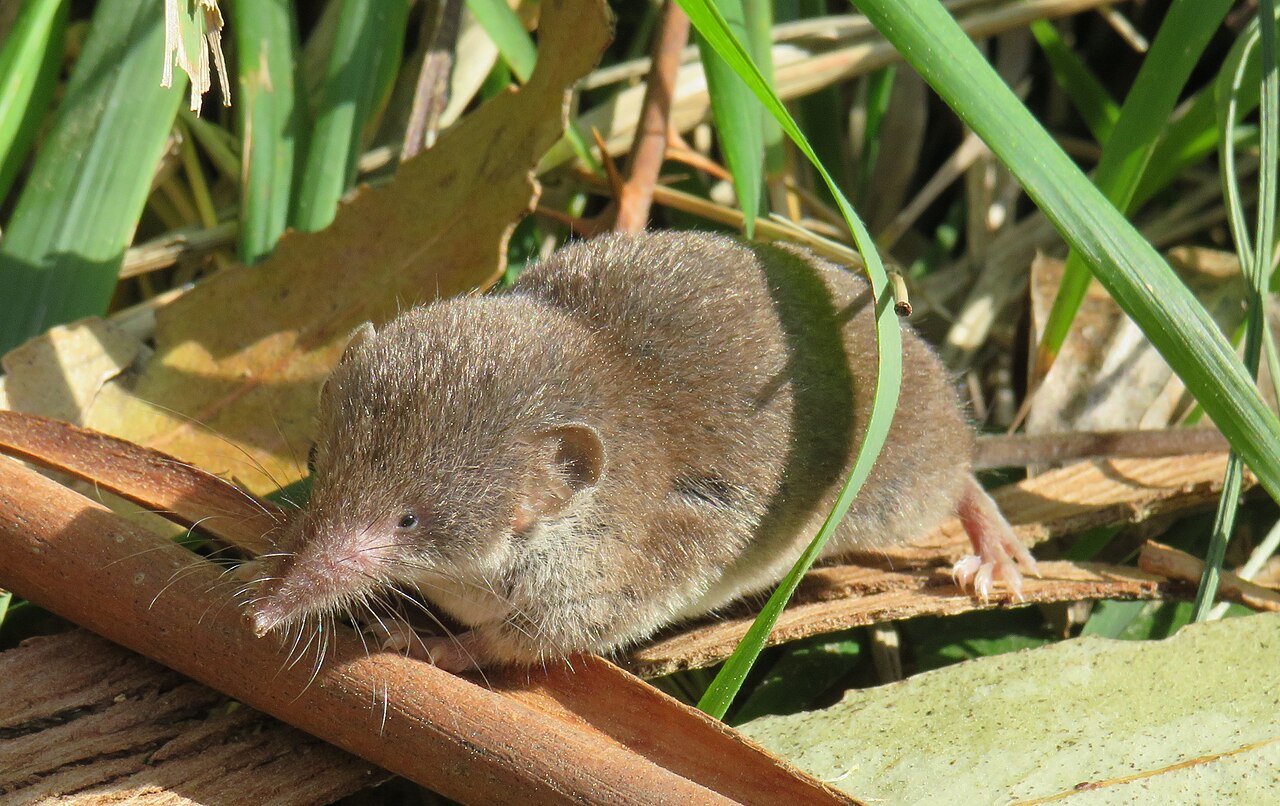
Head close-up

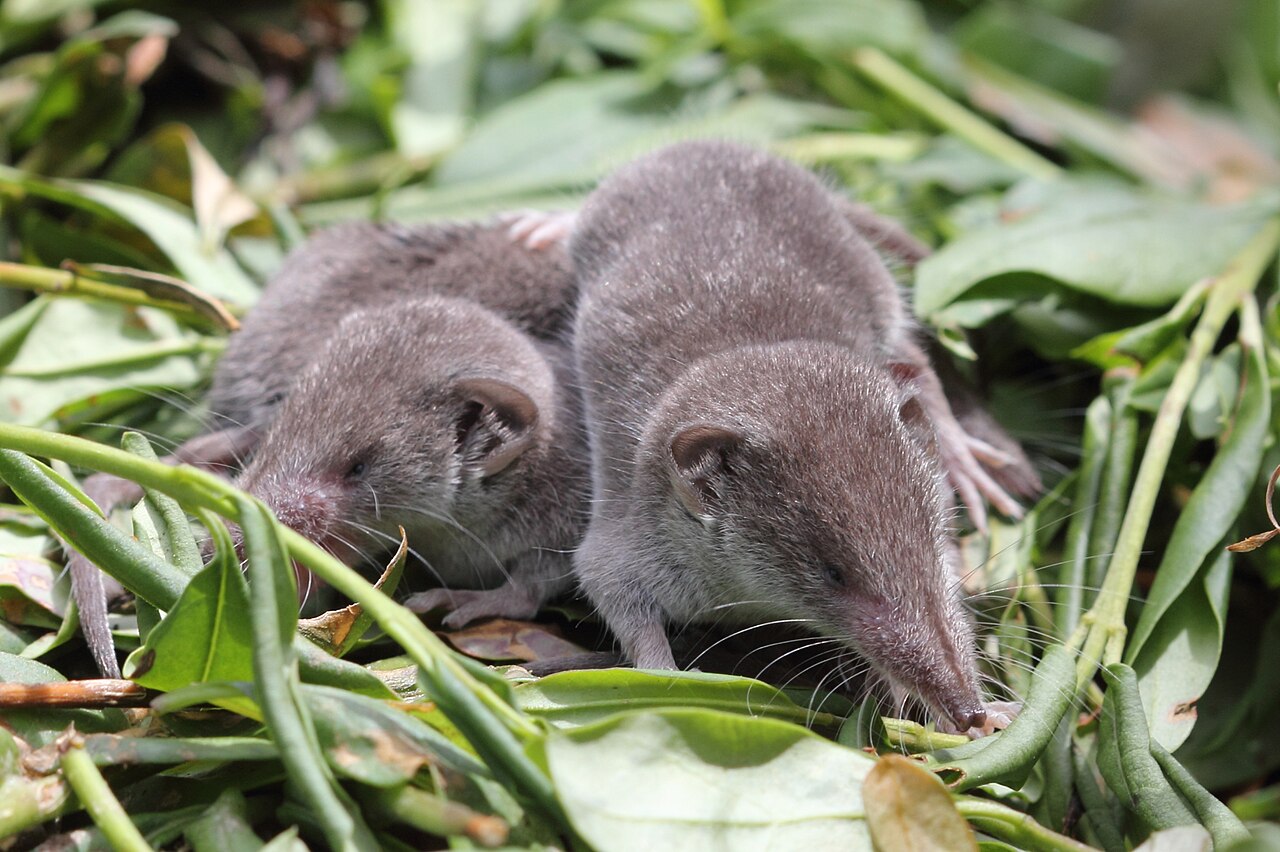
The young
Identification
A medium-sized shrew with soft, moderately dense fur. The back is highly variable in colour, from reddish brown to grey, with a yellowish-grey hair base; the belly is paler, greyish white to grey. Characteristically, the transition between back and belly is gradual and does not form a line: the back colour shades gradually down the flank. The ears are large and stand clearly out of the fur, the feet are dark but lighter than the back, and the tail is about half the head-body length, dark brown and set with long, projecting tactile hairs among the short hair. The teeth are pure white. Head-body 4.4 to 8.6 cm (a wide range, because young and adult animals differ greatly), tail 2.4 to 4.7 cm, weight 5 to 16 grams. Animals from North Africa and Gran Canaria are smaller on average.
Similar species
There are two groups of confusion species, with different outcomes. The Bicoloured Shrew (Crocidura leucodon) is about the same size but has a sharp boundary between dark back and white belly, which never occurs in the Greater White-toothed Shrew; a side view is sufficient. More difficult are the small species of the suaveolens group: the Lesser White-toothed Shrew and the taxa split from it, Crocidura fimbriata, C. iculisma and C. gueldenstaedtii. The Greater White-toothed Shrew is only larger on average, with a proportionally shorter tail and a broader head. That difference applies to series, not to individual animals: a large Lesser and a small Greater White-toothed Shrew overlap completely, and where both occur (south-western France, northern Italy, northern Iberia) the tooth row, skull or DNA decides. The red-toothed shrews (Sorex) can be separated: red-brown tooth tips, three colour zones with a distinct flank band, small ears sunk in the fur and a tail without projecting tactile hairs. Savi's Pygmy Shrew (Suncus etruscus) weighs about two grams and is much smaller. Indoors: a House Mouse has a blunt muzzle, large eyes and gnawing incisors, which can be seen at a metre's distance.
Habitat
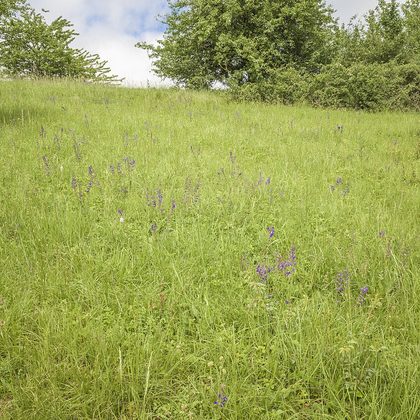
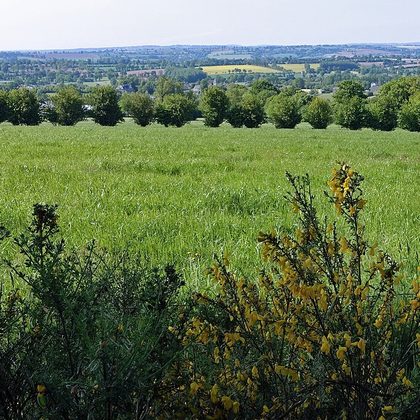
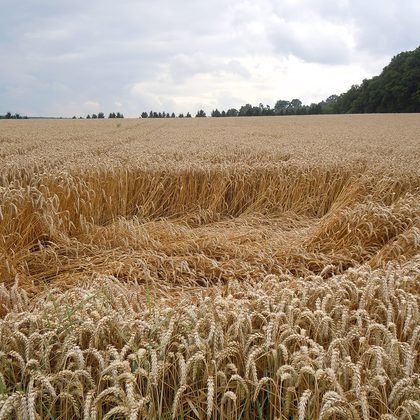
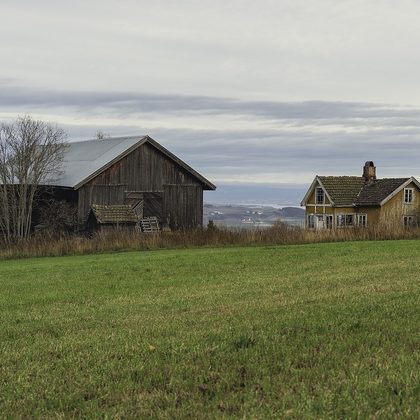
Broad, with a clear preference for small-scale farmland: mesic grassland and woodland edges with a dense herb layer, hedgerows, shelterbelts, verges, field margins, orchards, allotments and gardens, in the south maquis and scrub, and above all old agricultural terraces with dry stone walls, which provide runs, cover, warmth and insects. Along streams and rivers, up to about a thousand metres. In the north of its range and higher in the mountains the species is largely commensal, living in and around houses, sheds, cellars and compost heaps. The Gran Canaria population lives in remnants of laurel forest and in extensively farmed land.
Where the animal is most at home, classified with EUNIS — the European standard for habitats.



Distribution
Western and south-western Europe: Germany, Belgium, the Netherlands, Luxembourg, northern and western Switzerland, France, Spain and Portugal, with many offshore islands, and in North Africa northern Morocco and northern Algeria. In the Iberian Peninsula the species occupies almost the entire mainland and is one of the commonest shrews in the agricultural mosaic. In the Netherlands it occurs throughout the country and is absent only from Vlieland and Terschelling. On Gran Canaria lives a population that was long regarded as a separate species (Crocidura osorio) but on closer study proved to belong to the Greater White-toothed Shrew; it was almost certainly introduced by people. The same applies to the most recent expansion: in 2008 the species was first reported from Ireland, where it is not native and has been spreading since, and in 2021 came the first record in England. In the Channel Islands it occurs on Guernsey and Herm; Jersey and Sark have the small species of the suaveolens group.
- Native
- dark = core range, pale = thinly spread
Way of life
The species forages in leaf litter and is active in short bouts around the clock, with peaks at dusk and dawn. The diet consists mainly of invertebrates (insects, earthworms, centipedes, spiders, snails and slugs), supplemented with plant material and occasionally a young mouse or a lizard; in Algeria a seventh of the biomass eaten consisted of lizards, geckos included. About half its own body weight is eaten daily. Unusual for a shrew is its social behaviour: the species is monogamous, male and female stay together throughout the season and both care for the young. In winter home ranges overlap strongly and several animals share one nest, where they enter torpor together: a short, shallow drop in body temperature and metabolism that saves more energy the more animals share the nest. This is not hibernation. The winter shrinkage of the skull known in Sorex as Dehnel's phenomenon has not been established in this genus. There is one breeding season, from March to September and in the Mediterranean region from February to November, with up to four litters a year of two to ten young after a gestation of 28 to 33 days; the young are independent at thirteen to twenty days. Mainly the females disperse, while the males stay close to their birthplace; in most mammals it is the other way round. In the wild a Greater White-toothed Shrew rarely lives longer than eighteen months.
Where and when to look
Look for the species in gardens and farmyards. Lay a plank or a sheet of corrugated iron on a sunny, rough spot in a garden or along a field edge and lift it every few weeks: underneath there are often runs, droppings and sometimes a nest. Listen on summer evenings for the sharp squeaking along compost heaps and walls. In winter the shed is the best place; a live trap baited with cat food, checked every hour through the night, produces records where other methods fail, but only in the hands of trained and licensed people, because a shrew dies in a trap left too long. If an animal caught by a cat is still alive, release it into cover and photograph it from the side so that the flank is visible. Keep records: because of the recent splits, old reports of this species from the edges of its range are worth checking.
Conservation status
Least Concern (LC, 2016) and very common throughout its wide range; it is also listed as not threatened on the Dutch Red List. It tolerates habitat loss better than most small mammals, because field margins, gardens and sheds serve as habitat. The species is, however, sensitive to toxins: near runoff from pyrite mines in Europe it accumulates heavy metals in liver and kidneys, and in intensive arable farming the loss of insects has immediate consequences, because it cannot go a day without food. Important issues lie outside the core range. In Ireland the introduced Greater White-toothed Shrew is displacing the native Pygmy Shrew, which disappears from areas where the Greater White-toothed Shrew becomes established; this is a well-documented case of displacement between two small mammals in Europe, and a reason to follow developments in Britain. Taxonomically: now that Crocidura pachyura of Sardinia, Ibiza and Pantelleria has been split off as a separate species and the range of the Greater White-toothed Shrew has become smaller as a result, the populations at the southern and eastern edges still listed under this name require revision.
Scientific name
Crocidura russula | (Hermann in E. A. W. von Zimmermann, 1780)
Hermann in E. A. W. von Zimmermann described the species in 1780 as sorex russulus; because it was later moved to another genus, the author and year stand in brackets. Crocidura is Greek, from krokys, genitive krokydos, 'flock of wool, nap', and oura, 'tail', after the long loose hairs standing out among the short ones on the tail. russula goes back to Hermann's russulus, a Latin diminutive of russus, 'red', hence 'reddish', after the red-brown coat. The specimen the first description was based on came from France, Bas Rhin.