All species › Hedgehogs, shrews and moles › Shrews › Sicilian Shrew
Sicilian Shrew | Crocidura sicula
Siciliaanse spitsmuis | Musaraña De Sicilia
The Sicilian Shrew is a white-toothed shrew of Sicily, Gozo and a few smaller islands. The species was originally distinguished on its chromosomes: Sicilian animals have thirty-six, a number that differs from that of the species on the Italian mainland. Molecular work places the origin of the species in North Africa; its closest relatives live in the Canary Islands and on the Moroccan Saharan coast.
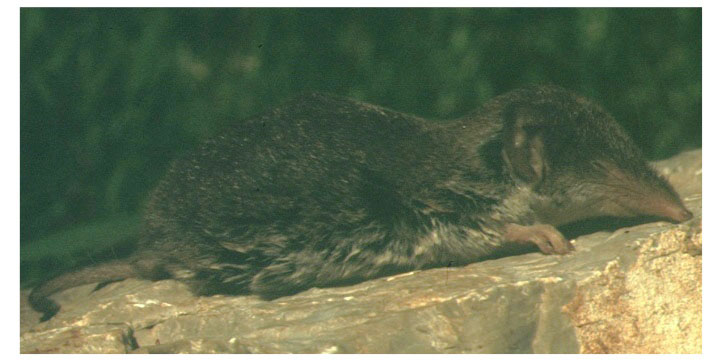
Tracks
No signs specific to this species have been described; the following applies to the genus. The dropping is two to four millimetres long, dark, pointed and glossy with chitin remains, and lies hidden under a stone, a roof tile or a plank; on Sicily the foot of an old terrace wall is the first place to look. The runs are half a centimetre to a centimetre and a half wide and pass through the litter layer, under dead wood and between stones; small round openings at the foot of a wall belong with them. A print of barely a centimetre, with five toes on both fore and hind foot, registers only in very fine damp silt. The voice is high, shrill and rapidly repeated, at the upper limit of what an adult ear perceives. The richest source of data is the pellet: the occurrence of the Gozo subspecies on Comino rests entirely on Long-eared Owl pellets, and on Sicily analysing Barn Owl pellets is the cheapest method of filling in the distribution.
Identification
A medium-sized white-toothed shrew with pure white teeth, a pointed, mobile snout, very small eyes, ears projecting from the fur and a tail with long projecting bristle hairs. The back is grey-brown, the underside whitish grey to white, and on the flank a clear dividing line runs between the two; this is unusual for the genus, but because no other Crocidura occurs on the islands, it is of no importance for identification. The tail is distinctly two-toned and usually has a white tip; fore and hind feet are whitish, on Gozo bright white. Young animals show more contrast than old ones. Head-body 5.0 to 7.9 cm, tail 2.8 to 4.5 cm, ear 6 to 10.5 mm, weight 4 to 10.5 grams; the animals of the Egadi Islands and of Gozo are smaller than those of Sicily. The Ustica population is melanistic, dark grey-brown to grey-black and without a white tail tip, possibly an adaptation to that island's black volcanic rock.
Similar species
Within the range every shrew of the genus Crocidura on Sicily, Ustica, the Egadi Islands and Gozo is this species. There is no second Crocidura and there are no Sorex species; the only other shrew is Savi's Pygmy Shrew (Suncus etruscus), which at about two grams, with a proportionally longer tail and a much smaller head, is immediately distinguishable. On the Italian mainland and on Sardinia there are species that look alike in the hand: the Greater White-toothed Shrew, Crocidura pachyura and C. fimbriata. There separation is by locality, not appearance; none of these three has been recorded on Sicily. The sharp flank line is not an identification character: the Bicolored Shrew also has one, and does not occur on the islands. To separate this species from an animal brought in from the mainland, laboratory analysis is needed: the karyotype of 2n = 36 is decisive, and also the shape of the tooth row, in which the tips of the second and third upper unicuspids line up with the tip of the massive, rectangular parastyle.
Habitat
Not specialised, from sea level to about a thousand metres: open woodland, maquis and garrigue, farmland margins, olive and citrus groves, gardens and the edges of villages and towns. The limiting factor is moisture: in summer the species moves to the dampest places, such as stream valleys, springs, irrigated plots and north-facing slopes with a deep litter layer. Old terraces with dry stone walls provide cover, warmth and insects.
Where the animal is most at home, classified with EUNIS — the European standard for habitats.




Distribution
Sicily and the island of Ustica, the Egadi Islands (Favignana, Levanzo and Marettimo) and, in the Maltese archipelago, Gozo and probably Comino. The species also occurred on Malta itself, where it is almost certainly extinct. It does not occur outside these islands. Molecular work places the origin of the species in North Africa and makes it the sister species of the pair Crocidura canariensis of the Canary Islands and C. tarfayensis of the Moroccan coast, not of the European species. On Sicily and Malta a larger form, C. s. esuae, lived in the Middle Pleistocene; it is extinct and may have been the direct ancestor of the present animals.
- Native
- dark = core range, pale = thinly spread
Way of life
Ground-dwelling, active both by night and by day, with the emphasis on the dark hours. The species can enter torpor, a short, shallow drop in body temperature and metabolism, which is linked to the dry, food-poor summers on the islands. It does not hibernate, and the winter skull shrinkage known in the red-toothed shrews (Sorex) as Dehnel's phenomenon has not been established in the white-toothed shrews. The diet consists of invertebrates: mainly caterpillars and beetles, also millipedes, earthworms and snails. A litter holds three to nine young; life span in the wild is twelve to eighteen months. Numbers follow a seasonal pattern opposite to that of most European small mammals: low from May to September and high in winter. This is linked to the Mediterranean climate, in which summer is dry and food-poor and winter wet.
Where and when to look
The best period is November to March, when numbers are highest and the ground is damp enough to keep the animals at the surface. Search along old terrace walls in the Sicilian hills, in citrus and olive groves and along streams, and walk a path with leaf litter with a torch after dark; the high squeaking is often heard before any movement is seen. On Gozo every Crocidura belongs to the subspecies calypso; on Ustica the aim is a photograph of a dark animal without a white tail tip. The most reliable method remains the analysis of pellets: Barn Owls breed on Sicily in churches, ruins and pumping stations, and one evening of pellet analysis yields more distribution data than a week of fieldwork. Prey brought in by cats on the small islands also often provides the first evidence that the species is still present.
Conservation status
Least Concern (2016). The species is distributed throughout Sicily, but at much lower densities than the Crocidura species of other Mediterranean islands; this is the only established fact about its numbers, and the trend is unknown. On Malta itself it has almost certainly disappeared, leaving the subspecies calypso of Gozo as a single-island population; it is protected under Maltese and European law. Threats listed are pesticides in farmland and, on the small islands, feral and domestic cats, which on an island of a few square kilometres can greatly reduce an isolated population. The species is listed in Appendix III of the Bern Convention; there are no further measures. Data on numbers, trend and distribution on the small islands are lacking, so that a disappearance such as that on Malta can go unnoticed.
Scientific name
Crocidura sicula | G. S. Miller, 1901
G. S. Miller described the species in 1901 and placed it straight away in the genus where it still stands. Crocidura is Greek, from krokys, genitive krokydos, 'flock of wool, nap', and oura, 'tail', after the long loose hairs standing out among the short ones on the tail. sicula is Latin for 'Sicilian', after the island from which Miller described the animal. The specimen the first description was based on came from Italy, Sicily.