All species › Carnivores › Dogs, wolves and foxes › Blanford’s fox
Blanford’s fox | Vulpes cana
Afghaanse vos | Zorro de Blanford
Blanford's Fox is a small fox of dry, rocky mountains in the Middle East and Central Asia. Within the guide area it is known from the slopes around the Dead Sea and from the mountains near Eilat. Genetically it is the closest relative of the Fennec Fox; the two lineages are estimated to have diverged three to four million years ago.
No photograph of a living wild animal of this species with a suitable Creative Commons licence exists. Do you have one that meets the rules? Send it in.
Tracks
No descriptions of prints or scat of this species were found in the sources consulted. The hairless soles and sharp, semi-retractile claws distinguish the foot from those of Rüppell's Fox and the Fennec Fox, which have densely furred soles.
Identification
A small fox with a long, very bushy tail about three quarters of the head-body length. The head is orange-buff, especially in winter, with a slender face and a dark band from the muzzle to the inner corner of the eye. The ears are large, pale brown on both sides, with long white hairs along the front edge. The body is brownish grey, fading to pale yellow on the belly. A black mid-dorsal stripe runs from the nape along the back and continues as a crest along the whole tail; the tail tip is usually black, white in some individuals. The winter coat is soft and woolly, with dense black underfur and white-tipped hairs on the back; the summer coat is thinner and paler. Unlike the other foxes of the Middle Eastern deserts, the soles are hairless and the claws curved, sharp and semi-retractile, like a cat's. The sources consulted give contradictory values for head-body length, which has therefore been left open.
Similar species
Rüppell's Fox occurs in the same regions but is sandy-coloured, has a white tail tip and furred soles, and lives on flat sand and gravel plains rather than steep rocky slopes. The Red Fox is much larger and redder, with black backs to the ears and black fronts to the legs. The Fennec Fox lives in sandy desert, has proportionately even larger ears and a shorter tail, and within the guide area occurs only in North Africa. A small fox with a long, bushy tail on a steep rocky slope points to this species.
Habitat
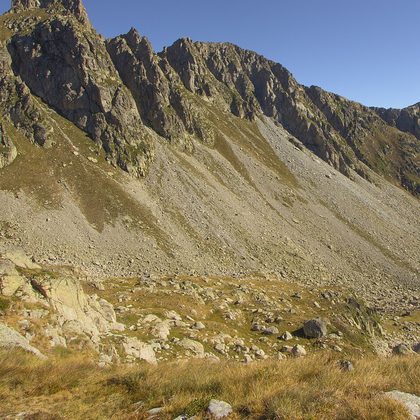
Steep, rocky slopes, cliffs and canyons in semi-arid steppe and mountains, up to about 2000 m. In the guide area this means the cliffs and wadis along the Dead Sea and the mountains near Eilat. Open sand plains and the lowlands between the mountains are not inhabited.
Where the animal is most at home, classified with EUNIS — the European standard for habitats.


Distribution
The Middle East and Central Asia: Israel, Jordan, Sinai in Egypt, Saudi Arabia, Oman and the United Arab Emirates, and further Iran, Afghanistan, Pakistan, Tajikistan, Turkmenistan and Uzbekistan. The guide area touches only the north-western edge of the range; records within it come almost entirely from Israel, with a few from Jordan.
- Native
- dark = core range, pale = thinly spread
Way of life
Strictly nocturnal; activity begins closely after sunset, and the animals are active for eight to nine hours a night, irrespective of the length of darkness, covering on average about 9 km. The strict nocturnality is interpreted as protection against diurnal raptors. Blanford's Fox hunts alone. Its food consists mainly of insects, such as beetles, locusts, ants and termites, and fruit, including that of the caper bush. Mating takes place from December to February; after a gestation of 50 to 60 days one to three young, on average two, are born in March or April. The species does not hibernate.
Where and when to look
A sighting requires a night at a known site: a wadi or rocky slope around the Dead Sea or near Eilat, with a torch that is not shone directly into the animal's face. The first hours after sunset give the best chance. Look for the long tail with its black crest and the dark stripe from muzzle to eye.
Conservation status
Least Concern (LC, 2015). Fully protected in Israel and locally common in the south-east, with estimated densities of about 2 per km² at Ein Gedi and 0.5 per km² at Eilat; much of its habitat there lies within protected areas. Hunting is banned in Jordan and Oman; no legal protection is known in Egypt, Saudi Arabia, the United Arab Emirates, Iran, Afghanistan or Pakistan. Development along the shores of the Dead Sea is cited as a possible threat to its habitat.
Scientific name
Vulpes cana | Blanford, 1877
Blanford described the species in 1877 and placed it straight away in the genus where it still stands. Vulpes is the Latin word for 'fox'. cana is Latin for 'grey, hoary', after the silvery coat; Blanford still wrote canus, but since Vulpes is feminine the adjective has to be cana. The specimen the first description was based on came from Pakistan.