All species › Hedgehogs, shrews and moles › Moles and desmans › Blind Mole
Blind Mole | Talpa caeca
Blinde mol | Topo Ciego
The Blind Mole is one of the smallest European moles and the only one with a range divided between two peninsulas: the western Alps and the Apennines on one side of the Adriatic, the mountains of the western Balkans on the other. Wherever it occurs a larger mole species is also present, and the Blind Mole is there as a rule the less common one: it occupies the margins of the landscape, high in the mountains, in karst dolines and on slopes the larger species does not use.
No photograph of a living wild animal of this species with a suitable Creative Commons licence exists. Do you have one that meets the rules? Send it in.
Tracks
The only regular sign is the molehill, and it is smaller than the Common Mole's: a hill holds 1.3 to 5 kg of excavated soil. The tunnels are 4.4 to 5 cm across and usually lie 10 to 20 cm deep; in woodland with loose soil they descend to 25–35 cm. The hills themselves cannot be told from those of other moles: a run of small molehills in a karst doline or on a mountain slope above 1000 metres is an indication but not proof. No other signs have been described for this species; the animal comes above ground only rarely.
Identification
The Blind Mole has the same cylindrical build, the same digging spades and the same velvety coat that lies in any direction as other moles, but with a head-body length of about 10 to 12 cm and a weight of 40 to 65 grams clearly smaller and lighter than the Common Mole. The fur is blackish grey and is described as somewhat glossier. The eyes are always covered by skin: there is no eyelid slit, only a membrane over the eye, which can be seen with a lens on a dead animal. The rhinarium is smaller than in the Common Mole. Males are 13 to 25 per cent larger than females, and size varies by region and with altitude: in the Balkans and wherever a larger mole lives nearby, animals average smaller. The measurements above are from Swiss animals. Internally the species has its own chromosome number (2n = 36, against 34 in the other European moles), and the pelvis is usually of the so-called caecoid type, with the fourth sacral foramen open at the rear ; these characters can only be established in the laboratory.
Similar species
Externally almost nothing separates this species from the other Talpa species; size and locality are the only field clues. Against the Common Mole (Talpa europaea), with which it shares the Alps and the western Balkans, the eye decides: the Common Mole has a small eyelid slit, while in the Blind Mole the eye lies entirely beneath the skin; the Blind Mole is also smaller, with a narrower snout. The Roman Mole (Talpa romana) of central and southern Italy is its closest relative and also has covered eyes, but is clearly larger and heavier, with a massive skull. In the southern Balkans the same holds for the Balkan Mole (Talpa stankovici): covered eyes as well, but larger. Where two species share a region they seldom live at exactly the same spot: the Blind Mole usually occupies the places the larger species does not use. Certain identification rests on skull, teeth or DNA.
Habitat
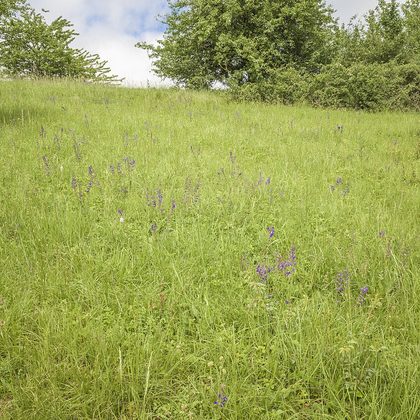
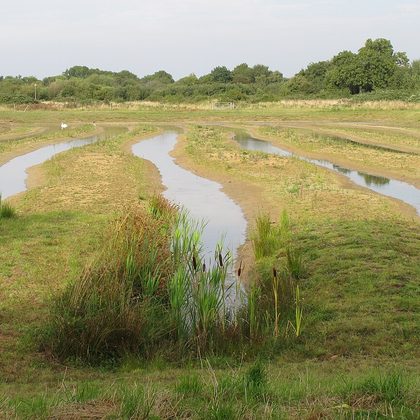
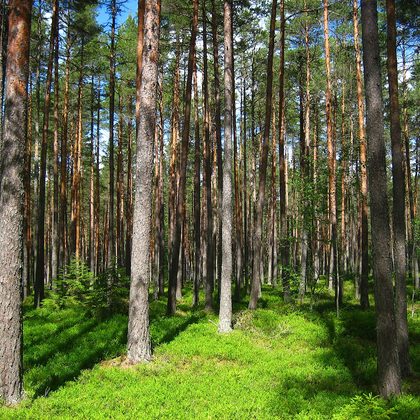
A wide range of habitats, provided the soil is deep and loose enough: the species prefers deep sandy, sandy-loam and loam soils and avoids hard, dry pastures. It lives in mountain pastures with thin soil and in mesic forests with deep, light soil, from chestnut, oak and beech to silver fir, pine and spruce, and has been caught in thickets of juniper, hazel and bramble. On floodplains it occupies reedbeds and rush meadows and woods of white poplar, willow, alder and manna ash. North-facing slopes often offer better conditions than the drier south-facing ones, and in the karst of the western Balkans suitable soil is often found only on the floor of dolines. It ranges from sea level (5 m on the Dalmatian coast) to about 2200 m, exceptionally 2500 m; the centre of gravity lies above 1000 m.
Where the animal is most at home, classified with EUNIS — the European standard for habitats.



Distribution
The range consists of two separate parts. The western part covers the western Alps — Switzerland, north-west Italy and south-east France — and the Apennines of Italy as far south as the Sila massif in Calabria. The eastern part lies in the broken mountain country of the western Balkans: south-east Bosnia and Herzegovina, adjacent Dalmatia, Montenegro, Kosovo, western North Macedonia, Albania and western Greece. Genetically the two halves are clearly distinct: a western lineage in Italy and Switzerland and an eastern one in the Balkans. Throughout its range the species lives alongside a larger mole — the Common Mole in the Alps and western Balkans, the Roman Mole in Italy, the Balkan Mole in the southern Balkans — and is usually the less common of the two.
- Native
- dark = core range, pale = thinly spread
Way of life
The Blind Mole lives almost entirely underground and surfaces only occasionally. Little is known of its way of life. Earthworms have been found in stomach contents. Breeding presumably begins in spring; a lactating female has been caught at the end of May. The data on social organisation contradict each other: some authors describe the species as solitary and territorial, while three to six animals of both sexes and different ages have also been caught in a single burrow system. No specific daily rhythm has been described. Its smaller size lets it get by where food is scarce, which probably explains why it occupies the marginal places that larger moles do not use.
Where and when to look
Search in places where the larger mole species is absent: high mountain pastures, karst dolines, north slopes and woods with loose soil, especially above 1000 metres. Small molehills there are a pointer, not proof. A dead animal, left for instance by a cat or a bird of prey, is the best chance of certainty: check the eye with a lens — an eye lying entirely beneath the skin rules out the Common Mole — and note size, weight and locality. Compared with the Roman and Balkan Moles, size and locality are the clues; a definitive identification needs the skull or DNA.
Conservation status
Least Concern (LC, 2024). The range is large and includes much mountain country where the soil is little worked. At the same time the Blind Mole is everywhere the less common of two mole species, with populations often confined to marginal sites such as dolines and high pastures, and knowledge of its numbers and way of life is limited. The Red List assesses the species as a whole; the two genetically distinct halves of the range have no assessment of their own.
Scientific name
Talpa caeca | Savi, 1822
Savi described the species in 1822 and placed it straight away in the genus where it still stands. Talpa is the Latin word for 'mole'. caeca is Latin for 'blind'; in this mole the eye is grown over by the skin. The specimen the first description was based on came from Italy, Pisa.