All species › Rodents › Voles and hamsters › Cabrera's Vole
Cabrera's Vole | Microtus cabrerae
Cabrerawoelmuis | Topillo de Cabrera
Cabrera's Vole is the only living member of the subgenus Iberomys, a lineage that split off on the Iberian Peninsula in the Middle Pleistocene and survives only there. It is a large, selectively grazing vole of damp, evergreen grass tussocks. Of the Iberian voles it is the heaviest and the only one on the Red List. Unlike most other voles, the species can be identified reliably.
No photograph of a living wild animal of this species with a suitable Creative Commons licence exists. Do you have one that meets the rules? Send it in.
Tracks
In Spain and Portugal the species is monitored not with traps but through its droppings; for a European mammal this is unusual. The droppings are 4 to 8 millimetres long, cylindrical and strikingly dark green, the result of a diet consisting almost entirely of fibrous evergreen grass. They are not scattered but lie in latrines: clusters of three or more droppings of different ages, within ten centimetres of one another, at a fixed point on a run, used repeatedly. According to Portuguese research, three minutes of searching per two hundred and fifty square metres is sufficient to detect the species with better than eighty-five per cent certainty where it is present; deriving numbers requires much more effort and even then remains a coarse index. Latrines lie along the runways, swept tunnels through the base of tall grass tussocks and rushes, and near the heaps of clipped grass left beside the runways. There are burrows too, but they are shallow and few; the animals live mainly above ground in the dense grass. In summer search the wettest part of the tussock, because the animals withdraw there.
Identification
Large and heavy for a vole: head-body 10 to 13.5 cm and 30 to 78 grams, one and a half to nearly five times as heavy as the small Iberian pine voles. The tail measures 3 to 5.2 cm, about a third of the head-body length. The fur is long, soft and dense, buffy wood-brown with long black guard hairs tipped or banded buff or white, which gives the back a grizzled, coarse appearance at close range; the belly is yellowish cream. The ears are moderately long and project clearly from the fur, the eyes are rather small and the skull is strongly convex in profile. Two characters are decisive in the hand: a hind foot of more than twenty millimetres (shorter in all other Iberian Microtus) and the number of plantar pads: six, against five in all others. The upper incisors are markedly opisthodont.
Similar species
The species shares its range with four other voles; against all four size is the first character: it is distinctly larger and heavier and has a long, coarse coat where the others have a smooth one. The Mediterranean and Lusitanian Pine Voles are much smaller (19 to 32 grams), with very small eyes, short ears hidden in the fur and a much shorter tail; they live underground and throw up soil, whereas Cabrera's Vole hardly digs and moves above ground through the vegetation. The Common Vole is smaller, yellower and smoother and lives in short, dry, grazed grassland, whereas this species needs tall, evergreen grass; in the hand the hind foot and the sixth plantar pad are decisive, and on the skull the zygomatic arch of Cabrera's Vole is about 1.3 times as wide. Microtus lavernedii, the Mediterranean Field Vole, is shaggier and darker but lighter, with small hidden ears and five plantar pads. At a distance, as the species is usually seen, the combination of size, projecting ears and the habitat (a dense, tall, evergreen tussock along a ditch or brook) is almost decisive. In addition the species leaves a distinctive sign: dark green droppings in latrines.
Habitat
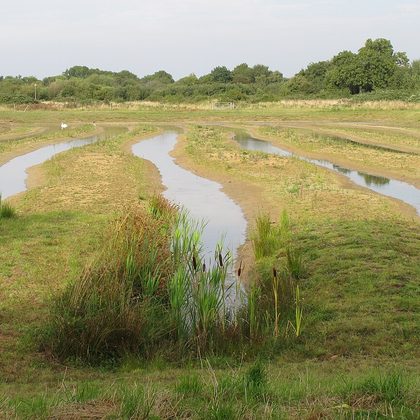
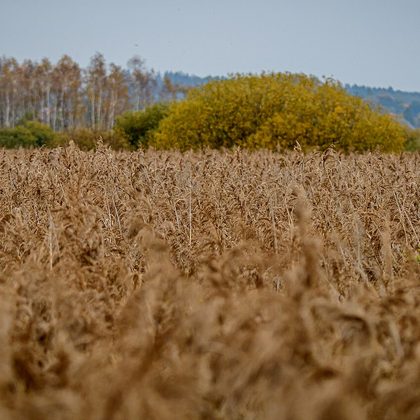
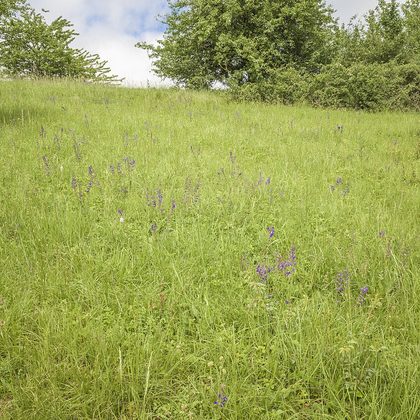
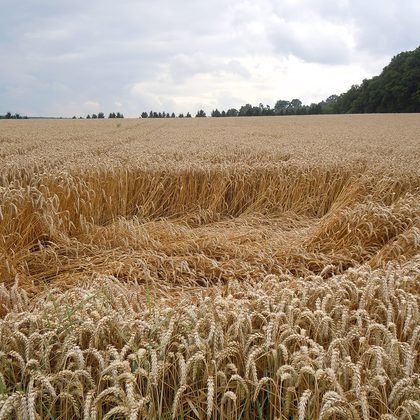
The habitat is narrowly defined: tall, dense, year-round green herbaceous vegetation on damp soil, usually over thirty centimetres high, in a Mediterranean climate with 600 to 1200 millimetres of rain. In practice these are narrow margins that receive water all year: a brook edge, a pond edge, a ditch, an irrigation channel or a field margin over a high water table. The vegetation is a mixture of bent, oat-grass, brome, fescue, quaking grass, reed and cattail, often with bramble, rockrose, gorse or lavender at the edge. The species prefers natural grassland to scrub, pine plantation, cropland and sown grassland, and occurs from sea level to about 1500 metres, mostly between 500 and 1200 metres. Much of its range lies in the dehesa, the cork-oak wood pasture, and in small-scale farmland with scattered woodlots.
Where the animal is most at home, classified with EUNIS — the European standard for habitats.


Distribution
Endemic to the Iberian Peninsula: Spain and Portugal. The range is not continuous but consists of four or five separate cores (central Spain and the Iberian System, southern Spain and the Baetic ranges, the Levante around Valencia and Murcia, south-western Spain with the adjoining Portuguese Alentejo, and the north-west), and within each core of hundreds of separate patches, some smaller than two thousand square metres. Fossils show that the range was formerly much larger: until one to two thousand years ago the species also occurred in southern France, on the northern side of the Pyrenees, and in the Pleistocene the lineage reached north-western Italy. The range is still contracting.
- Native
- dark = core range, pale = thinly spread
Way of life
Mainly diurnal: between October and April activity peaks around midday, between May and September at dawn and dusk; over the year activity is highest in winter. At high temperatures it lets its body temperature rise rather than use water for cooling. Almost wholly herbivorous and distinctly selective: leaves, stems and seeds of monocotyledons (grasses, sedges, rushes and lilies), preferring some species and actively avoiding others. The species lives in small colonies averaging about two thousand square metres, with home ranges of forty to a thousand square metres; the core in which an animal spends half its time may be no larger than a few square metres. The mating system is largely monogamous, and after birth the male stays with the female and young. Breeding is not tied to a season but is more intensive in winter and stops during summer drought; after three weeks' gestation three to five young are born, blind, deaf and naked, with eyes open on day eleven and weaned at fifteen days. The species depends on dispersal: colonies die out and are re-established, and an animal can travel nearly 450 metres in a night and more than a kilometre over a few months.
Where and when to look
In winter or early spring, preferably around midday, walk along a ditch or brook in a Spanish or Portuguese dehesa and look for a tall green tussock that stands out in an otherwise parched landscape. Search there not for the animal but for a latrine: dark green droppings in a small heap in a swept tunnel. A latrine shows that the species is present, even if the animal itself is not seen. South-western Portugal, Extremadura and Castilla-La Mancha offer the best chances. Summer is unsuitable: the vegetation is then grazed off or dried out, the animals are in the wettest spots and breeding has stopped.
Conservation status
Near Threatened (NT, 2024) globally and Vulnerable on the national red lists of Spain and Portugal; the species is listed on Annexes II and IV of the Habitats Directive and in the Bern Convention, and Andalusia runs its own recovery programme. The area actually occupied is estimated at about 115,000 square kilometres, divided over a large number of small, mutually isolated patches, and that area is decreasing. The cause is not persecution or hunting but loss of habitat: the damp, unmown, year-round green margin. Drainage, ploughing up to the field edge, canalisation of ditches, higher stocking rates, water abstraction for irrigation, eucalyptus and pine planting, and burning remove those margins. In one Portuguese farmed landscape about a third of colonies die out each year and about half that number are newly established; more than half of local extinctions are directly attributable to agricultural operations. Conservation of the species therefore depends mainly on margin management: leaving a strip a few metres wide along every ditch undisturbed is the most important measure.
Scientific name
Microtus cabrerae | O. Thomas, 1906
O. Thomas described the species in 1906 and placed it straight away in the genus where it still stands. Microtus is Greek, from mikros, 'small', and ous, genitive ōtos, 'ear', after the small ears hidden in the fur. cabrerae honours the Spanish mammalogist Ángel Cabrera (1879–1960), then still a young member of the Madrid museum. The specimen the first description was based on came from Spain, Sierra de Guadarrama.