All species › Even-toed ungulates › Oceanic dolphins › Common bottlenose dolphin
Common bottlenose dolphin | Tursiops truncatus
Tuimelaar | Delfín mular
The Bottlenose Dolphin is a large, robust dolphin of temperate and warm seas worldwide. In Europe it lives from northern Norway to Portugal, in the Mediterranean and, as a separate subspecies, in the Black Sea. Besides animals that range far offshore, there are small coastal populations along the British and Irish coasts, in Portugal and in the Mediterranean that stay in the same bays and estuaries year after year, and these are the Bottlenose Dolphins you see from shore.
Tracks
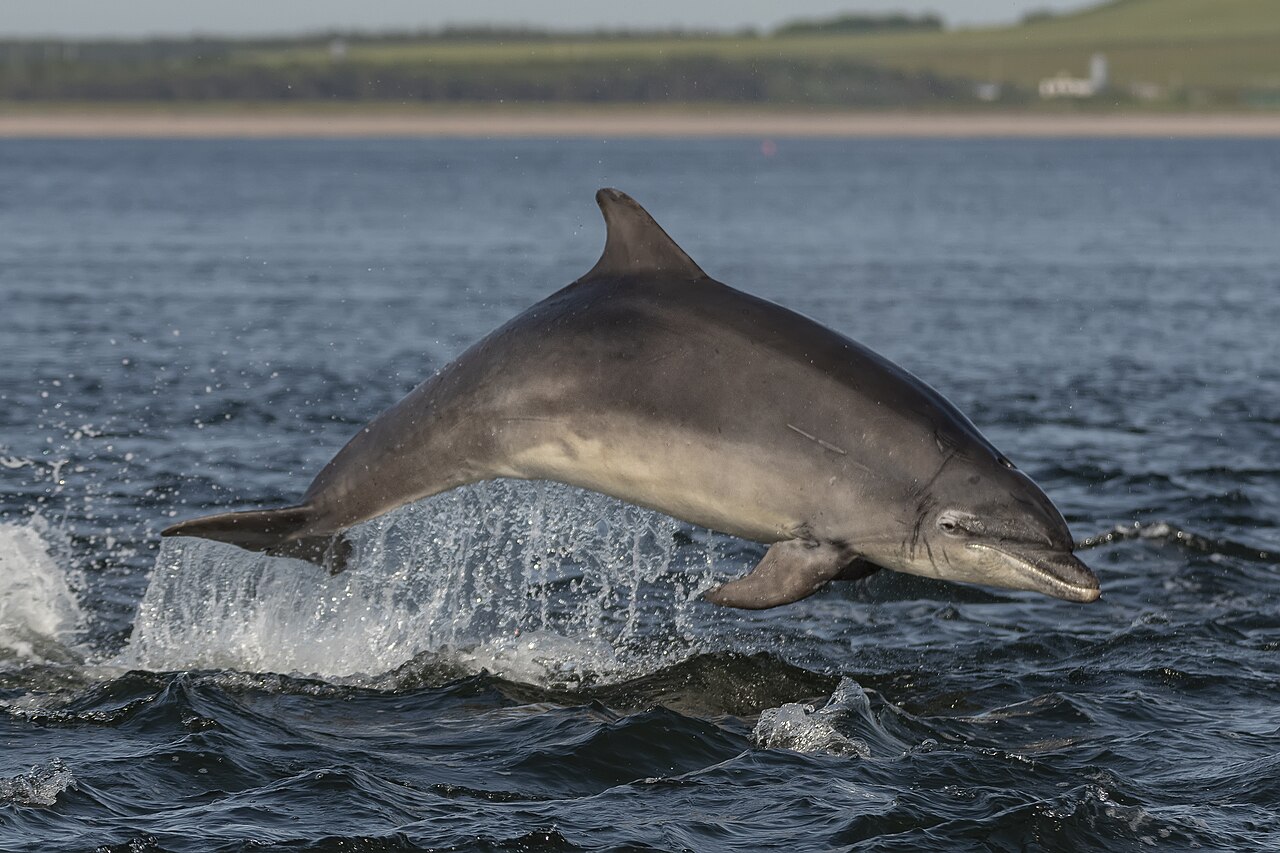
At sea you recognise the Bottlenose Dolphin by its silhouette and behaviour. The blow is short and low and usually invisible; in still weather the exhalation can be heard. On surfacing the head with the short beak often appears first, then the back with the tall, curved fin rolls over; on a deep dive the tail sometimes shows briefly. The species regularly leaps clear of the water, slaps the tail on the surface and rides the bow wave of boats. Groups usually number two to fifty animals; in coastal waters often groups of five to fifteen swimming close together. Bottlenose Dolphins like to hunt in the current off headlands and in river mouths, and can be expected there at fixed places on the falling or rising tide. A feeding group shows rapid changes of direction, splashing and diving seabirds above it.
Identification
Large and heavy for a dolphin, with a short, thick beak separated from the rounded melon by a clear crease. The colour is plain grey to brownish grey, the back darker than the flanks and the belly pale; there is no spotting or hourglass pattern. The dorsal fin is tall, sickle-shaped and set in the middle of the back; in many animals the trailing edge bears nicks by which researchers recognise individuals. The animals in European coastal waters are among the largest of the species: adult Bottlenose Dolphins in British waters are about three to nearly four metres long. At the surface the head with its beak often shows briefly, followed by a high-arched back with the fin.
Similar species
The Harbour Porpoise is half the length, has no beak and a low triangular fin, and rarely leaps. Risso's Dolphin is as large and also has a tall fin, but a blunt head without a beak and a body covered in white scratches; old animals are almost white. The White-beaked Dolphin of the North Sea and North Atlantic has black-and-white and grey panels on the flanks and a white or pale grey beak. The Common Dolphin and the Striped Dolphin are smaller and slimmer, with a long narrow beak and a distinct flank pattern, and usually live in larger, faster groups. A female or young Killer Whale also has a curved fin, but is black with a white eye patch and a grey saddle. At long range a Bottlenose Dolphin whose head is not seen can sometimes not be told from a Risso's Dolphin.
Habitat
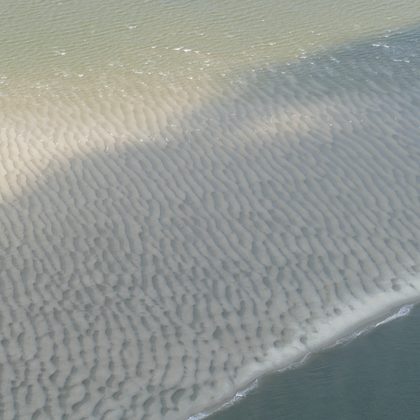
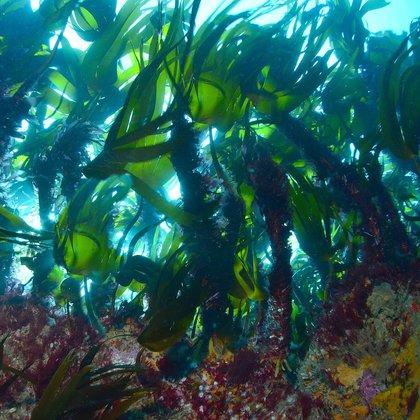
From shallow coastal waters, bays, fjords and estuaries to the open sea over the continental shelf and its slope. The coastal populations use a small area: shallow water with strong tidal current, sandbanks and rocky bottom, close inshore. Offshore animals live over deeper water and range over greater distances. Diet depends on the area: gadoids such as cod, saithe, whiting and haddock, also salmon, sprat, sandeels, flatfish and squid.
Where the animal is most at home, classified with EUNIS — the European standard for habitats.


Distribution
In Europe from northern Norway to Portugal, throughout the Mediterranean and in the Black Sea, where the subspecies T. t. ponticus lives. The number of Bottlenose Dolphins on the continental shelf from Portugal to western Scotland is estimated at about 115,000. In addition there are small resident coastal populations, among others in the Moray Firth in eastern Scotland (about two hundred animals, which also range south along the east coast to Yorkshire), in Cardigan Bay and the Irish Sea (two to three hundred), around the Hebrides, in the Shannon Estuary and off Connemara in western Ireland, along the coasts of Cornwall, Devon and Dorset, and in the Sado estuary near Setúbal in Portugal. In the southern North Sea, where the species was regular until the mid-twentieth century, it is now an irregular visitor, and in the Baltic a vagrant.
- Native
- dark = core range, pale = thinly spread
Way of life
Active by day and night. The Bottlenose Dolphin lives in groups whose membership changes; mothers with calves stay together for long periods, and adult males sometimes form pairs or small alliances. Gestation is about twelve months; in British waters calves are born over a long season, with a peak from May to November. The calf is suckled for eighteen to twenty-four months, and a female calves on average once every four years (two to ten years). Females mature at five to thirteen years, males at nine to fifteen. Males live forty to forty-five years, females up to fifty. The species hunts alone or in groups and adapts its technique to the prey. In the Moray Firth and Cardigan Bay Bottlenose Dolphins have been shown to kill Harbour Porpoises without eating them.
Where and when to look
The best-known place in Europe to see Bottlenose Dolphins from land is Chanonry Point near Fortrose, on the Moray Firth north-east of Inverness: around the rising tide the animals hunt salmon and sea trout in the current there, often a few dozen metres from the shore, from spring into autumn. In Wales you watch from the harbour wall of New Quay over Cardigan Bay; in Portugal boats leave Setúbal for the group in the Sado. In the Mediterranean Bottlenose Dolphins are often seen from coastal ferries and in bays. Look for the tall fin and the short beak; leaping animals are often the first thing noticed from shore. From a boat keep your distance and do not drive through a group: coastal populations are approached by the same boats year after year.
Conservation status
Least Concern (LC, 2019). The Black Sea subspecies, T. t. ponticus, is listed separately as Endangered (EN). The small coastal populations are vulnerable because of their size: the groups in the Moray Firth and Cardigan Bay each number a few hundred animals. Threats are high loads of pollutants such as PCBs, underwater noise, collisions with fast recreational craft and, further south, entanglement in fishing nets. The species is protected under the Habitats Directive, which requires special areas of conservation for it; the Moray Firth and Cardigan Bay are designated as such. It is covered by the ASCOBANS and ACCOBAMS agreements.
Scientific name
Tursiops truncatus | (G. Montagu, 1821)
G. Montagu described the species in 1821 as Delphinus Truncatus; because it was later moved to another genus, the author and year stand in brackets. Tursiops is formed from Latin tursio, in Pliny the name of a dolphin-like sea animal, and Greek -ops, 'face, appearance': 'looking like a tursio'. truncatus is Latin for 'cut short, truncated'. Montagu gave the name in 1821 to an animal from the River Dart; the explanation usually given, worn teeth in the type specimen, has not been checked against the original description. The specimen the first description was based on came from England, Stoke Gabriel (River Dart).