All species › Even-toed ungulates › Oceanic dolphins › Striped dolphin
Striped dolphin | Stenella coeruleoalba
Gestreepte dolfijn | Delfín listado
The Striped Dolphin is a slender dolphin of warm and temperate waters in all oceans. In the guide area it is the dolphin most often seen in the Mediterranean, and it also occurs in the Bay of Biscay and south-west of the British Isles. Between 1990 and 1992 more than a thousand died in the Mediterranean from a morbillivirus.
Tracks
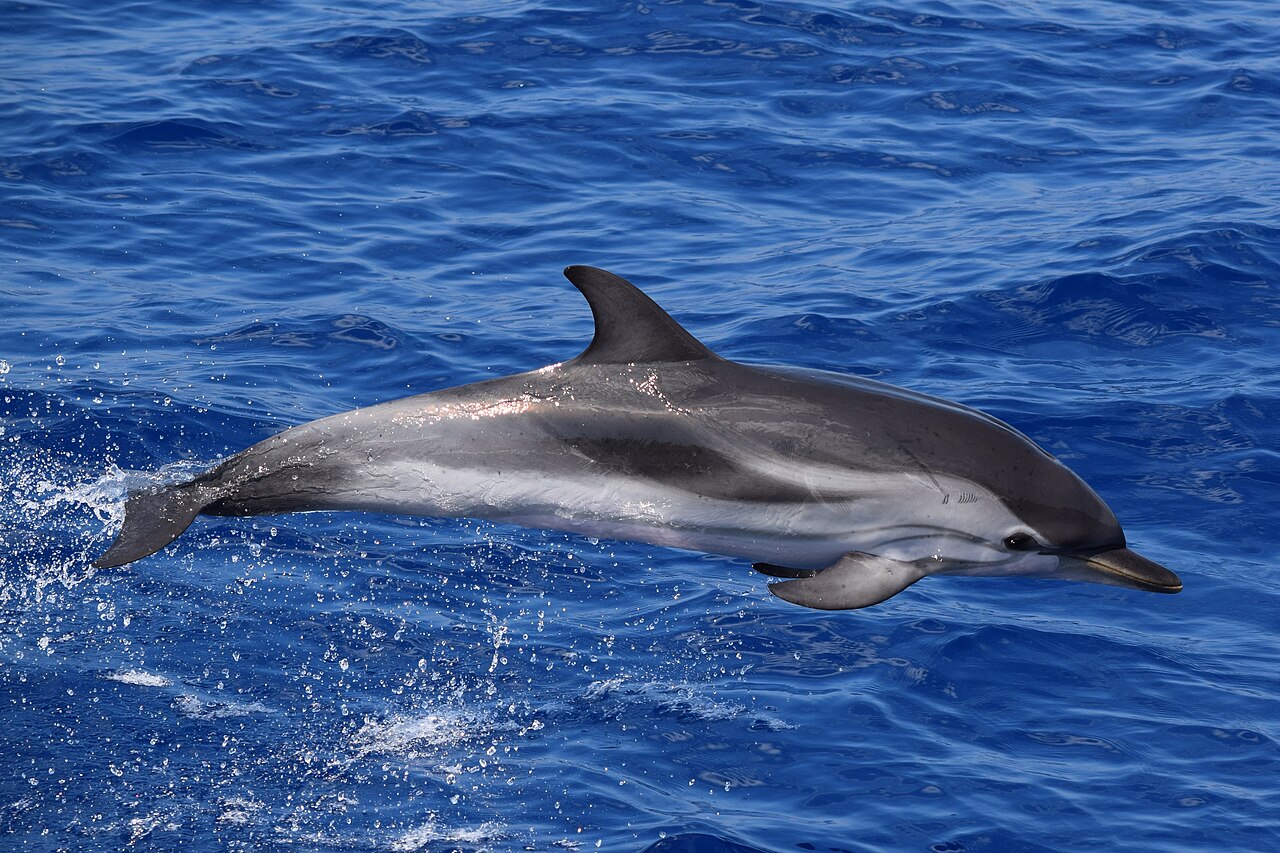
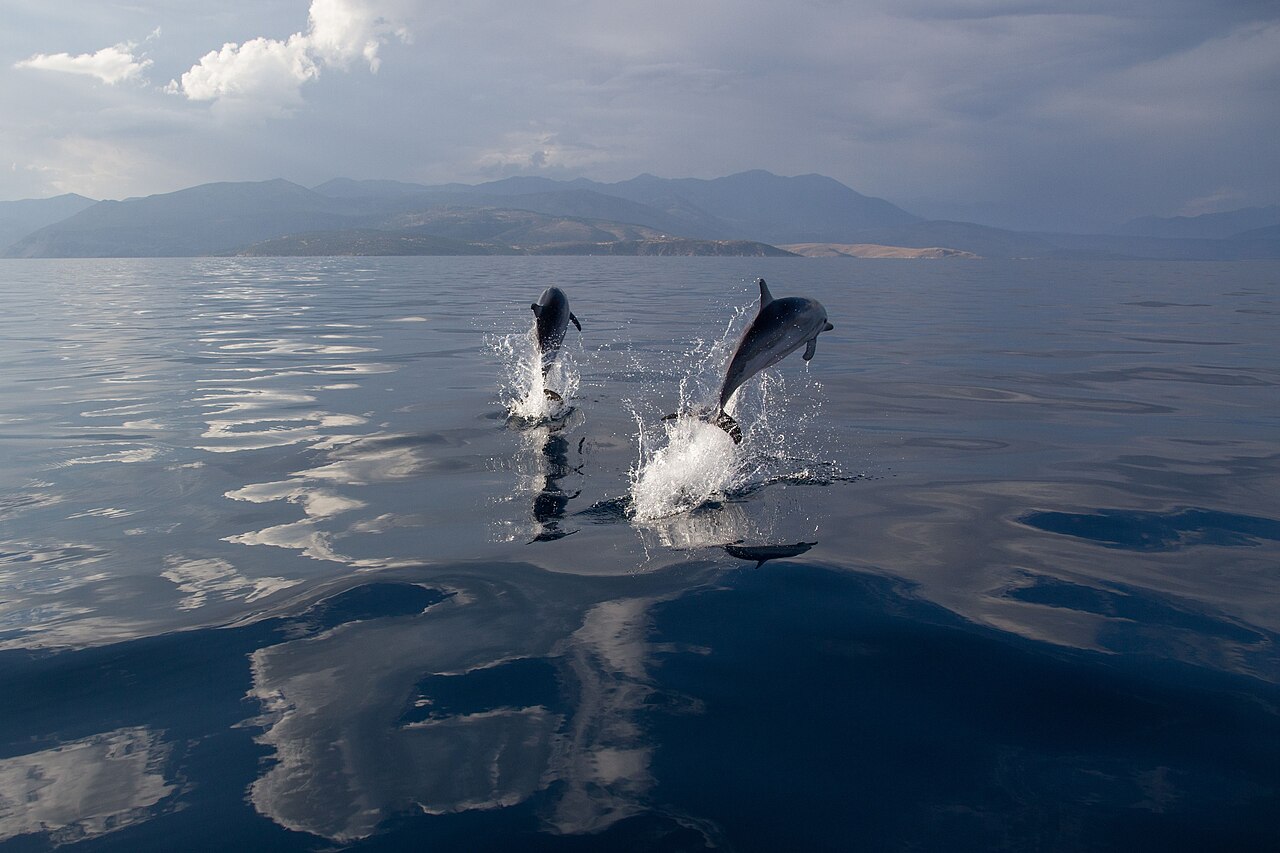
Striped Dolphins are active at the surface: they often leap high and far out of the water, ride the bow wave and slap the water with the chin. A behaviour described for this species is 'roto-tailing': a high leap during which the animal rotates its tail in the air. The blow is not visible. Around the British Isles sightings are of single animals, mixed groups with Common Dolphins or groups of ten to thirty; in the Mediterranean groups are often larger. A fast-swimming group throws up a lot of spray and can therefore be seen at a greater distance than the animals themselves. When swimming quietly they surface low and fast and are harder to follow.
In its habitat
Identification
A slender dolphin with a medium-length dark beak, separated from the forehead by a distinct crease. The back is blue-grey to dark grey, the belly white. Characteristic are two dark stripes: a long stripe from the eye along the flank to the anus, and a shorter stripe from the eye to the flipper. Above them a pale grey blaze sweeps up from the flank towards below the dorsal fin. The dorsal fin is set mid-back and is slender and sickle-shaped to erect; in Atlantic animals it sometimes has a pale spot in the centre. Adults reach 2.56 metres.
Similar species
The Common Dolphin is of similar size and sometimes swims in the same groups, but has an hourglass pattern on the flank with a yellow or ochre front half and a grey rear half; the long side stripe from eye to anus and the pale blaze below the fin are absent. Because both species often surface only briefly, the distinction is surest on a leaping animal or one swimming just below the surface: a yellowish flank points to the Common Dolphin, a pale blaze running obliquely towards the dorsal fin to the Striped. The Bottlenose Dolphin is larger and plain grey, with a short thick beak. Risso's Dolphin has no beak and a pale, scratched skin.
Habitat
Open, deep water beyond the continental shelf and over its slope, mostly where the sea is deeper than a few hundred metres. The species eats fish, including lanternfish, blue whiting, sprat, herring, mackerel, hake and sandeel, as well as crustaceans and cephalopods; part of the prey lives in the deeper water layers and rises at night. In the Mediterranean it occurs in the open basin and in deep waters close to the coast, such as the Ligurian Sea.
Where the animal is most at home, classified with EUNIS — the European standard for habitats.

Distribution
Worldwide in warm and temperate seas. In the guide area in the eastern Atlantic south of the British Isles, from the Bay of Biscay and the Western Approaches of the Channel south along the Iberian coast, off Madeira and the Azores, and throughout the Mediterranean. There it is the most frequently seen dolphin, with many sightings in the Ligurian Sea (the Pelagos Sanctuary). A small, isolated group lives in the Gulf of Corinth in Greece. Around the British Isles the species is seen mainly in the Western Approaches, and rarely in the Irish Sea. Single animals sometimes wander further north, into the North Sea.
- Native
- dark = core range, pale = thinly spread
Way of life
Active by day and night. Males mature at seven to fifteen years, females at six to eighteen, depending on the population. Gestation is estimated at twelve to thirteen months and a female calves once every two to four years. A newborn calf is 0.93 to 1 metre long and weighs seven to ten kilos.
Where and when to look
In the Mediterranean the chances are best on trips in the Pelagos Sanctuary, from harbours on the Ligurian coast between Genoa and Imperia and on the Côte d'Azur, from spring to autumn. On the ferries from Genoa, Livorno, Toulon and Nice to Corsica and Sardinia you can also see dolphin groups from the deck. In the Atlantic the ferries between England and northern Spain, which cross the Bay of Biscay, are a well-known place. A distant group gives itself away by the spray of leaping animals; check with binoculars for the pale blaze below the dorsal fin.
Conservation status
Least Concern (LC, 2019). The isolated Gulf of Corinth subpopulation is listed as Critically Endangered (CR). In the Mediterranean more than a thousand Striped Dolphins died between 1990 and 1992 from dolphin morbillivirus, an outbreak that began in Spain and spread through the western basin, the Tyrrhenian Sea and the Aegean; later outbreaks caused far fewer deaths. High loads of organochlorines such as PCBs are linked to reduced resistance. Further threats are bycatch, formerly above all in driftnets, and disturbance by shipping. The species is protected under the Habitats Directive and is covered by ACCOBAMS and ASCOBANS.
Scientific name
Stenella coeruleoalba | (Meyen, 1833)
Meyen described the species in 1833 as Delphinus coeruleo-albus; because it was later moved to another genus, the author and year stand in brackets. Stenella is a diminutive of Steno, the name of a related dolphin genus: 'little Steno'. coeruleoalba is formed from Latin caeruleus, 'sky-blue', and albus, 'white', after the blue-grey and white pattern. The specimen the first description was based on came from Argentina/Uruguay, Río de la Plata.