All species › Rodents › Gundis › Common gundi
Common gundi | Ctenodactylus gundi
Noord-Afrikaanse goendi | Ctenodactylus gundi
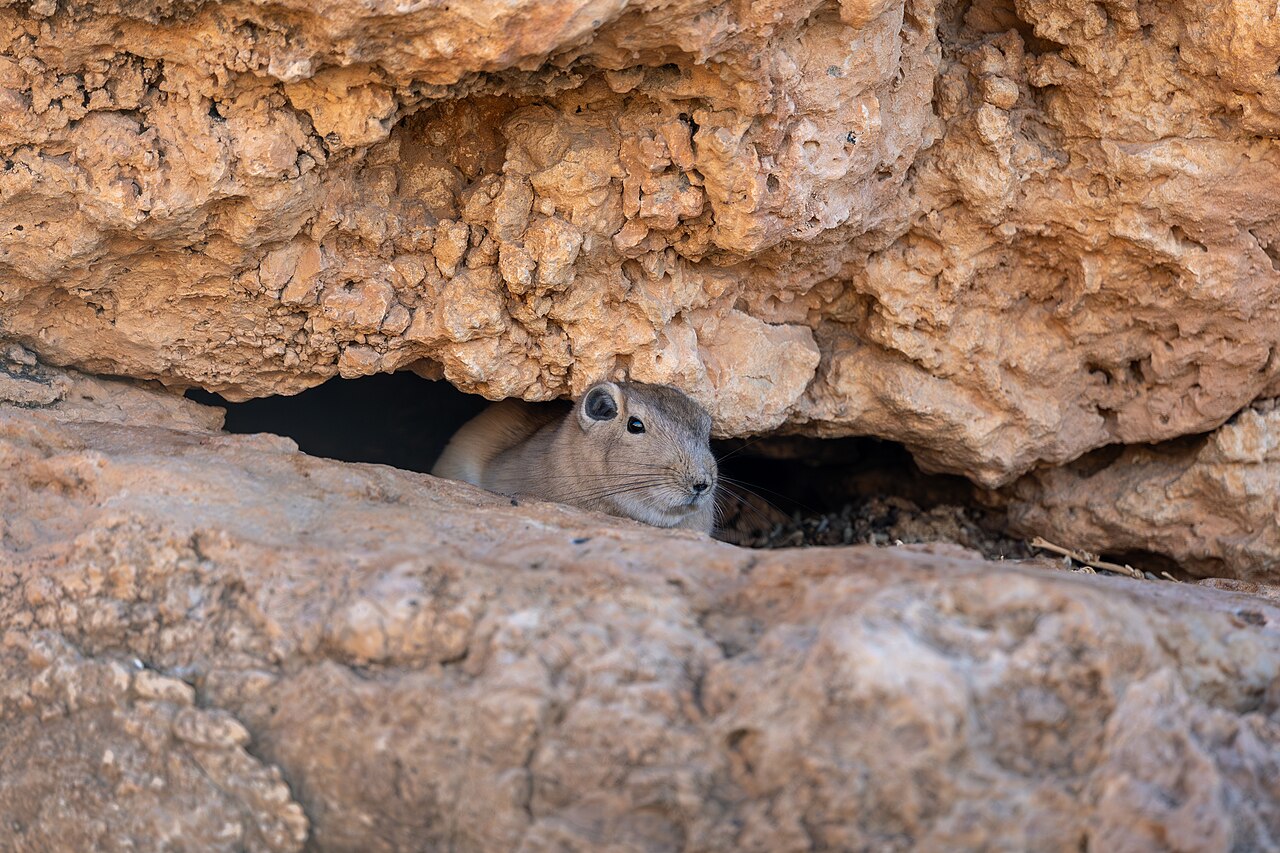
The Common Gundi is a rodent of bare rock at the edge of the Sahara, about the size of a guinea pig and without a visible tail. The animals lie in the sun on stones in the morning and do not drink. The species belongs to the gundis or comb rats (Ctenodactylidae), a family found only in Africa, from the Maghreb and the Sahara to the Sahel and the Horn of Africa, and represented in the guide area by this species alone; the name refers to the combs of stiff bristles between the claws of the hind feet.
Tracks
The gundi leaves few signs, and these are on the rock. It digs no burrows but uses natural crevices, cavities under overhanging blocks and gaps in drystone walls. At the entrances smooth, polished patches form on the stone through long use. On sunning spots and at crevice entrances lie droppings of 3 to 5 mm, round to short oval, hard, dry and dark brown, which accumulate over years into a thin layer; in sheltered places the urine dries to a hard, glossy brown crust on the rock, as in the hyrax. There are also feeding signs on the few plants nearby: acacia leaves and rosettes of succulents gnawed to the veins, and loose bitten-off stems on the rock. Prints are rare, because the animals avoid sandy ground as far as possible.
In its habitat

Identification
Compact and thickset, with a short neck, a broad, blunt head and a tail of at most two centimetres, not visible at a distance. The fur is dense, soft and sand-coloured, grey-buff to warm ochre, matching the colour of the rock; the underparts are paler. The ears are short and lie flat against the head, without a projecting rim. The eyes are large and dark, the whiskers long and stiff. On the two inner toes of each hind foot there is a comb of stiff white bristles used to remove sand from the fur; this is the family character and can be seen at close range with binoculars. The gundi can flatten its ribs and so squeeze into a crevice narrower than its body.
Similar species
Within the range there is little scope for confusion. Val's Gundi (Ctenodactylus vali) lives in south-eastern Morocco, western Algeria and Libya and is barely distinguishable: paler and with a slightly longer tail, but in the field locality almost always decides. The Rock Hyrax (Procavia capensis), which occurs in rocky areas of the Levant and north-eastern Africa, is two to three times as large and much darker. Rock mice and desert gerbils are much smaller and always long-tailed. A rounded, tailless, sand-coloured animal lying in the sun on a boulder field in the Maghreb is a gundi.
Habitat
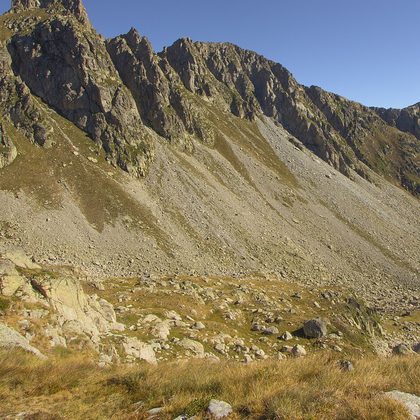
Exclusively rocky terrain in dry areas: bare limestone and sandstone outcrops, gorge walls, steep scree slopes and old stone walls, mainly on the southern slopes of the Atlas Mountains and in the semi-desert and steppe beyond, up to 2900 metres. Required are crevices deep enough to spend the midday heat in, and some vegetation within a few hundred metres, such as an acacia, a tussock of steppe grass or succulents between the stones. Open water is not needed.
Where the animal is most at home, classified with EUNIS — the European standard for habitats.



Distribution
North-eastern Morocco, northern Algeria, Tunisia and north-western Libya; within that area mainly on the southern slopes of the Atlas Mountains. In the guide area the species is confined to the Maghreb; it does not occur in Europe and never has. The range lies a few hundred kilometres south of Andalusia, but the Strait of Gibraltar has not been crossed. Well-known and accessible sites are in Tunisia (Bouhedma, Chambi, the gorges at Tamerza and Midès) and in the Moroccan foreland of the Atlas.
- Native
- dark = core range, pale = thinly spread
Way of life
Strictly diurnal. The animals emerge early and lie flat on a warm stone until the temperature rises above twenty degrees, then forage for one to two hours, and withdraw into the shade of the crevices as soon as it becomes warmer than thirty degrees; in the late afternoon they emerge again. The diet consists of leaves, stems, flowers and seeds of almost all plants in the vicinity; the animals cover up to a kilometre per morning for this. The gundi does not drink: all moisture comes from green food, and the kidneys retain so much water that the urine dries to a crust. The species lives in loose colonies and warns with a sharp, bird-like call and rapid drumming of the hind feet, after which all animals disappear under the stones at once. After a gestation of about forty days one to three young are born furred, with open eyes and almost immediately independent; this is exceptional for a rodent and is linked to life in crevices, where a nest of naked young is not safe. The young are weaned at four weeks.
Where and when to look
The best time is the first two hours after sunrise, on an east-facing rocky slope, preferably in March or April while there is still green vegetation. Find a boulder with a polished crevice entrance and droppings in front of it, sit about twenty metres away and wait: at first light the animals emerge one by one and lie still. They are not shy but are watchful; if approached too closely the alarm call follows and all animals disappear. In Tunisia the gorges of Tamerza and Midès and Bouhedma National Park are the best-known sites.
Conservation status
Least Concern (2008) and common in most places. Its habitat, bare rock of no agricultural value, is hardly taken into use, which protects the species to a large degree. Locally the gundi is hunted for food and trapped for the pet trade, and overgrazing by goats removes the herbs on which it lives; neither threatens the species as a whole. Because the colonies live on isolated rock outcrops in the steppe, the species is vulnerable to prolonged drying of the Maghreb; colonies that disappear are not recolonised by themselves.
Scientific name
Ctenodactylus gundi | (Rothman, 1777)
Rothman described the species in 1777 as Mus Gundi; because it was later moved to another genus, the author and year stand in brackets. Ctenodactylus is Greek, from kteis, genitive ktenos, 'comb', and daktylos, 'finger, toe', after the comb of stiff bristles on the hind toes. gundi is the animal's Arabic name in North Africa, which Rothman took over as the specific name; it stands as an indeclinable noun in apposition to the genus name. The specimen the first description was based on came from Libya.