All species › Lagomorphs › Hares and rabbits › Eastern cottontail
Eastern cottontail | Sylvilagus floridanus
Floridakonijn | Conejo Castellano
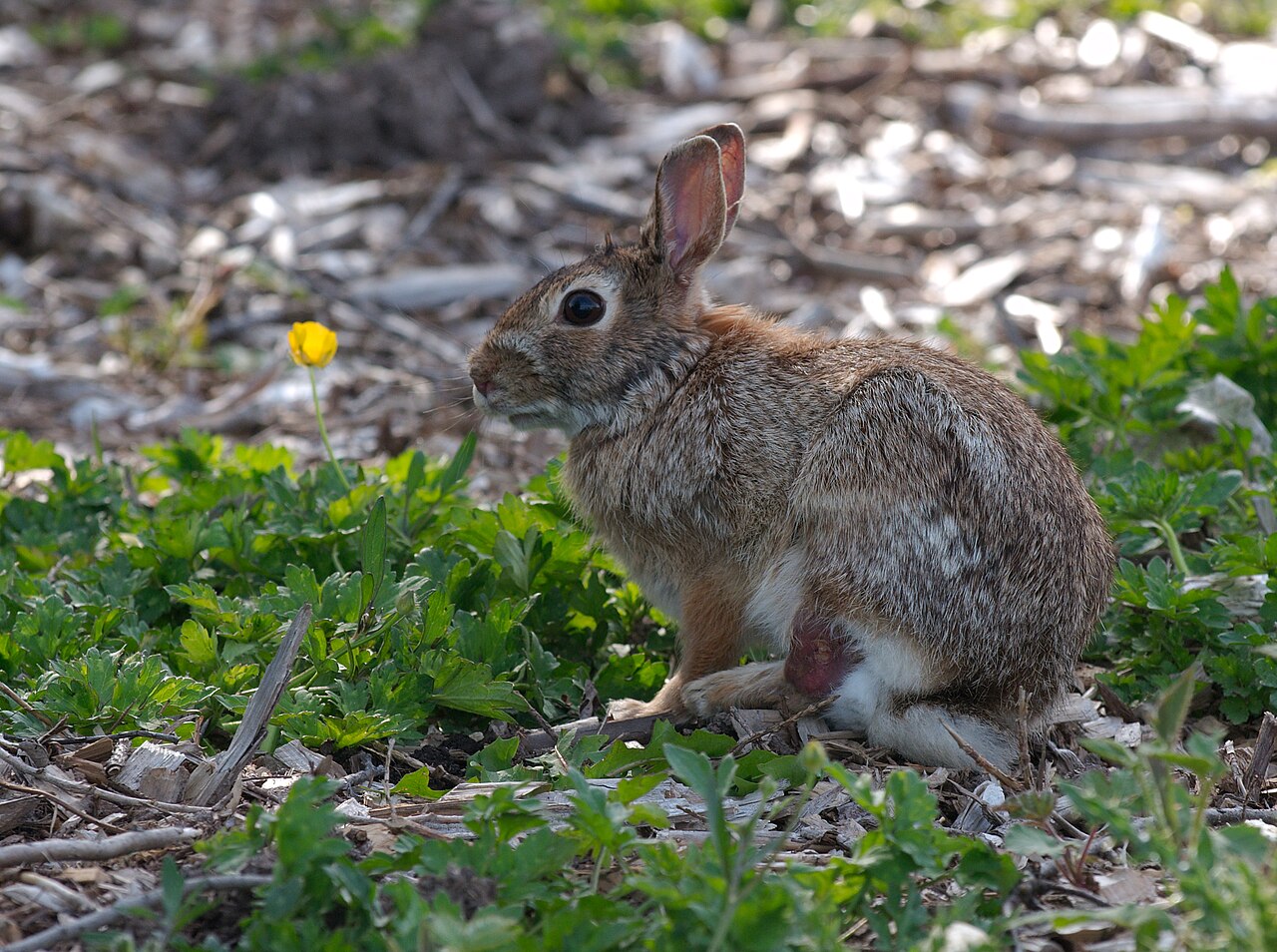
The Eastern Cottontail (Sylvilagus floridanus) is the commonest lagomorph of North America. In Europe it has been released for shooting since the 1950s, in the Po plain and in France, and has been spreading gradually there since. Unlike the European rabbit it digs no warren, lives solitarily and places its young in a shallow scrape in the grass.
Tracks
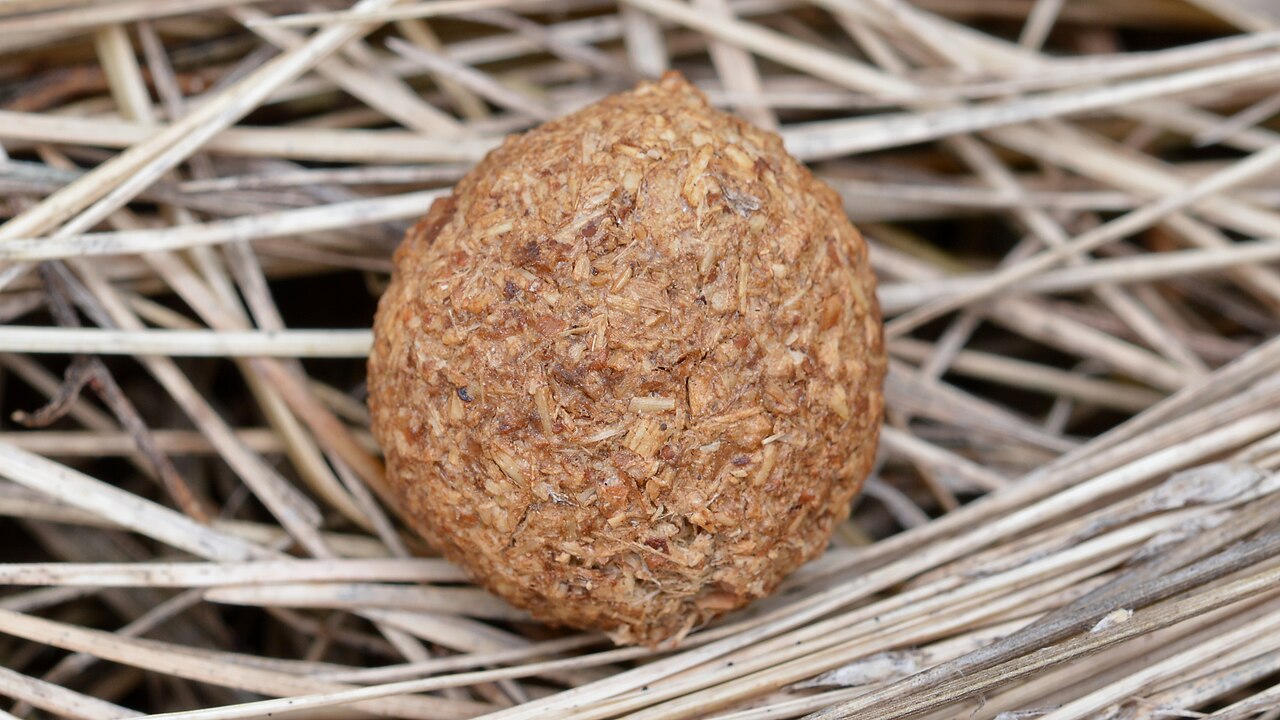
The droppings are round, dry, fibrous pellets of 8 to 12 mm, pale brown to greenish grey, and cannot be distinguished from those of the rabbit. They lie, however, scattered over the feeding area and not in large latrines, because this species defends no warren and has no fixed dunging site. The print is small, with four toes and no clear pads because the sole is furred; the trail shows the Y-shaped pattern of lagomorphs, with bounds of 25 to 60 cm. Characteristic is the nest: a shallow, slanting scrape in grass or rough vegetation about 12 by 12 cm, lined with dry grass and covered with the female's belly fur, visible from above as a tuft of grey hair among the stems. Nests are mostly found during mowing; beneath lie four to eight young. Other signs: a form under a bramble or log pile, and in winter bark and twigs clipped cleanly at an angle, up to about 50 cm above the ground or snow.

Head close-up
The young

Identification
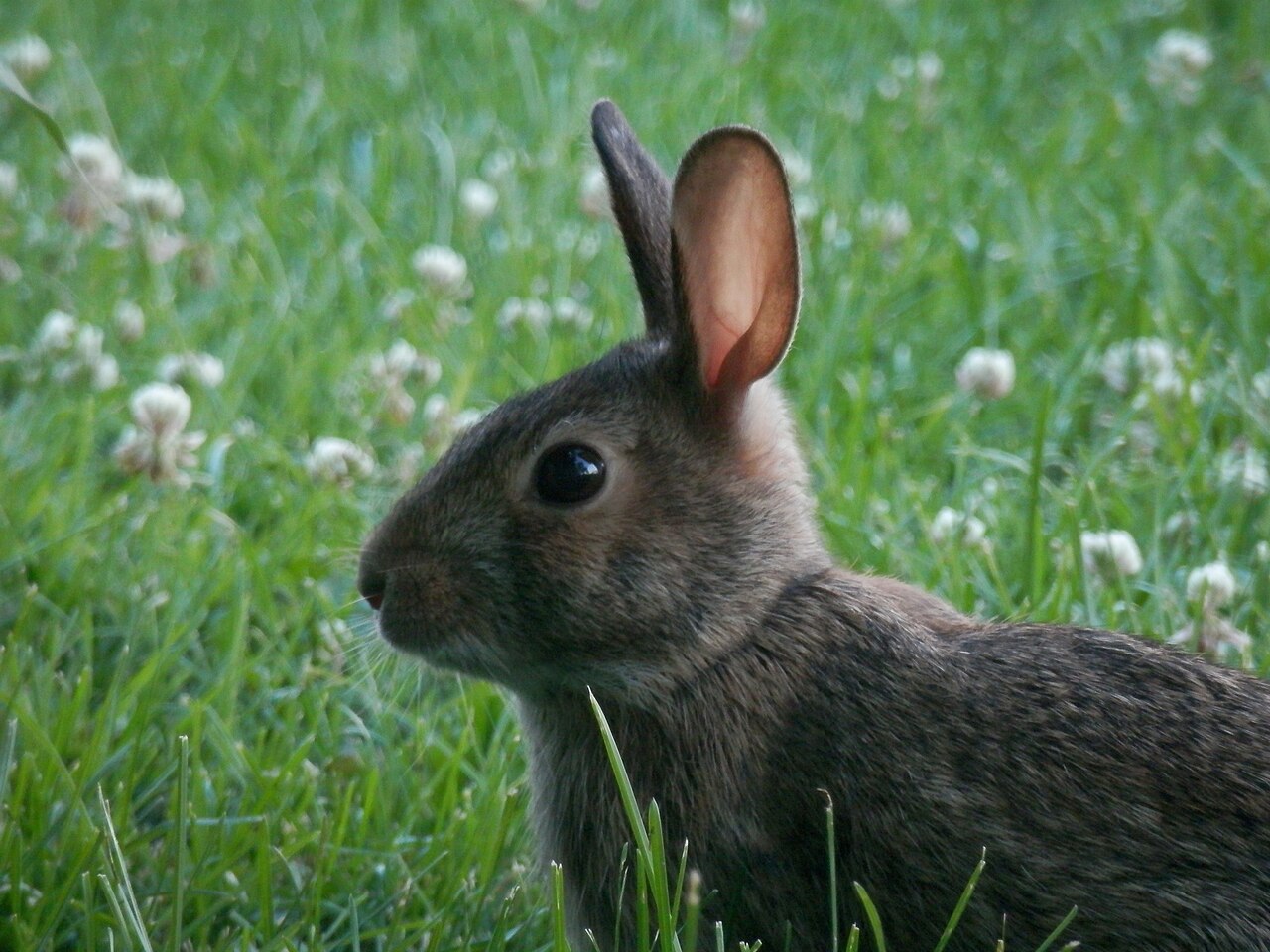
A rabbit with a relatively narrow, hare-like head: grizzled grey-brown, with a rusty patch on the nape that is distinct in older animals, a white eye-ring and medium-length ears without black tips. The English name refers to the tail: pure white and fluffy below, and raised when the animal runs so that the white shows above the back; in the European rabbit the tail is shorter, flatter and clearly black above. Young animals have a white blaze on the forehead that fades with age. The ears are held less erect than in the rabbit, and the animal stands higher on its legs.
Similar species
In Italy and France the Eastern Cottontail lives alongside the European Rabbit (Oryctolagus cuniculus). Separation rests on three characters: the rusty nape (weaker and more buff in the rabbit), the tail (white and fluffy in the cottontail, black above in the rabbit) and behaviour (the cottontail digs no warren and does not live in colonies; a group of rabbits at a fan of excavated sand are European rabbits). The Brown Hare is much larger, has much longer black-tipped ears and long hind legs, and a tail that is black above. At a distance and in poor light the white, fluffy tail is the quickest character.
Habitat
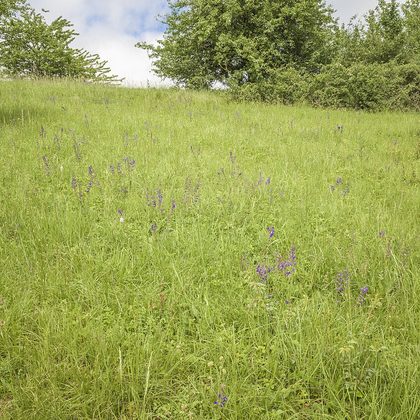
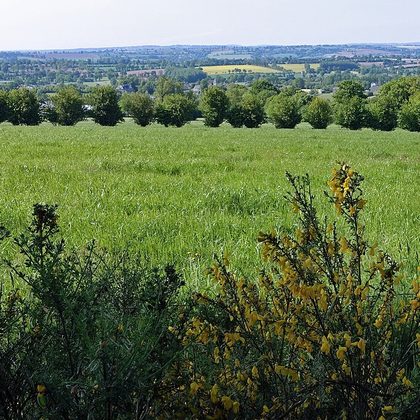
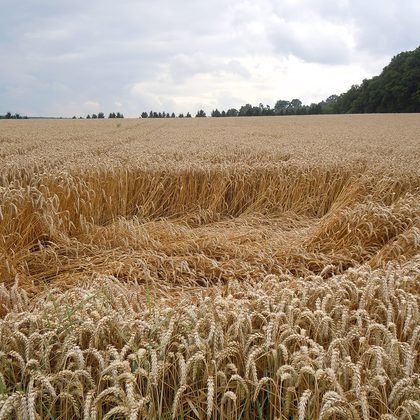
Transitional habitats: rough pasture and meadow with scrub, hedgerows, woodland edges and clearings, field margins, railway embankments, orchards, allotments and town parks. Closed woodland and open arable land without cover are avoided. In the Po plain the species occurs on heavy, wet clay where the European rabbit has difficulty digging; the cottontail does not dig and is not dependent on this.
Where the animal is most at home, classified with EUNIS — the European standard for habitats.




Distribution
In its native range from southern Canada to Venezuela. In Europe the species has been released for shooting since the 1950s and 1960s in northern Italy (Piedmont, Lombardy, Veneto, Emilia-Romagna, with its centre in the Po plain) and in France, mainly in the centre and south-west. From Piedmont it is spreading slowly north and west. In the Iberian Peninsula the species is not established and no releases are known; all wild rabbits there are Oryctolagus. It is not established in Britain and Ireland: nineteenth-century introductions to England failed. It does not occur in the Low Countries and no releases are known; a rabbit with a white fluffy tail there is almost certainly a feral domestic rabbit.
- Established introduction
- dark = core range, pale = thinly spread
Way of life
Active at dusk and at night, in quiet places also late in the afternoon. The cottontail eats grasses, clover and herbs, and in winter bark, buds and twigs; like all lagomorphs it re-ingests its soft night droppings. Unlike the rabbit it is solitary: it digs no burrow, at most uses an empty fox or marmot burrow as shelter in frost, and has a home range of a few hectares. Reproduction is rapid: from March to September three to four litters, sometimes seven, of three to eight young after a gestation of 28 days; a female is pregnant again within a few hours of giving birth. The young are born naked and blind, open their eyes after a week and leave the nest after two weeks. Mortality is high: most animals do not reach one year of age.
Where and when to look
Search in Piedmont and Lombardy in the last hour before dark along the edges of rice fields and poplar plantations, or in France along a bramble edge beside a meadow. The animal first sits tight and only then runs off; watch the tail when it runs. After snowfall the Y-shaped trail can be followed to a form under a bramble. In rabbit counts in northern Italy both species must be distinguished, since they often occur in the same area.
Conservation status
Least Concern (LC, 2019) in its native range, where it is the commonest small game species of North America. In Europe it is an introduced species, and attention focuses on its effects on native species. It carries the myxomatosis virus and the rabbit virus RHDV without suffering much itself, and is therefore regarded as a reservoir for diseases that periodically cause high mortality in the native rabbit. It also competes for food with rabbit and hare, and there is evidence that it reduces hare density in the Po plain. Italy has placed the species on its list of invasive alien species with eradication as the aim, which has proved unachievable in practice. The species is not on the European Union's list of invasive alien species of Union concern (Regulation 1143/2014), including the consolidated list of August 2025; Spain does include the species in its national catalogue.
Scientific name
Sylvilagus floridanus | (J. A. Allen, 1890)
J. A. Allen described the species in 1890 as Lepus sylvaticus floridanus; because it was later moved to another genus, the author and year stand in brackets. Sylvilagus joins Latin silva, 'wood', to Greek lagōs, 'hare': the hare of the woods. floridanus means 'of Florida', where Allen described the animal. The specimen the first description was based on came from USA, Florida.