All species › Rodents › Squirrels and marmots › Eastern fox squirrel
Eastern fox squirrel | Sciurus niger
Amerikaanse voseekhoorn | Sciurus niger
The Eastern Fox Squirrel is the largest tree squirrel in North America, with a head-body length of up to 37 cm and an orange belly. In Europe the species is established nowhere. It was placed on the Union list of invasive alien species in 2016 as a precautionary measure, because in ecology and risks it closely matches the Grey Squirrel.

Tracks
No signs are known from Europe, because there are no free-living populations. The North American signs are relevant because they can hardly be distinguished from those of the Grey Squirrel. The species builds a leaf nest of twigs, leaves and bark in a crown fork or uses a tree hole; the nest is larger than that of the Grey Squirrel, but the sizes overlap completely. Nuts are buried one by one in shallow scrapes spread over a large area and recovered by memory and scent; the scrapes and disturbed leaf litter are visible. At feeding places on a stump or post lie gnawed walnuts, hickory nuts and acorns, and stripped pine cones. The bounding trail is that of all tree squirrels, four prints in a group with the larger five-toed hind feet side by side ahead of the smaller four-toed forefeet, but large: the hind print measures six to eight centimetres and the bounds are over a metre. An unusually large squirrel trail in Europe is a reason to check for the species with a camera.
Head close-up
Identification
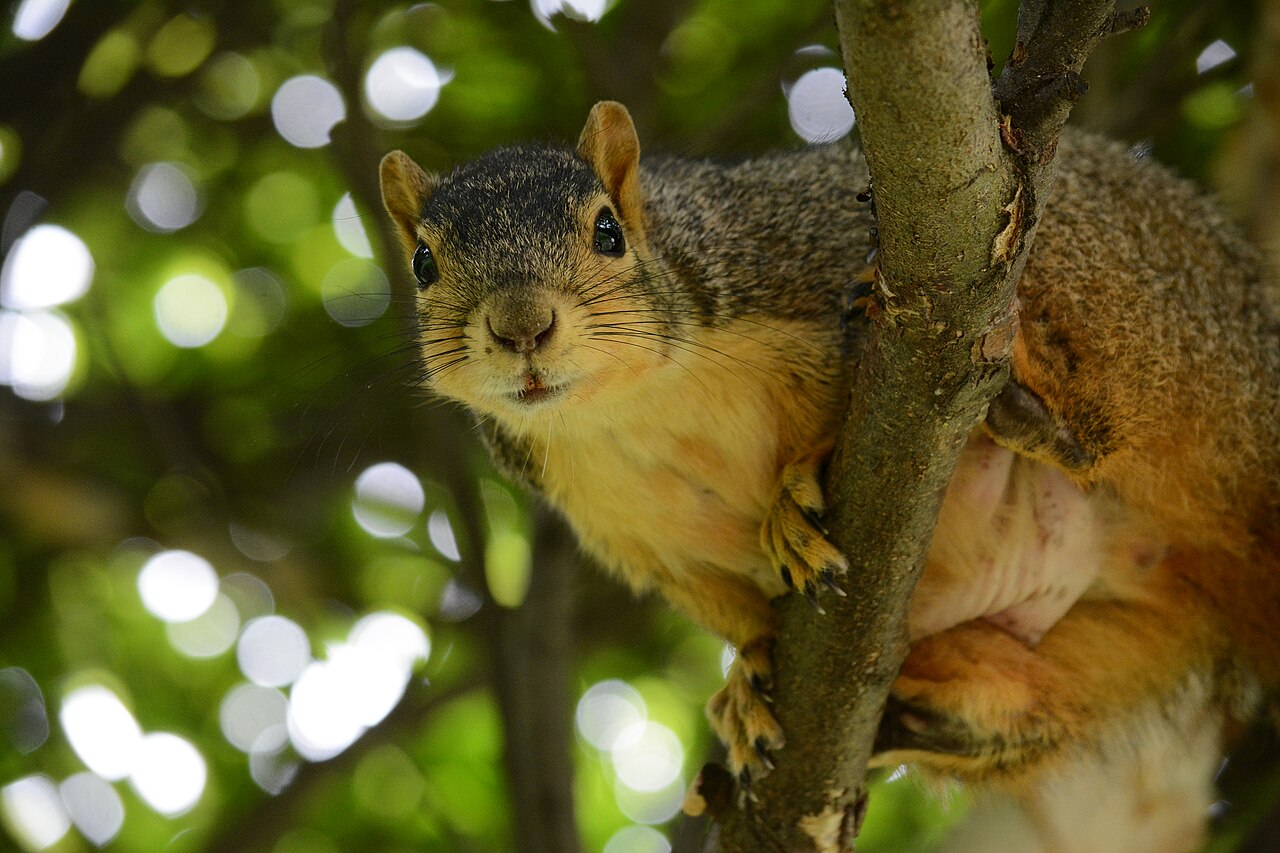
The heaviest tree squirrel that may be encountered in Europe as an escaped animal: head-body 26 to 37 cm, tail 20 to 33 cm, and half a kilo to one and a half, two to four times the weight of a Red Squirrel. The colour is highly variable and differs by region. In interior North America the usual coat is a grizzled buff-grey to ochre back with an orange to rusty belly, flanks and tail fringe; in the north-east the animals are more silvery grey, and in the south-east black animals occur with a white muzzle and white ears. Constant characters are: the belly is never white but ochre, orange or black; the tail is long and broad with an ochre to rusty-orange fringe; and the ears are small, round and without tufts. The species is heavily built, moves slowly in the canopy and spends much time on the ground, where it moves in short, heavy bounds.
Similar species
The Grey Squirrel is the main confusion species: the two look very similar at a distance, and the Grey Squirrel does occur in Europe. Three characters are decisive. First, the belly: sharply white in the Grey Squirrel, ochre to rusty orange or black in the Fox Squirrel, never white. Second, the tail fringe: silvery white in the Grey Squirrel, ochre to orange in the Fox Squirrel. Third, size: the Fox Squirrel is a third to a half heavier, which shows in the build. The Red Squirrel is much smaller and lighter, with a white belly and winter ear tufts, which the Fox Squirrel lacks. A large squirrel with an orange belly in a European park is an escaped animal and must be reported immediately, since that is the only opportunity to prevent establishment.
Habitat
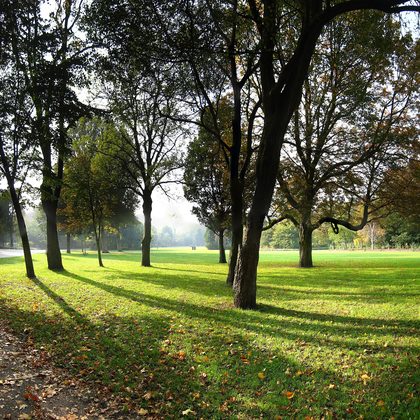
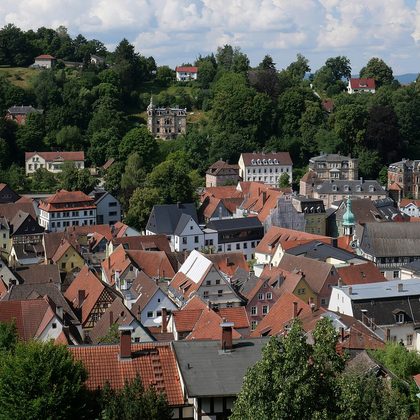
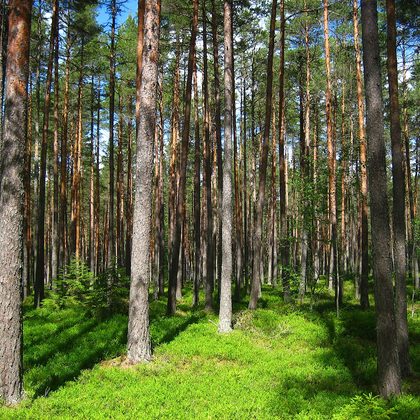
In North America open woodland: oak-hickory forest with wide spacing between the trunks, savanna-like wood pasture, forest edges, shelterbelts between fields, and in the south-east open pine woodland and cypress swamp. Closed, dark forest is avoided; there the Grey Squirrel dominates. The species prefers half-open, park-like cultural landscape: orchards, golf courses, campuses, cemeteries and town parks. This landscape type is widespread in western Europe, and that is one of the reasons why risk assessments classify the species as a real risk.
Where the animal is most at home, classified with EUNIS — the European standard for habitats.


Distribution
Native to eastern and central North America, from southern Canada and the Great Lakes to Florida, Texas and northern Mexico, and through introduction also on the west coast of the United States. In Europe the species is established nowhere and no population is known. There are a few records per country in Belgium, Germany, the Netherlands, Britain and Sweden; they concern animals escaped or released from the pet trade and from zoos, with no evidence of breeding. By listing the species in 2016 the European Commission aimed to maintain this situation.
Way of life
Diurnal and active all year, without hibernation or winter rest; in winter activity is concentrated in the middle of the day, in summer in two peaks, early and late. The diet consists mainly of tree seed (acorns, hickory nuts, walnuts, beech mast, pine and cypress seed), supplemented with buds, flowers, bark, fungi, fruit, insects and occasionally birds' eggs. Stores are made by scatter-hoarding nuts. The species holds no territory but a home range of half a hectare to several tens of hectares, overlapping strongly with that of neighbours; females with young do defend a core area. There are two mating periods a year, in winter and in late spring; after a gestation of 44 to 45 days two to seven young are born in a tree hole or leaf nest. They emerge at six to eight weeks and are weaned at about three months.
Where and when to look
In Europe this is not a species to search for, but one to recognise. The main character is a squirrel the size of a cat with an orange belly. Report a sighting immediately, with a photograph, to the national recording scheme. In North America the species is common and tame in almost any park in the American Midwest.
Conservation status
Least Concern globally (LC, 2016). This assessment concerns North America, where the species is common, hunted and has been introduced westwards; a few east-coast subspecies are less numerous and are protected there. It says nothing about Europe, where the species does not occur. Since 3 August 2016 the species has been on the Union list of invasive alien species of Union concern (Regulation 1143/2014), with a ban on keeping, breeding, transporting, trading and releasing. The listing is a precautionary measure and not a response to an existing population. The rationale derives from experience with the Grey Squirrel: the Fox Squirrel is larger and heavier than the Red Squirrel, eats the same food, can digest unripe acorns, thrives in half-open cultural landscape such as occurs in western Europe, and is, like the Grey Squirrel, a possible carrier of squirrelpox virus, which is lethal to the Red Squirrel. Because the species was kept in European zoos and by private owners, there was a risk that escaped animals would form a population. The effectiveness of this precautionary measure cannot be demonstrated, because the absence of establishment produces no measurable data. Unlike the raccoon, the coypu and the Grey Squirrel, the species was listed before a population existed in Europe.
Scientific name
Sciurus niger | Linnaeus, 1758
Linnaeus described the species in 1758 and placed it straight away in the genus where it still stands. Sciurus is the Latin word for 'squirrel', from Greek skiouros, from skia, 'shadow', and oura, 'tail': the animal that shades itself with its tail. niger is Latin for 'black'; the species has a black form, but is usually greyish brown. The specimen the first description was based on came from USA, Carolina.