All species › Rodents › Dormice › Edible dormouse
Edible dormouse | Glis glis
Relmuis | Lirón gris
The Edible Dormouse is the largest dormouse in Europe. It hibernates for about seven months of the year, from late October to mid-May, and in a year without beech mast or acorns this can extend to eleven months. The Romans fattened it in earthenware jars and ate it as a delicacy; the scientific name Glis refers to this. In Slovenia it is still trapped in autumn, when it is heaviest.
Tracks
Two signs point to the species. The first is characteristic of the whole family: the gnawed hazelnut. All dormice open it in the same way: a round hole with a smooth, sharp inner rim without cross grooves, surrounded on the outer surface of the shell by a ring of fine tooth marks set at an angle to the hole. The dormouse places its lower incisors in the rim and grinds the hole round, instead of biting through from the outside. A Wood Mouse leaves clear parallel tooth grooves on the inner rim and rough scratches on the surface; a Bank Vole leaves parallel grooves on the inner rim but no marks outside it; a squirrel splits the nut in two. The second sign is bark stripping: shortly before and after hibernation it gnaws away bark of sycamore, beech, silver fir, larch and sometimes Norway spruce, in patches a finger to a hand wide, sometimes around the entire trunk. The tooth grooves are 2 to 2.5 mm wide — a squirrel's 2.5 to 3 mm — and unlike the squirrel it does not strip in a spiral. There are also droppings of 8 to 12 mm, cylindrical with blunt ends, dark and glossy, which lie in small heaps in lofts and nest boxes; a nest of leaves, moss and bark in a tree hole, woodpecker hole or nest box; and at night, from July to September, loud calls — screeches, squeaks and a rhythmic chek-chek-chek — from the canopy or a roof space.
In its habitat
The young

Identification
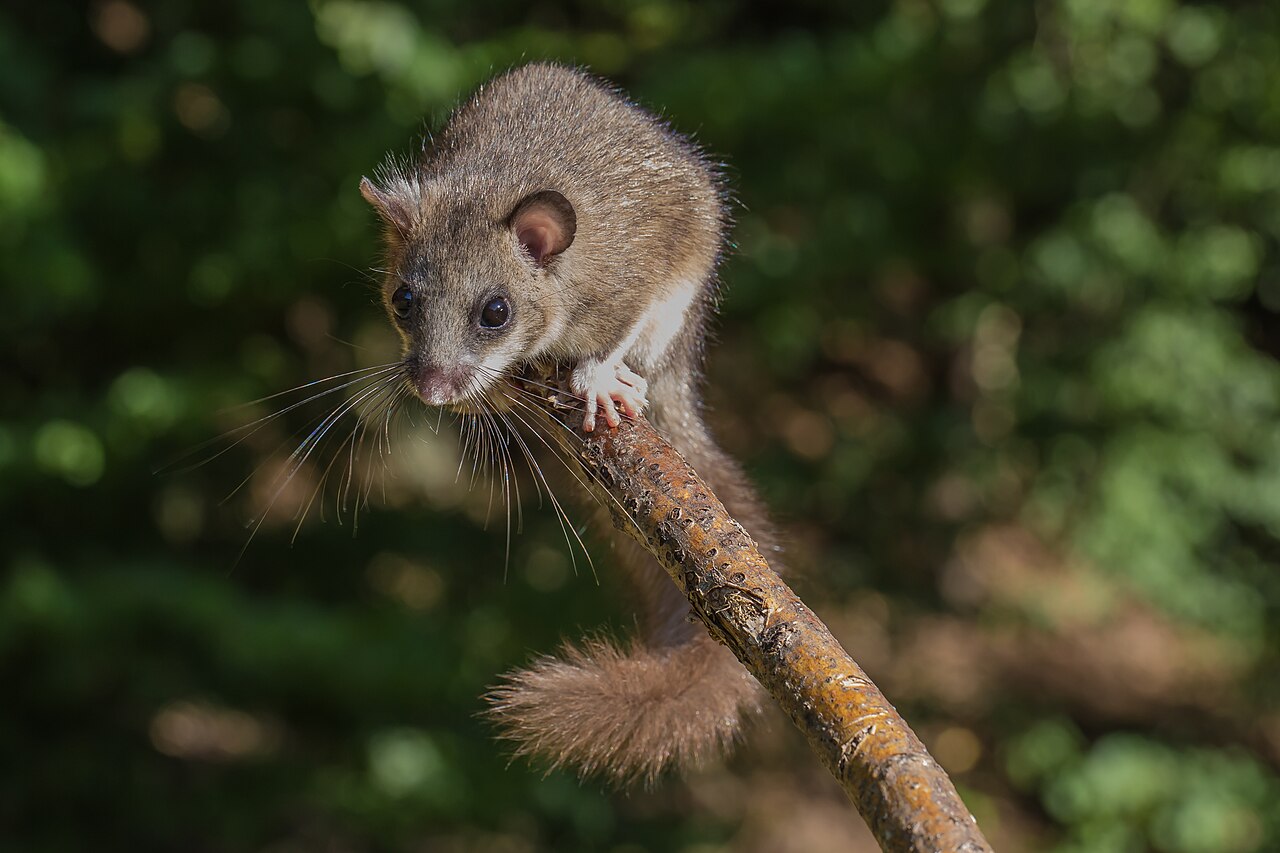
At first sight the animal resembles a small squirrel: grey to grey-brown above and pure white below, with a sharp boundary, large black eyes, small rounded ears and a bushy tail that is densely and evenly furred along its whole length and measures about three-quarters of head-body length. Unlike the other European dormice it has no black mask: at most a faint dark ring around the eye. Several indistinct dark lines often run along the flanks. The legs are short, the toes pink and broad, with pads that allow it to walk upside down along a branch. If seized by the tail, the tail skin can come away.
Similar species
The Garden Dormouse (Eliomys quercinus) is the same size but has a conspicuous black mask running from the muzzle past the eye to behind and below the ear, is brown with white underparts, and has a tail ending in a flattened black-and-white tuft; the tuft is decisive. The Forest Dormouse (Dryomys nitedula) is clearly smaller and also has a black eye-stripe, but it ends at the ear. The Hazel Dormouse (Muscardinus avellanarius) is small, orange-buff and has no mask. A Red Squirrel is three times as heavy, russet or black, with ear tufts and a much longer tail, and is active by day. In a shed or loft confusion with a Brown Rat is most likely: that has a bare, scaly tail and a pointed muzzle, the dormouse a densely furred tail and a blunt head.
Habitat
Old broadleaved woodland with a closed canopy and many holes: beech woodland in the first place, also oak-hornbeam, sweet chestnut, mixed woodland with sycamore, and in the south montane oak and beech forest. It is strongly arboreal and crosses open ground as little as possible; a continuous canopy matters more to it than the size of the wood. It also occurs in old orchards, parks with mature trees and — all year or only in winter — sheds, lofts, holiday homes and cavity walls of houses at the woodland edge.
Where the animal is most at home, classified with EUNIS — the European standard for habitats.




Distribution
From northern Spain and France east through central, southern and eastern Europe to the Volga and the Caucasus, including Italy, the Balkans and most Mediterranean islands; to the north it reaches southern Poland, Lithuania and Latvia. In Spain it occupies a well-defined strip in the Cantabrian Mountains and the Pyrenees: from the Basque Country and Navarre along the north coast to Asturias, León and northern Palencia and Burgos, and along the Pyrenees to Catalonia, in humid beech and oak forest and almost never below 500 m; it is absent from central and southern Spain and from Portugal. At the north-western edge of the range it occurs in the Netherlands only in the far south of Limburg, in the Vijlenerbos and surroundings, and in Belgium in the Voer area and a few places in Wallonia. In Britain it was introduced: in 1902 animals escaped from Lionel Walter Rothschild's collection at Tring (Hertfordshire), giving rise to the Chilterns population, estimated at about ten thousand animals and confined to a triangle of about two hundred square miles between Aylesbury, Beaconsfield and Luton. It is absent from Ireland.
- Native
- dark = core range, pale = thinly spread
Way of life
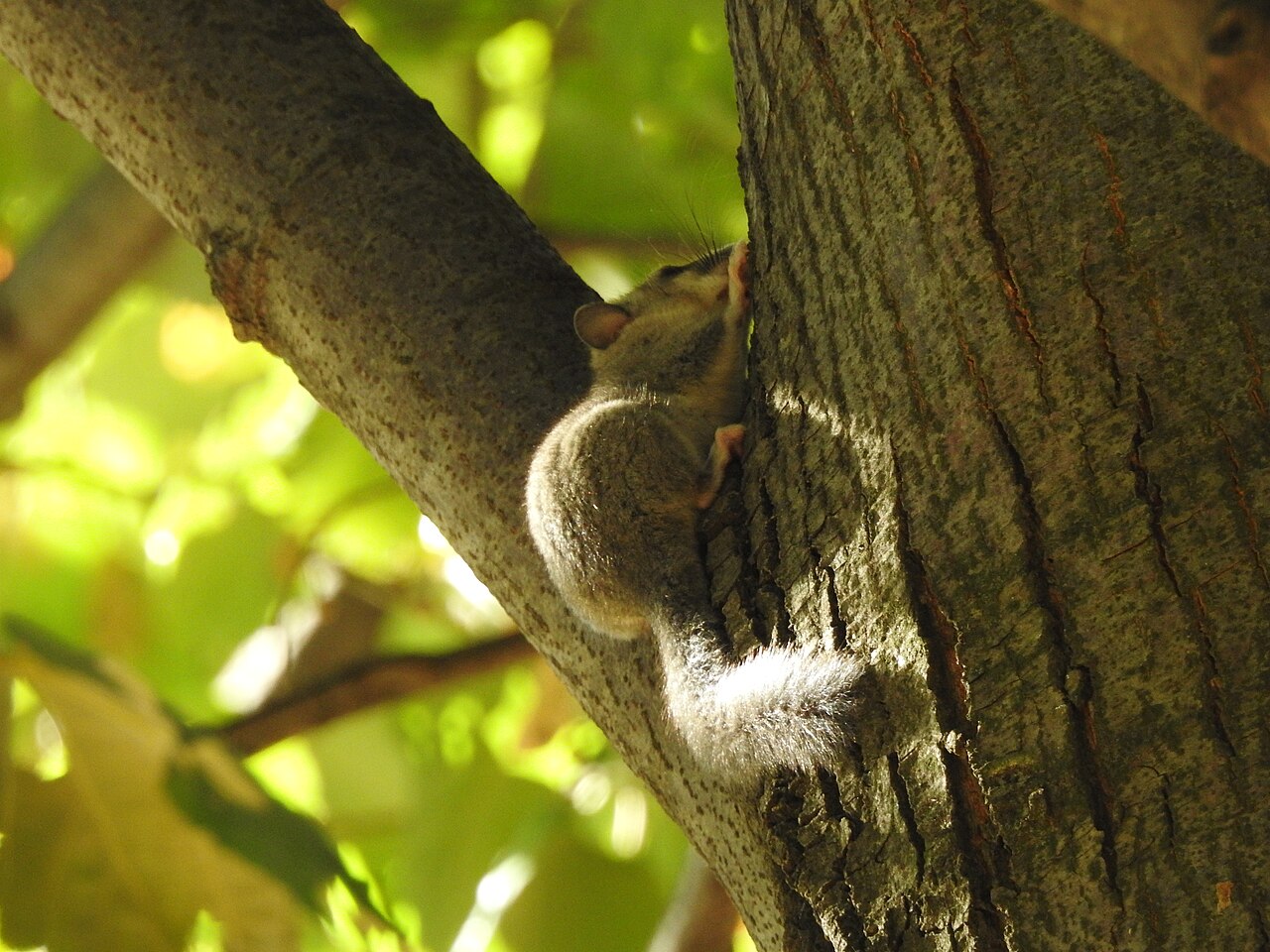
Strictly nocturnal and almost entirely arboreal. It eats plant food: beech mast, acorns, hazelnuts, sweet chestnuts, buds, bark and soft fruit, with some insects in spring and occasionally an egg or nestling. Hibernation determines the annual cycle. In September and October it almost doubles its weight, then digs into the ground — under a tree root, in a cavity or an old mouse tunnel, usually 10 to 60 cm deep — and curls up with the tail over its head. Body temperature and heart rate fall to just above ambient temperature, and breathing can stop for up to an hour. It does not reappear until May or June. In a year without mast it skips breeding and sometimes stays underground for up to eleven months; this is linked to its long lifespan of up to twelve years in the wild. Mating takes place in June and July; after thirty days four to eleven naked, blind young are born in a nest high in a cavity; the eyes open at three weeks and the young are independent at one month to six weeks. Pine Marten, Tawny Owl and cat are the main predators.
Where and when to look
On a warm evening in August stand quietly beneath the canopy of an old beech wood and listen; the screeching overhead usually comes from edible dormice, and a torch aimed at the sound shows the silver-grey tail among the branches. Nest boxes give the best chance: edible dormice readily use bird boxes, and in South Limburg, the Voer area, the Cantabrian Mountains and the Pyrenees the species is mainly found this way; in the Chilterns licensed surveyors check boxes in June and September. In old barns in southern Europe and northern Spain, running across the roof beams between midnight and three in the morning is often an edible dormouse.
Conservation status
Least Concern (LC, 2021) and common over most of its range. At the north-western edge — the Netherlands, Belgium, northern Germany — it is rare and vulnerable; there the management of old broadleaved woodland with enough holes is decisive, because the species needs trees old enough to form cavities. In the Netherlands it is legally protected and regarded as critically endangered. In Spain it is protected, and the populations in the Cantabrian Mountains and the Pyrenees are regarded as stable but highly fragmented. Its dependence on mast makes it sensitive to years without beech mast and, in the long term, to changes in the masting rhythm of woodland. In Slovenia and Croatia the traditional autumn trapping of dormice is still permitted and regulated. In Britain it is a non-native species that may not be released, and damage to lofts, insulation and wiring is a recurring complaint.
Scientific name
Glis glis | (Linnaeus, 1766)
Linnaeus described the species in 1766 as Sciurus Glis; because it was later moved to another genus, the author and year stand in brackets. Glis is the Latin word for 'dormouse'; the Romans fattened the animal in jars for the table. The specific name repeats the genus name. The specimen the first description was based on came from Slovenia, Carniola.