All species › Rodents › Beavers › Eurasian Beaver
Eurasian Beaver | Castor fiber
Europese bever | Castor Europeo
The Eurasian Beaver is Europe's largest rodent and alters the landscape in which it settles: the water level rises, willow carr dies back through waterlogging, clearings, pools and standing deadwood appear, and within a few years a stream can turn into a marsh. By the nineteenth century the species had disappeared from almost all of Europe; its present distribution is mainly the result of more than a hundred years of releases rather than of natural recovery.
Tracks
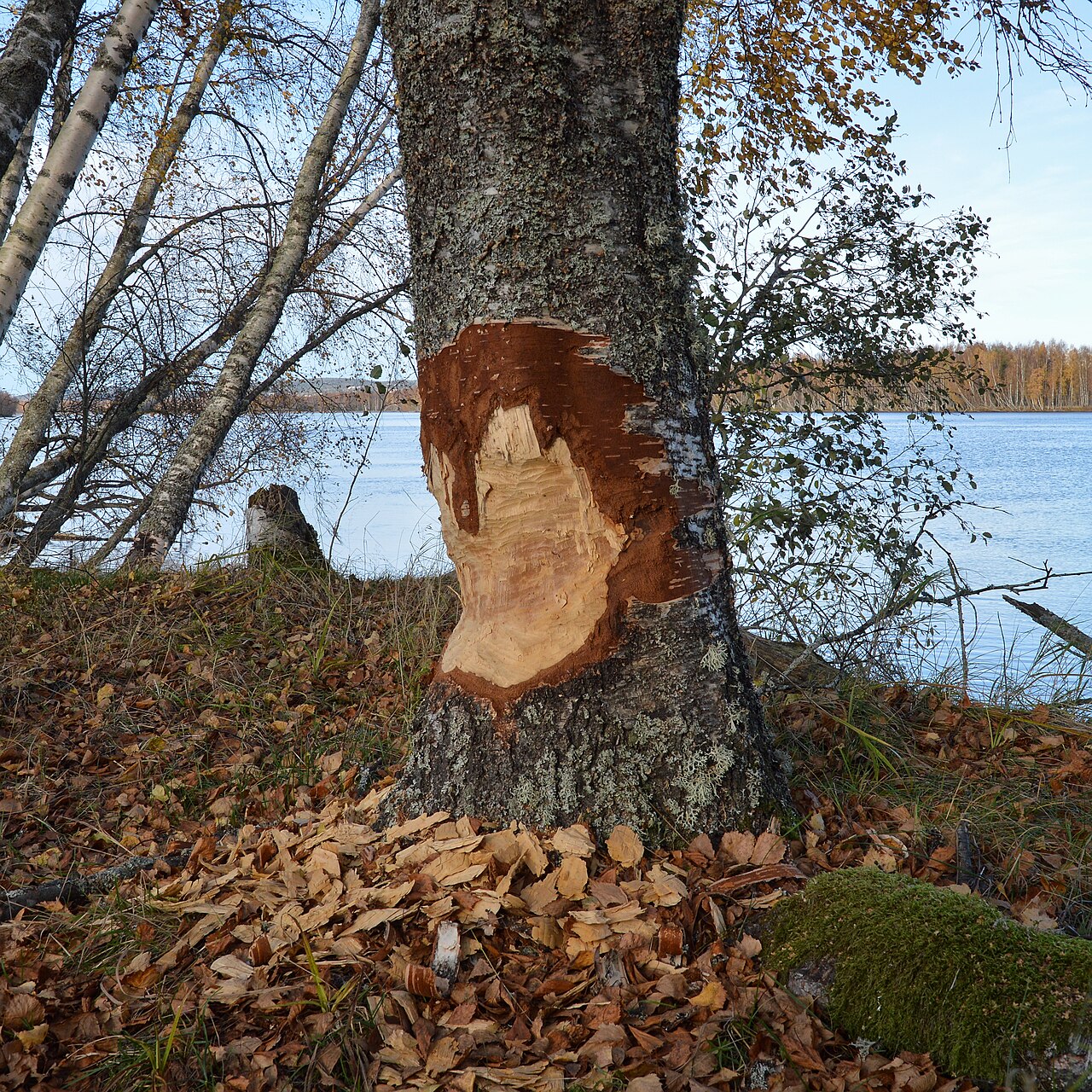
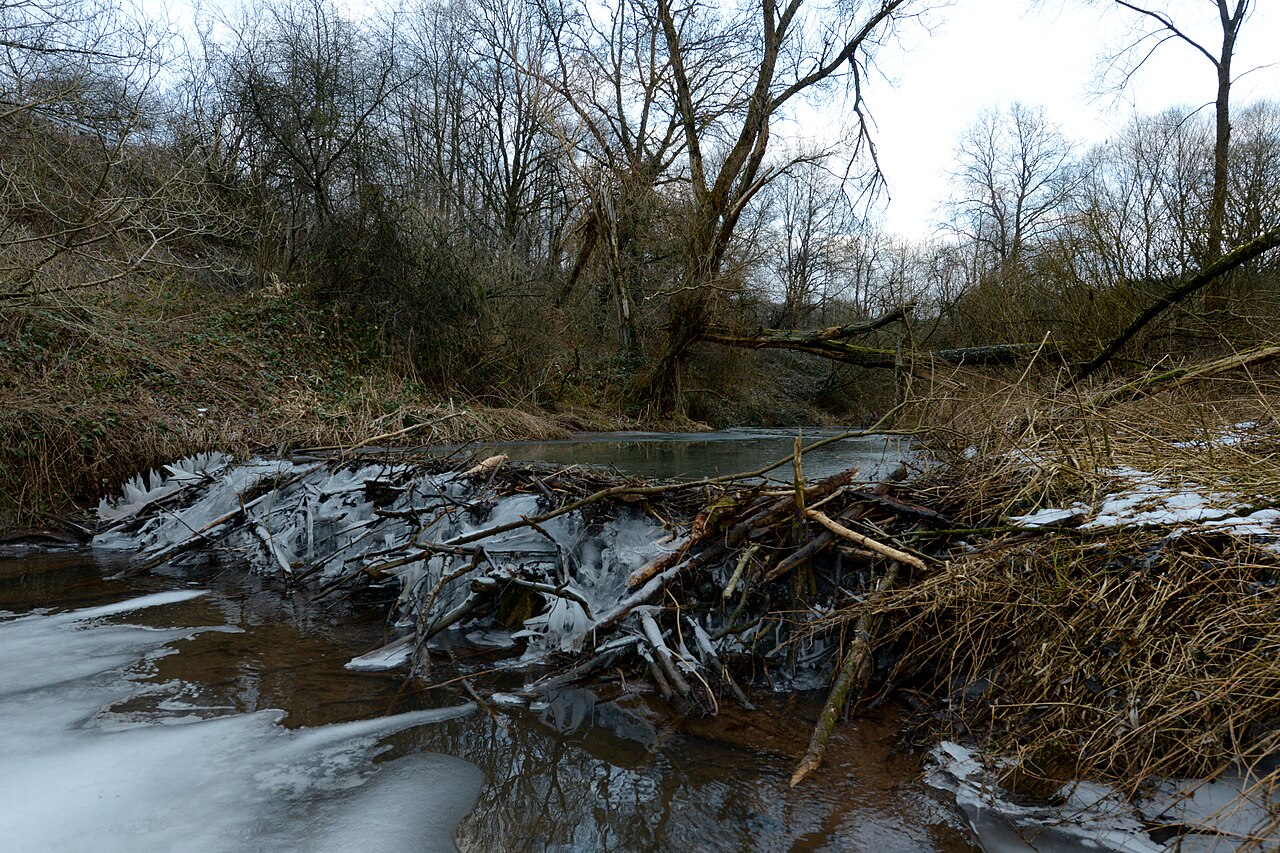
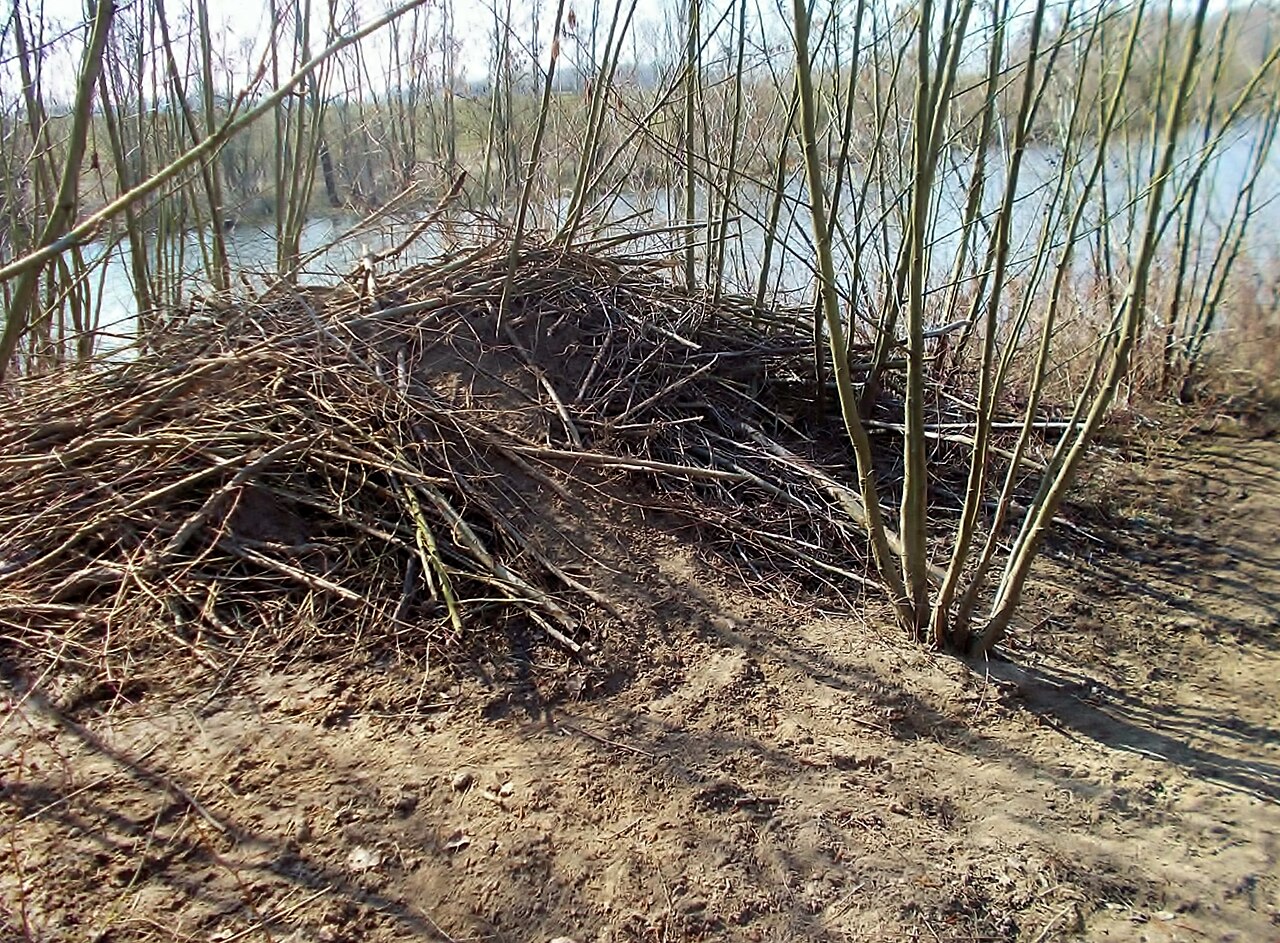
The signs are large and long-lasting, and are usually found before the animal itself is seen. Best known is the gnawed stump: the beaver gnaws a trunk from several sides into an hourglass shape or a point, with broad, parallel tooth grooves in the pale wood and a ring of wood chips five to ten centimetres long on the ground around it. A trunk up to about 15 cm thick is felled in less than an hour, one of 25 cm or more over several nights. Almost all felling takes place within sixty metres of water; further away is rare, and a gnawed tree two hundred metres out is exceptional. The slide is a smooth, bare, muddy track thirty to fifty centimetres wide running obliquely from the water up the bank, polished by the animal's belly and by the branches it drags down. Where food lies too far from the water, canals are dug up to a metre wide and half a metre deep, which may run hundreds of metres inland. The lodge is a pile of sticks up to two metres high and up to six metres across above the water, with the entrances below the surface and an air vent at the top; where the bank is high enough a bank burrow is dug instead, recognisable only by the collapsing ground above the tunnel. The dam is twenty centimetres to three metres high and half a metre to hundreds of metres long, made of sticks, mud, stones and grass, bowed upstream; it is built only where the water is too shallow to keep the lodge entrance submerged, so that on deep rivers such as the Meuse, the Waal or the Ebro no dams are built. Along the territory boundary lie scent mounds: heaps of scraped-up mud and plant material ten to thirty centimetres high, daubed with castoreum, with a sweet, tarry smell that on a still evening can be smelled before the mound is seen. There are also peeled sticks in and beside the water, white and smooth, the bark removed in crosswise strips, and in late autumn a food cache: a sunken bundle of branches close to the lodge entrance, accessible under the ice. Prints are scarce and usually erased by the dragging tail; where they survive, the hind print is large and shows the web between the toes.
In its habitat
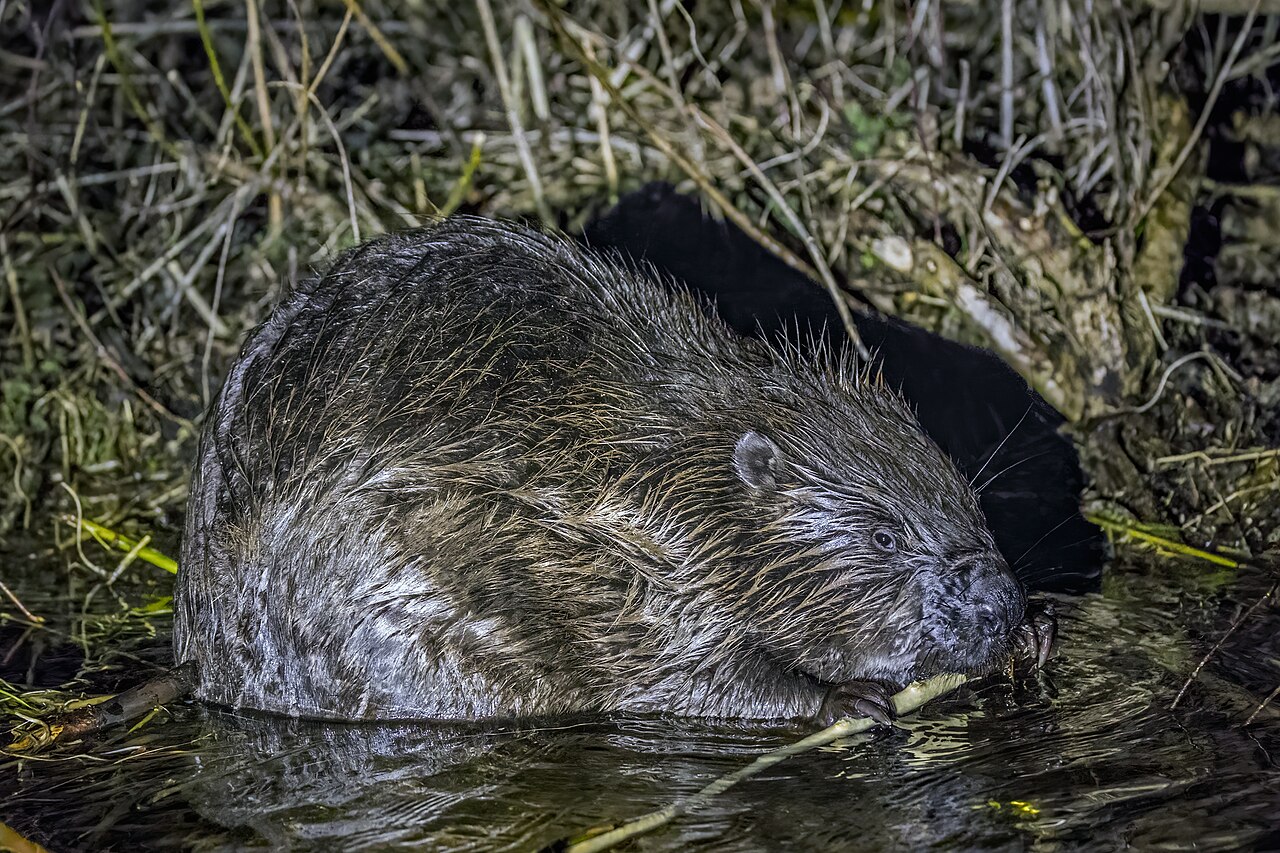
Head close-up

Identification
A heavy, thickset, water-bound rodent of 80 to 100 cm head-body and 11 to 30 kg, about the size of a large dog, but low and broad. The fur is dense, chestnut to nearly black and glossy when wet; the head is blunt, with small eyes and small, round ears set high and far back, so that ears and nose stay above water while the rest of the animal is submerged. The decisive character is the tail: naked, with horny scales, flattened horizontally and 25 to 50 cm long; no other European mammal has such a tail. The hind feet are large and fully webbed; the forefeet are small and hand-shaped and are used for digging, carrying and holding food. The incisors are orange to rust red from iron in the enamel and grow throughout life. On the water usually only a broad, low head with a wake is visible; when disturbed the animal slaps its tail hard on the surface and dives.
Similar species
On the water the beaver is confused at a distance with three species. The Muskrat is much smaller (a third of the length) and has a thin tail flattened sideways that is often visible above the water, undulating as it swims. The Coypu is larger than a muskrat but smaller than a beaver, also has orange teeth, but a round, scaly tail and conspicuous white whiskers with a white patch on the muzzle. The Otter is slim rather than heavily built, dives with a rolling movement in which the back arches above the water, and has a thick but round tail. The most difficult case is the North American Beaver, introduced in Europe in Finland and at a few sites in Russia: it cannot be distinguished from the Eurasian Beaver in the field, because the distinguishing characters are not visible on a living animal; identification rests on genetic analysis. In Finland and Karelia identification by sight is therefore not conclusive; elsewhere in Europe a beaver is a Eurasian Beaver.
Habitat
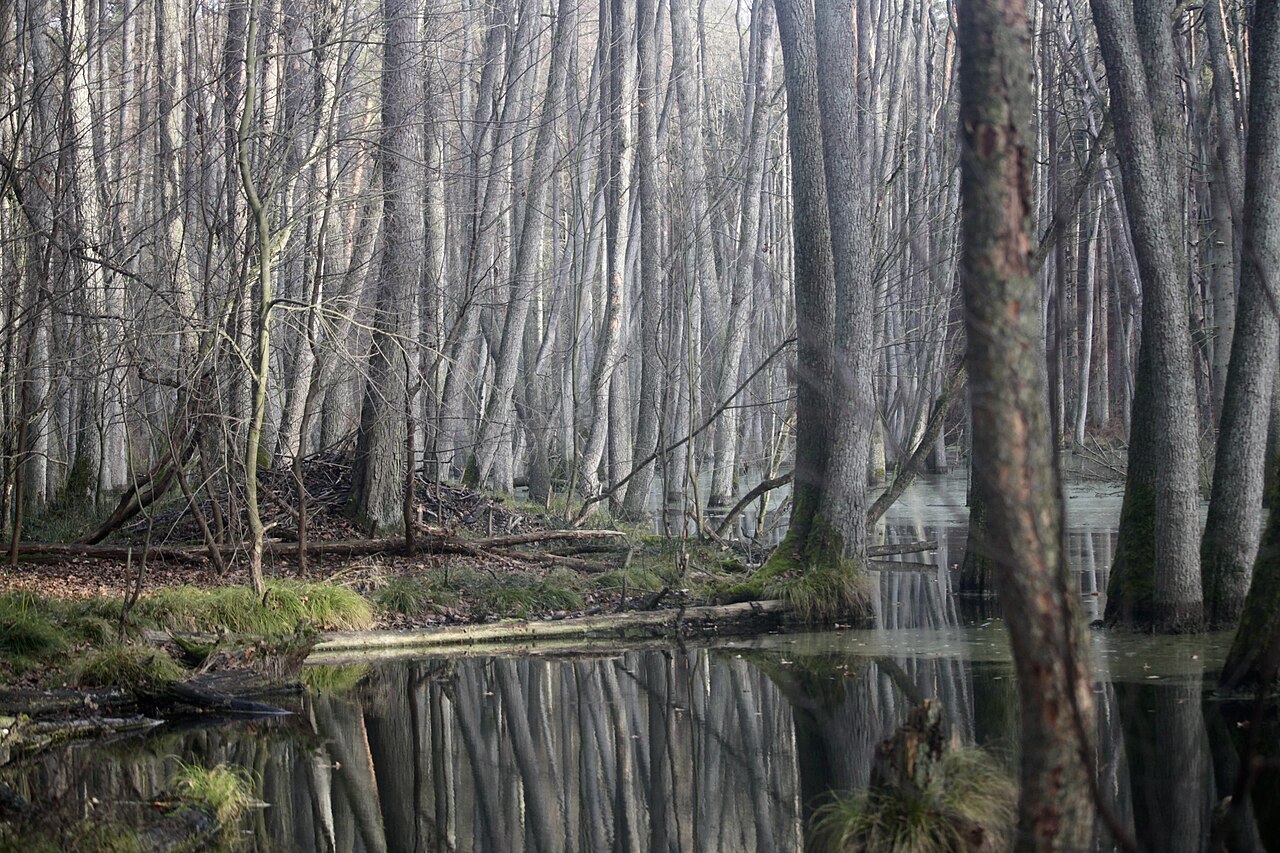
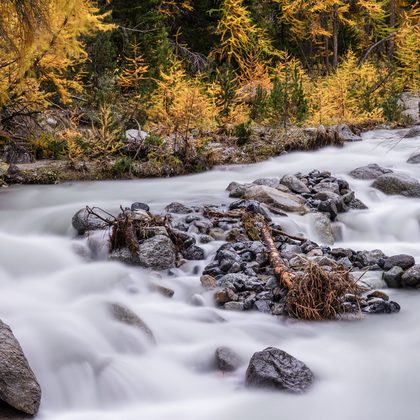
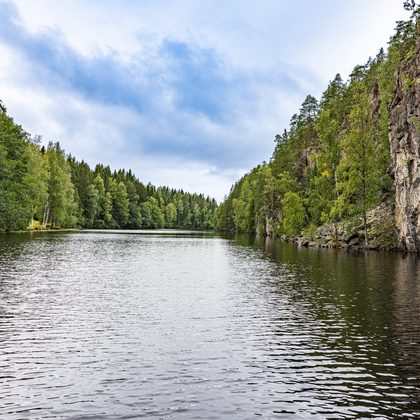
Slow-flowing streams and rivers, backwaters, creeks, marshes, lakes, canals and even ditches, provided three conditions are met: water deep enough all year to keep the entrance submerged, a bank that can be dug into, and softwood within reach. The last condition is decisive: willow, poplar, alder and birch are the winter food, and a river bank without willows is not occupied, however clean the water. The species tolerates farmed landscape well and lives behind flood banks, along canals and on the edges of towns.
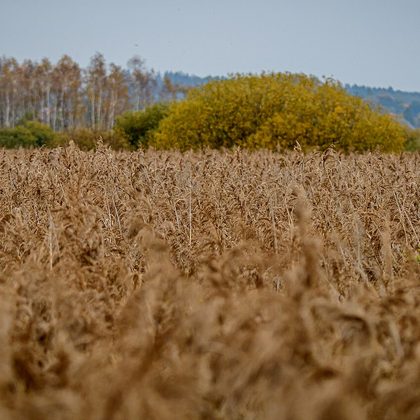
Where the animal is most at home, classified with EUNIS — the European standard for habitats.



Distribution
The present distribution rests largely on reintroduction. The species occurred for centuries from Ireland to Siberia; at the beginning of the twentieth century about 1,200 animals remained in all of Eurasia, in eight separate remnant populations: on the Rhône and the Elbe, in southern Norway, in Belarus and in a few Russian and Siberian river systems. Hunting for fur, meat and above all castoreum had eliminated the other populations. Since then releases have reoccupied almost all large river systems in Europe. In Britain the beaver had disappeared by the sixteenth century; place-names such as Beverley, Beverley Brook and Barbon recall it. Recovery began with an unlicensed population on the Tay and an official trial release at Knapdale (Argyll) in 2009; in Scotland the beaver was recognised as a native species in 2016 and legally protected in 2019. In England, where escaped and released animals occupy the River Otter in Devon and many other catchments, the population exceeded a thousand animals in 2024, and in that year the first licensed wild releases were approved; Wales is following. In the Netherlands the last beaver was killed at Zalk on the IJssel in 1826; in 1988 the first animals, from the Elbe, were released in the Biesbosch, soon followed by the Gelderse Poort, the Limburg Meuse, Flevoland and Drenthe, and several thousand animals now live there. In Wallonia the species returned in the late 1990s through unofficial releases in the Ourthe catchment and spread from there to Flanders, where it now occurs along the Meuse, the Dijle and the Demer. On the Iberian Peninsula the species died out in the seventeenth century. In 2003, 18 animals were released without authorisation on the middle Ebro; from there the population spread through Navarre, Aragon, La Rioja and Catalonia to more than a thousand animals by around 2020. The authorities first tried to remove the animals; later the species, as a native species protected by European legislation, came under management. In early 2024 the species was also confirmed on stretches of the Guadalquivir in the province of Jaén, probably after further unofficial releases. In addition, the beaver is naturally colonising the western Pyrenees from the French reintroduction areas.
- Native
- Reintroduced
- dark = core range, pale = thinly spread
Way of life
Nocturnal, with most activity between dusk and the middle of the night; in quiet areas and in late winter also in the late afternoon. The beaver is active in winter: there is no hibernation or winter rest. It then lives on the branches stored under water and swims under the ice between lodge and cache; where there is no ice, as in southern Europe, it also comes ashore in January. The diet is entirely vegetarian: in summer aquatic plants, herbs, grass and bankside vegetation, in winter bark and twigs of willow, poplar and alder. Beavers live in family groups of a pair that stays together for life, with the young of this year and the previous year, usually four to eight animals in all. Two-year-olds are driven out and travel up- or downstream, sometimes tens of kilometres, until they find an unoccupied stretch of bank. Once a year, in May or June, two to four young are born after a gestation of just over a hundred days, furred and with open eyes; they can swim almost immediately but stay with the family for two years. A beaver can stay under water for a quarter of an hour; nose and ears are closed off, and a transparent third eyelid protects the eye. In the wild a beaver lives ten to fifteen years.
Where and when to look
In May and June, sit by a quiet bank from an hour before sunset, with the wind blowing off the water and without moving; the beaver almost always leaves the water at the same point and then follows a fixed route. That point can be found by day from the slide and fresh white chips. The first activity often begins only after sunset, so waiting until it is fully dark is worthwhile. A tail slap means the animal has noticed the observer; it usually returns within ten minutes. Reliable sites include the Biesbosch, the Gelderse Poort, the Zwarte Water and the Limburg Meuse in the Netherlands, the Dijle valley in Flanders, the Tay and Earn catchments, Knapdale in Argyll, the Otter in Devon and the release sites in Cornwall and Kent in Britain, and the middle Ebro in Navarre, La Rioja and Aragon and some Pyrenean tributaries in Spain. In winter the signs themselves are easy to see: a freshly felled poplar with a heap of chips around it is visible from a distance.
Conservation status
Least Concern (LC, 2021). From about 1,200 animals around 1900 the Eurasian Beaver has increased, through protection and hundreds of release projects, to well over a million, in almost all countries where it formerly occurred. Britain (first Scotland, then England), the Netherlands, Belgium, Spain, Hungary and Denmark have all regained the species through releases. The increase raises management questions. In parts of Germany and the Netherlands the beaver has changed from a protected rarity to a management issue: burrowing into dykes and embankments, flooded fields and undermined railway embankments, and discussion about when intervention is permitted. In Spain the population derives from an illegal release in 2003; the authorities first tried to remove the animals, and now that the species is protected by European legislation, the country manages a recovery that was not planned. There, too, there are conflicts over felled poplars in plantations, dammed irrigation channels, undermined embankments and flooded plots, with discussion about compensation and intervention. There are two further concerns. The first is the North American Beaver, released in Finland in 1937, which has displaced the Eurasian Beaver there and is spreading east; the species do not interbreed, but the North American Beaver displaces the Eurasian. The second is genetic: almost all western European beavers descend from a small number of founders from the Elbe and Rhône remnant populations, and genetic variation is therefore limited.
Scientific name
Castor fiber | Linnaeus, 1758
Linnaeus described the species in 1758 and placed it straight away in the genus where it still stands. Castor is the Latin word for 'beaver', borrowed from Greek kastōr. fiber is a second Latin word for 'beaver', alongside castor. The specimen the first description was based on came from Sweden.