All species › Rodents › Squirrels and marmots › American red squirrel
American red squirrel | Tamiasciurus hudsonicus
Amerikaanse rode eekhoorn | Tamiasciurus hudsonicus
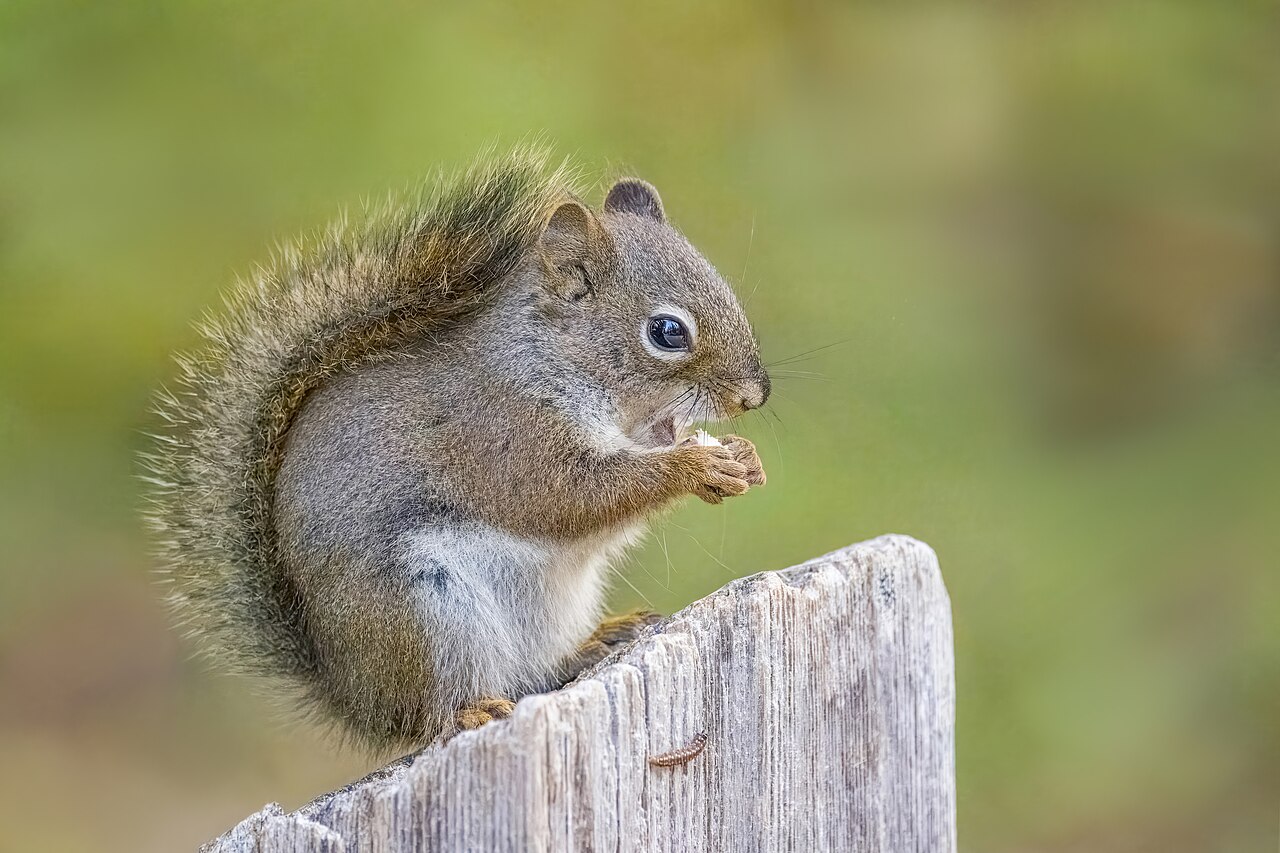
The American Red Squirrel is a North American tree squirrel that is established nowhere in Europe. Released or escaped animals from the cage-animal trade have been recorded regularly in the Netherlands and Belgium, a few hundred times since 2011. The species resembles the Red Squirrel: it is red, has ear tufts in winter and is found mainly in town parks.
Tracks
In North America the best-known sign of this species is the midden; in Europe such middens are not found, because there is no established population. Unlike the Red Squirrel, which buries its food scattered over a large area, this species keeps one central store and feeds year after year in the same place. Under a regular perch a heap of gnawed cone scales and cores builds up that can reach twelve metres across and tens of centimetres deep: a damp, cool store used for years, in which the cones of the new crop are buried. Such a heap in a European conifer wood would point to this species and not to the Red Squirrel. In addition there are stripped cones, gnawed from the base to the core with a tuft of untouched scales at the tip, identical to those of the Red Squirrel and inseparable from them, and the bounding trail of four prints in a group, which is the same in all tree squirrels and smaller in this species. The clearest character is the voice: a hard, rattling alarm call that continues for minutes as soon as someone stands under the tree, sharper and more sustained than the short chatter of the Red Squirrel.
In its habitat

Identification
A small tree squirrel, one of the smallest in North America, and clearly smaller than the Red Squirrel: head-body about 19 cm, tail about 12 cm (barely two-thirds of the body) and 200 grams or a little more, against 250 to 340 grams in the Red Squirrel. Upperparts red-brown to olive-grey with a rusty dorsal band, underparts white to off-white. In summer coat a black lateral stripe runs between the red flank and the white belly, which the Red Squirrel lacks; in winter coat that stripe fades and ear tufts grow, so that the resemblance to the Red Squirrel is then greatest. A distinct white ring surrounds the eye. The tail is short, flat and less full than in the Red Squirrel, red-brown with a dark band and a pale fringe. The species is vocal and jerks its tail when giving alarm calls.
Similar species
The Red Squirrel is the species with which confusion is most frequent: both are red, both climb, and both carry ear tufts in winter. Four characters are useful. First, size: the American Red Squirrel is clearly smaller and more compact, at about two-thirds of the weight. Second, the white eye ring, which the Red Squirrel lacks. Third, the tail: shorter, flatter and less bushy, with a dark band and a pale fringe, whereas the Red Squirrel's is long, full and uniform in colour, from red-brown to cream. Fourth, in summer, the black flank stripe between back and belly. The Grey Squirrel is much larger and grey, with a white, woolly tail fringe. A red squirrel in a European wood is almost always the Red Squirrel; a record of the American Red Squirrel requires a photograph.
Habitat
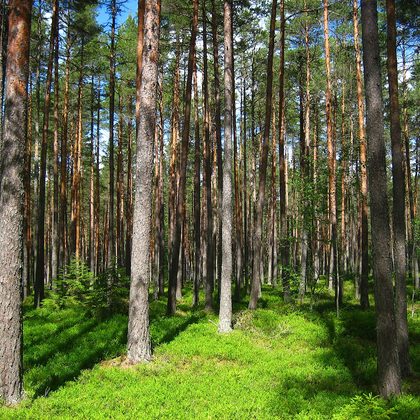
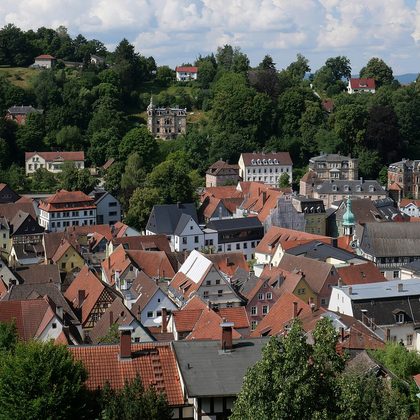
In North America conifer and mixed forest with a closed canopy and a good cone crop (spruce, pine, hemlock and fir), where a central store can be established; also broadleaved woodland with maple, beech and oak, and gardens, parks and suburbs. In Europe the species has no habitat of its own: the animals recorded stayed in town parks, villa gardens, avenues and small woods around the place where they escaped or were released. The two sites where more than one animal was present, a wooded area in Gaasterland (Friesland) and a city park in Rotterdam, are of that type.
Where the animal is most at home, classified with EUNIS — the European standard for habitats.



Distribution
Native to North America: from Alaska and all of Canada through the Rocky Mountains to New Mexico and along the Appalachians into the southern United States. In Europe the species is established nowhere; records come almost only from the Netherlands and Belgium. In the Netherlands there have been a few hundred reports since about 2011, spread over the whole country with a concentration in the Randstad. Almost always it concerns a single animal that stays for some time in a park or neighbourhood and is then not seen again; the high number of reports in 2020 largely comes from one animal in Almere. At two sites there was more: at Gaasterland (Friesland) a nest with young was found in 2012, and according to residents breeding had occurred earlier; in the Kralingse Bos near Rotterdam a lactating female was recorded in 2019. In Belgium there are a few dozen reports from Flanders and Wallonia, all included in the non-native species datasets. Elsewhere in Europe, including Spain, the species has hardly been recorded. In all cases the origin is the trade in cage animals.
- Established introduction
- dark = core range, pale = thinly spread
Way of life
Diurnal and active all year, without hibernation or winter rest; only in severe storms or frost does the animal stay in the nest for a few days. The diet consists mainly of conifer seed, supplemented with fungi (which are dried in a tree fork), buds, bark, tree sap tapped by cutting the bark, berries, nuts, insects, eggs and nestlings. Unlike the other squirrels in Europe, this species holds a territory that is defended all year: less than a hectare per animal, with the central store in the middle, and with sustained alarm calls against every intruder. Females are fertile for only one day per oestrus and have one, sometimes two, litters a year; after a gestation of 31 to 35 days three to five young are born in a tree hole or a drey, leave the nest at seven weeks and are weaned at about fourteen weeks. In the wild few animals live beyond five years.
Where and when to look
In Europe this is not a species to search for, but it is one to watch out for. If you see in a park or garden a small, compact red squirrel with a distinct white eye ring and a short tail, check in summer for a black stripe between back and belly, take a photograph and report the record. With this species every record matters, because an animal removed before a second animal is present cannot form a population. Listen as well: the long, hard rattle fits no native squirrel. In its natural range the species is quickly found in almost any Canadian or American conifer forest by its alarm call.
Conservation status
Least Concern globally (LC, 2016), with a large range in Canada and the United States, where the species is common. This assessment concerns North America and says nothing about Europe, where no population exists. The species is not on the Union list of invasive alien species of Union concern (Regulation 1143/2014), unlike the Grey Squirrel, the Eastern Fox Squirrel, Pallas's Squirrel and the Siberian Chipmunk. It is therefore the only North American tree squirrel that may still be freely traded and kept in Europe. The Dutch records derive from kept animals, and as long as the trade continues, the possibility remains that two animals are released at the same place at the same time. The two cases of breeding (a nest with young at Gaasterland in 2012, a lactating female in the Kralingse Bos in 2019) show that the species can breed in Dutch woodland. The risks concern food competition with the Red Squirrel and the possibility that the species, like the Grey Squirrel, transmits diseases to which the native squirrel is not resistant. Management takes place case by case on the basis of reports: the advice each time is to trap an animal present before a second one arrives. This approach is effective as long as it is applied early.
Scientific name
Tamiasciurus hudsonicus | (Erxleben, 1777)
Erxleben described the species in 1777 as Sciurus hudsonicus; because it was later moved to another genus, the author and year stand in brackets. Tamiasciurus joins Tamias, the chipmunks, to Sciurus, the true squirrels. hudsonicus means 'of Hudson Bay', the region of Canada from which the first specimens reached Europe. The specimen the first description was based on came from Canada, Ontario.