All species › Bats › Vesper bats › Eurasian Serotine
Eurasian Serotine | Cnephaeus serotinus
Laatvlieger | Murciélago hortelano
The Eurasian Serotine is one of the largest bats of central and western Europe: forearm 48 to 58 mm, weight 18 to 25 grams, wingspan about 37 cm. Until 2023 it was known as Eptesicus serotinus; in that year Cláudio and colleagues placed the Old World species of Eptesicus in the genus Cnephaeus Kaup, 1829, an arrangement followed by the Mammal Diversity Database. Older literature and most identification keys still use the name Eptesicus. Maternity colonies are mainly in buildings; the bats hunt at dusk along woodland edges, over pasture and around streetlamps.
Tracks
Maternity colonies are in buildings: in cavity walls, behind roof boarding and cladding, along ridges and in large cavities under the roof; sometimes in tree holes or rock crevices. The entrance is a narrow gap, and droppings accumulate below the access point or in the loft; they are larger than those of pipistrelles and contain many beetle fragments. The bats emerge about twenty minutes after sunset, earlier than most other species, and the large, broad-winged animals can be seen against the dusk sky. On a detector the calls sound like irregular dry claps at 25 to 30 kHz. During lactation there is a second activity peak around dawn.
Identification
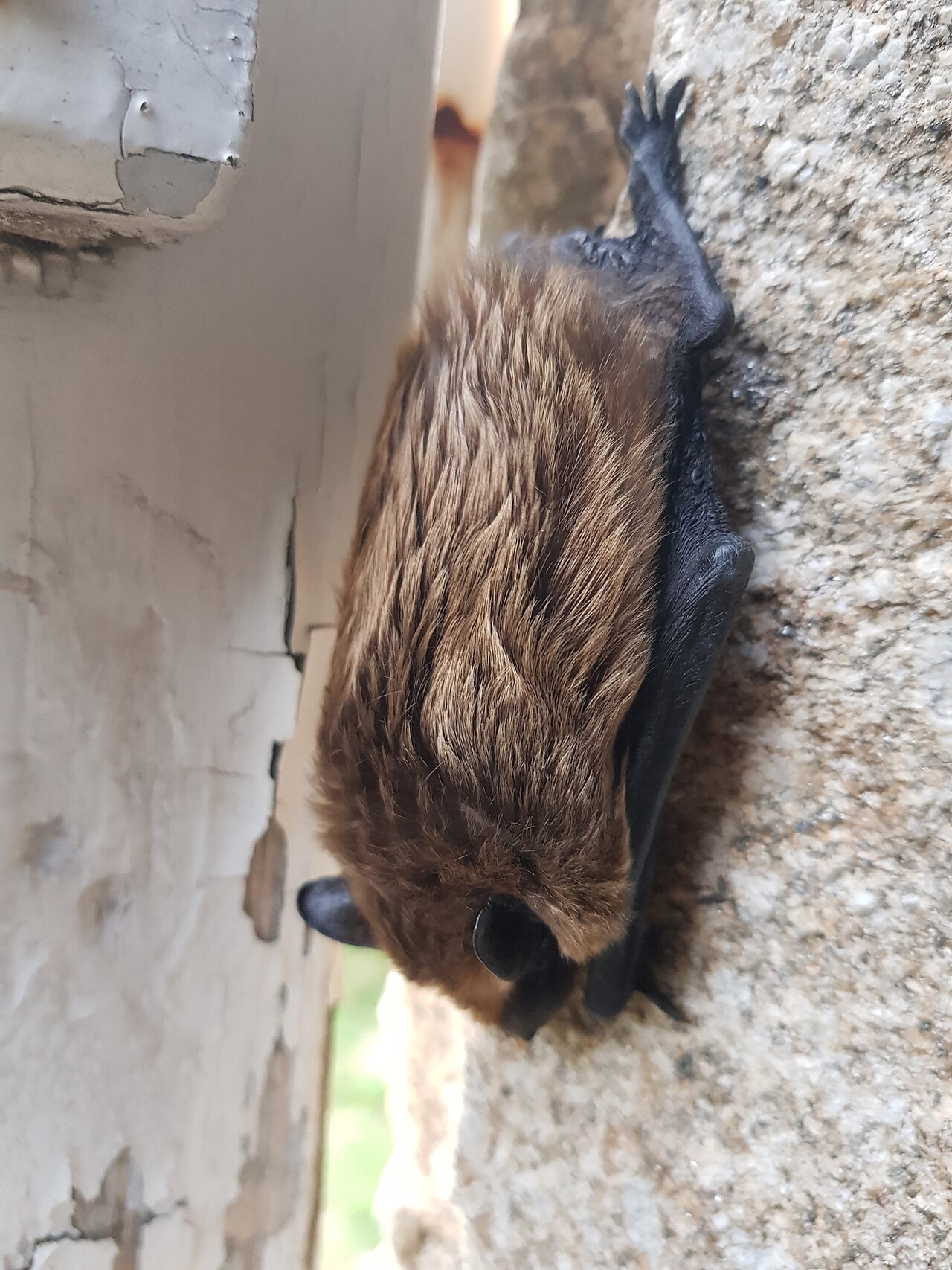
A large, robust bat with broad wings and a slow but agile flight with brief glides, usually at 10 to 15 m along woodland edges and hedgerows, occasionally up to 30 m. The dorsal fur is long and silky, smoky brown with a yellowish sheen (hairs with yellowish tips and dark bases), dark brown to reddish in some individuals; the underparts are paler, grey to buffy brown. Muzzle, ears and membranes are dark brown to blackish. The ears are moderately tall and triangular with rounded tips; the tragus is less than half the ear length and bluntly pointed. The tail projects 3 to 5 mm beyond the tail membrane. Search calls are frequency-modulated with a near-constant end (FM/QCF), with the peak generally between 23 and 44 kHz: around 34 kHz on average in Britain, 22.7 to 28.8 kHz in Spain. The rhythm is irregular.
Similar species
The Northern Serotine (Cnephaeus nilssonii) is smaller (forearm 37 to 44 mm) and has golden hair tips on a dark brown to blackish back. In the south of the Iberian Peninsula and in the Maghreb lives Cnephaeus isabellinus, long treated as a subspecies of the Eurasian Serotine; the two cannot be reliably separated externally or on a bat detector, and assignment rests on locality and DNA. On Rhodes, Cyprus and in southern Turkey C. anatolicus occurs, with paler, creamy fur. The Common Noctule (Nyctalus noctula, forearm 47 to 60 mm) is similar in size but has narrow, pointed wings, reddish-brown fur and a fast, high flight; Leisler's Noctule (N. leisleri) and the Particoloured Bat (Vespertilio murinus) are smaller. On a detector the calls of Eurasian Serotine, Northern Serotine, Nyctalus species and Particoloured Bat overlap and are often recorded together as a group.
Habitat
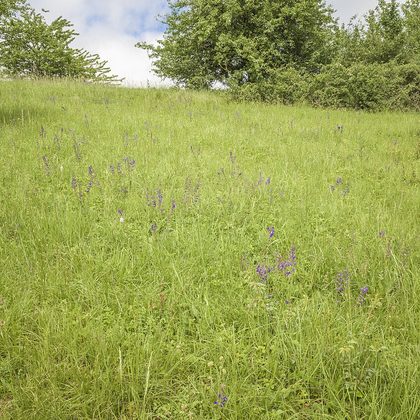
The species occurs in semi-open farmland, pasture (often above grazing cattle), woodland edges, parks and gardens with old trees, riparian vegetation and built-up areas; in the south and east of the range also in semi-desert and scrub. The handbook gives elevations from sea level to about 1440 m. Foraging takes place in open space: along woodland edges, tall hedgerows and tree lines, over meadows and orchards, around streetlamps and over water. Foraging areas usually lie 4 to 12 km from the roost.
Where the animal is most at home, classified with EUNIS — the European standard for habitats.






Distribution
In the guide area most of Europe: southern Britain, the north and centre of the Iberian Peninsula east to south-western Russia, the Caucasus and northern and eastern Turkey, with the southern tip of Scandinavia as the northern limit, and islands including the Balearics, Corsica, Sardinia, Sicily, Corfu, Lesbos, Samos, Crete and Rhodes. The subspecies mirza lives in southern Turkey, western Syria, Lebanon and Israel; turcomanus in Central Asia. In southern Portugal and Spain and in North Africa the Eurasian Serotine is replaced by C. isabellinus. Where exactly the boundary with C. pachyomus lies in Iran and further east has not been established.
Way of life
The Eurasian Serotine hunts in the air but also takes insects from vegetation or the ground. The diet consists mainly of beetles (dung beetles, cockchafers), supplemented with moths, true bugs and flies, mostly prey of 5 to 25 mm. An individual visits up to ten foraging sites a night. Maternity colonies usually hold 10 to 60 females, exceptionally up to 300, and last from May to August; roost temperature is around 22 °C. Males live alone or in groups of up to 20. Mating takes place in September and October; sperm is stored in the females until spring. Gestation averages about 52 days and the single young (twins are exceptional) is born around mid-June; it flies at about three weeks and is weaned at six to seven weeks. The species is considered sedentary: the longest recorded movement is about 330 km. Hibernation is mostly solitary, in crevices in walls, buildings or rocks, sometimes near cave entrances; many bats stay in or close to the summer roost. The greatest recorded age is 19.5 years.
Where and when to look
The best chance is in June and July at a known roost: stand by the building twenty minutes after sunset and count the bats as they emerge from the gap. After that, serotines can be seen at dusk along woodland edges, over pasture and around streetlamps at the edge of villages. On a detector a series of irregular calls around 25 to 30 kHz is an indication, not proof: the Nyctalus species and the Particoloured Bat call in the same band. In southern Spain and Portugal a serotine-type bat can only be recorded as Cnephaeus sp. without genetic analysis.
Conservation status
Least Concern (LC, 2021). The species is common over much of its range. Trends differ between countries: numbers appear to be increasing in Denmark and decreasing in Britain, Austria and the Pannonian Basin; in Austria a decline of about 70 per cent is cited, and the species has disappeared from the eastern lowlands there. Causes cited are roost disturbance, including during renovation and insulation of buildings, loss and fragmentation of habitat and a decrease in large insects. The Eurasian Serotine is listed in Annex IV of the Habitats Directive and is covered by the Bern Convention and the EUROBATS Agreement.
Scientific name
Cnephaeus serotinus | (von Schreber, 1774)
Von Schreber described the species in 1774 as Vespertilio serotinus; because it was later moved to another genus, the author and year stand in brackets. Cnephaeus is Greek, from knephaios, 'dark, of the twilight', from knephas, 'dusk'; Kaup coined it in 1829, and it has only recently come back into use. serotinus is Latin for 'late, of the evening', from serus, 'late', after its hunting at dusk. The specimen the first description was based on came from France.