All species › Bats › Vesper bats › Northern Serotine
Northern Serotine | Cnephaeus nilssonii
Noordse vleermuis | Murciélago norteño
According to the Handbook of the Mammals of the World the Northern Serotine is the most northerly distributed bat species: it breeds above the Arctic Circle in Norway, Sweden and Finland. Forearm 37 to 44 mm, weight 9 to 13 grams. The species was listed as Eptesicus nilssonii until 2023; since then the Mammal Diversity Database places it, with the other Old World species of Eptesicus, in the genus Cnephaeus. In much of Scandinavia and Finland it is the most numerous bat; in central Europe the range is largely confined to the uplands and the Alps.
Tracks
Maternity colonies are usually in buildings: under roofing, behind panelling, in walls and in cavities under metal sheeting; sometimes in tree holes. Droppings lie below the entrance. Males usually live alone all year. In autumn individuals defend their foraging areas and the surroundings of hibernation sites with chases and audible calls. In winter single bats are found in cellars, houses, caves and mines, often near the entrance and at temperatures around 0 to 2 °C. On a detector the species gives a series of calls around 30 kHz in a regular pattern along a fixed beat.
Identification
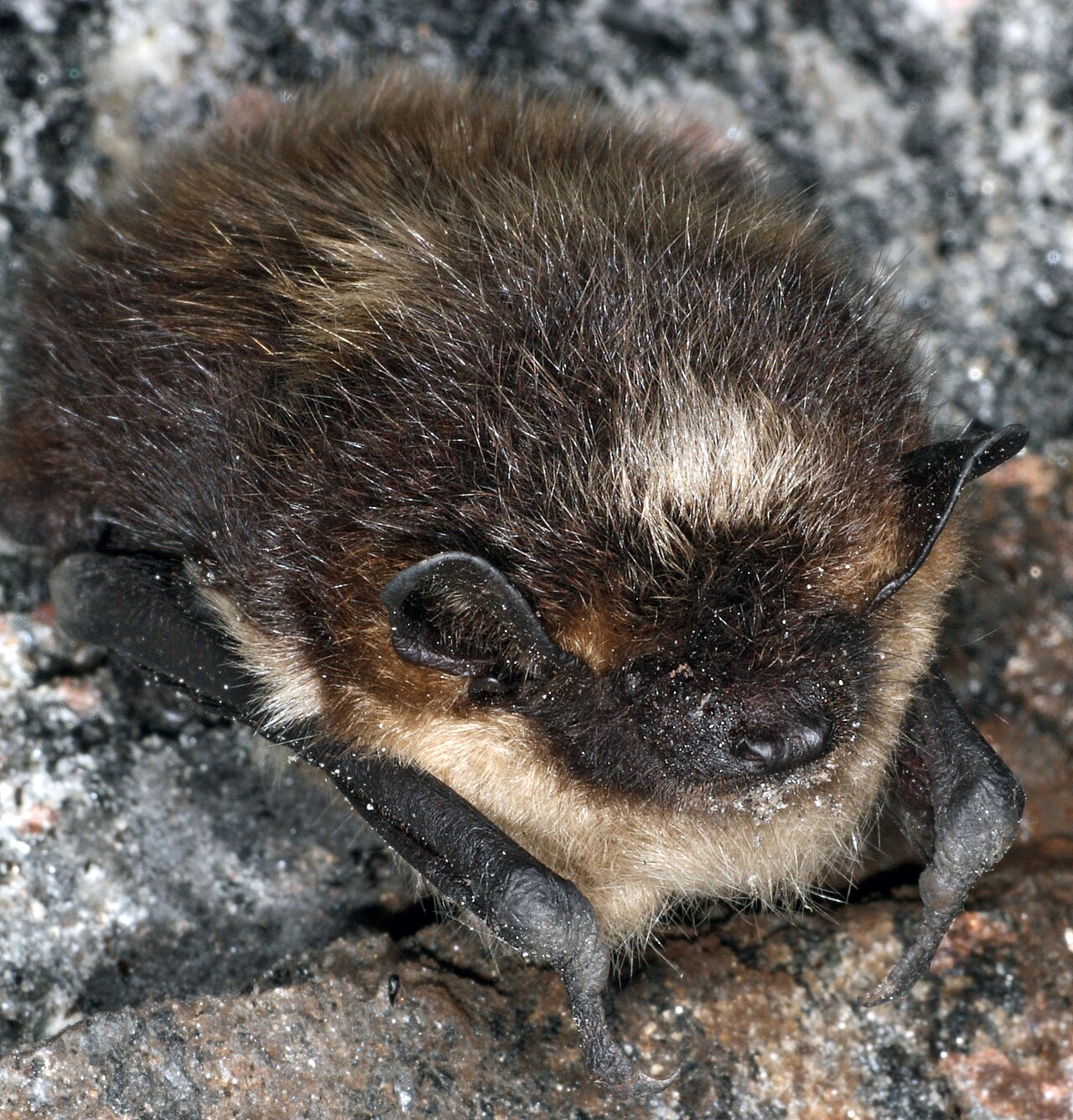
A medium-sized bat with long, silky, dark brown to blackish dorsal fur with golden-yellow hair tips, giving the back a yellowish sheen; the underparts are light brown to beige. Face, ears and membranes are dark brown. The ears are short, rounded and fleshy; the tragus is short, rounded and curved inwards. The wings are broad and long, with a wingspan of 24 to 28 cm, and the tail projects slightly beyond the tail membrane. Flight is fast and straight, at 2 to 20 m, often on fixed beats along a woodland edge or around a streetlamp. Search calls are frequency-modulated with a near-constant end (FM/QCF), up to 20 ms long, with the peak frequency usually between 26 and 32 kHz; an average of 32.4 kHz was measured in Sweden.
Similar species
The Eurasian Serotine (Cnephaeus serotinus) is larger (forearm 48 to 58 mm) and has a smoky brown back without the golden frosting. The Particoloured Bat (Vespertilio murinus) is of similar size and also has pale hair tips, but has a sharply demarcated white belly and throat and silvery rather than golden frosting. Savi's Pipistrelle (Hypsugo savii) is smaller (forearm 31 to 38 mm) and occurs mainly in southern Europe. On a bat detector the search calls of Northern and Eurasian Serotine are not well separable, and there is broad overlap with the Nyctalus species and the Particoloured Bat. Social calls are long near-constant-frequency tones of up to 60 ms, with strong second and third harmonics.
Habitat
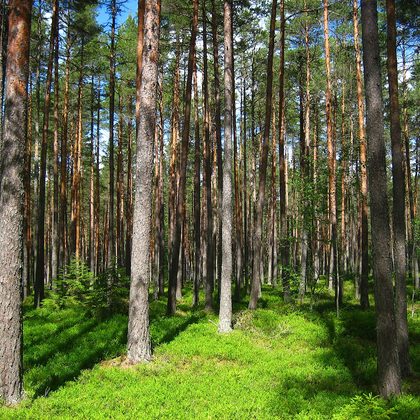
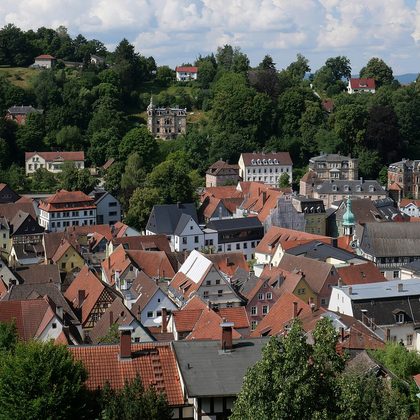
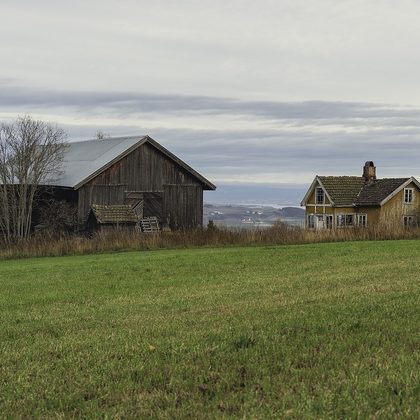
Boreal forest and mountain regions, mainly coniferous and mixed forest with clearings, woodland edges, lakes, marshes and bogs; also parks, gardens and villages, where the species often hunts around streetlamps. The handbook gives elevations from sea level to about 2920 m. Foraging areas are usually 1 to 10 km from the roost, exceptionally much further. In Sweden density at 57° N was five times higher than in similar landscape at 65° N.
Where the animal is most at home, classified with EUNIS — the European standard for habitats.

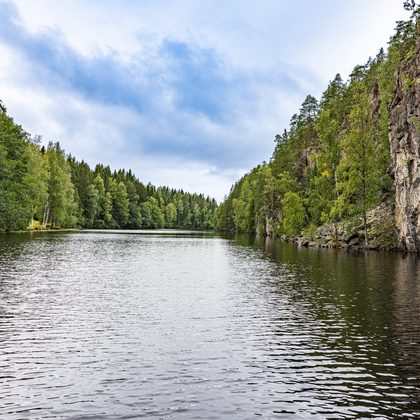
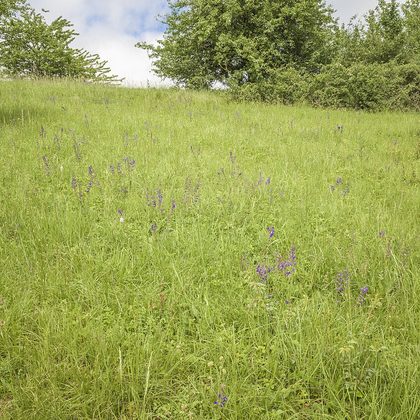
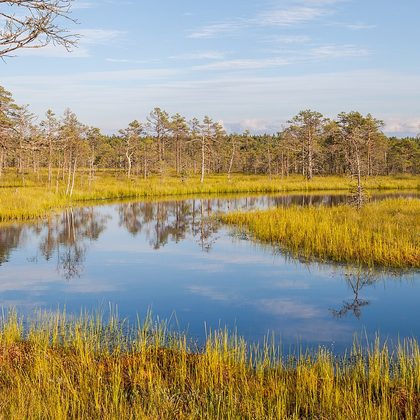
Distribution
In the guide area Norway, Sweden, Finland, the Baltic states and western Russia, and further south eastern France, the Alps, the Carpathians, the uplands of Germany, Czechia and Poland and the Caucasus. The species is largely absent from the lowlands of western and central Europe. Vagrants have been reported as far as Bulgaria, Italy and southern Britain. Outside the guide area the range continues through Siberia and Central Asia to north-east China, Korea, Sakhalin, Kamchatka and Hokkaido. The handbook notes that the distribution is given differently in different sources and should be regarded as tentative. The species is now considered monotypic.
Way of life
The Northern Serotine hunts in flight, mainly for small midges (Nematocera), also beetles, moths and true bugs, and can forage at temperatures just above freezing. In the light summer nights of the north foraging time is short: lactating females foraged 120 to 130 minutes a night just after giving birth and up to 320 minutes at peak lactation. Females often hold a small fixed feeding territory of around 100 m², to which they sometimes return for years. One or two young are born from mid-June to late July, later at higher latitudes; they fly at two to three weeks. Females do not usually breed in their first three years. Hibernation lasts from November or December to March or April, singly, in sites of 0 to 2 °C, sometimes down to −5 °C. The longest known movement in Europe is about 450 km. The greatest recorded age is about 20 years.
Where and when to look
In Scandinavia and Finland the species can be seen on summer evenings near villages and farms, hunting around streetlamps and along woodland edges; in June it is still light enough around midnight to follow the bats. In the Alps and central European uplands maternity colonies are mostly in houses and other buildings in villages. A bat flying a fixed beat around a lamp and calling around 30 kHz on a detector is an indication; the fur with golden tips can only be seen at close range, in the hand or on a photograph.
Conservation status
Least Concern (LC, 2016). In the north of the range the species is numerous and is sometimes called the commonest bat; in parts of central Europe, such as Germany, it is rare and regionally threatened. Climate change is cited as the main threat, because much of the range lies in northern habitats that will be strongly altered by rising temperatures. Disturbance and loss of roosts in buildings also play a part. The species is listed in Annex IV of the Habitats Directive and is covered by the Bern Convention and the EUROBATS Agreement.
Scientific name
Cnephaeus nilssonii | (von Keyserling & J. H. Blasius, 1839)
Von Keyserling & J. H. Blasius described the species in 1839 as Vesperugo Nilssonii; because it was later moved to another genus, the author and year stand in brackets. Cnephaeus is Greek, from knephaios, 'dark, of the twilight', from knephas, 'dusk'; Kaup coined it in 1829, and it has only recently come back into use. nilssonii honours the Swedish zoologist Sven Nilsson (1787–1883), author of the Skandinavisk fauna. The specimen the first description was based on came from Sweden.