All species › Bats › Vesper bats › Giant noctule
Giant noctule | Nyctalus lasiopterus
Grote rosse vleermuis | Nóctulo Grande
The Greater Noctule is the largest species of the genus Nyctalus and the largest bat in Europe: forearm 59 to 70 mm, weight 33 to 74 grams, wingspan 41 to 46 cm. Von Schreber described it in 1780 as Vespertilio lasiopterus; the type locality is uncertain, possibly Pisa. The species lives in old forest, hunts high above the canopy and in spring and autumn eats, in part, nocturnally migrating songbirds. In the guide area it is scattered over a patchwork of little-known sites.
No photograph of a living wild animal of this species with a suitable Creative Commons licence exists. Do you have one that meets the rules? Send it in.
Tracks
Summer roosts are in hollow trees and bat boxes, sometimes in buildings and in the dry leaves of tall palms (Washingtonia filifera); in winter mainly in hollow trees and rock crevices. On emergence the animals drop up to 3 m to gain speed. Maternity colonies hold up to 80 females with young, spread over several trees: the group lives in a fission-fusion society with a social ranking and distributes itself over different roosts every day. The loud, metallic social calls at a roost can be heard without a detector.
Identification
A very large, robust bat with long, narrow wings. The upperparts are reddish brown, with unicoloured hairs; the underparts are paler reddish brown, and belly fur extends onto the wing and tail membranes. Face, ears and membranes are dark brown. The muzzle is short and broad, with large glands between nostrils and eyes; the ears are short and triangular with four or five folds, and the tragus is very short and mushroom-shaped, as in all Nyctalus species. The wings attach at the ankle. The skull is large and robust and the dentition heavy. High in the air (above 50 m) the search calls are steep to shallow frequency-modulated, from an average of 25.1 down to 17.6 kHz, with the peak around 18.8 kHz, a duration of about 12 ms and about 320 ms between calls. Below 20 m the calls become steep FM/QCF with a second harmonic; sometimes two frequencies alternate, as in the Noctule. Social calls are loud, metallic and, with end frequencies of 9 to 15 kHz, audible to humans.
Similar species
The Noctule (Nyctalus noctula) has the same build, colour and tragus but is smaller: forearm 47 to 60 mm against 59 to 70 mm, weight 17 to 44 g against 33 to 74 g. In the overlap zone of 59 to 60 mm, weight, skull and teeth decide. On a bat detector the Greater Noctule's peak of about 19 kHz is lower than the Noctule's 22 to 27 kHz, but calls vary with flight height and overlap in part. Leisler's Bat (N. leisleri, forearm 35 to 46 mm) is much smaller and has bicoloured hairs. The Serotine (Cnephaeus serotinus) has broader wings and a slower, lower flight. The related N. aviator has sometimes been treated as a subspecies of this species, but the handbook treats it as a separate species.
Habitat
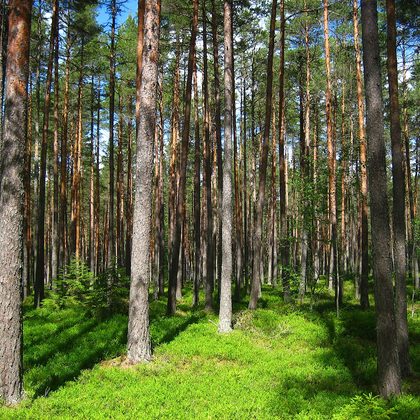
Mature, closed temperate mixed and deciduous forest in Europe; in Morocco intact Mediterranean forest of Cork Oak (Quercus suber) and Q. canariensis, in Libya forest of cypress (Cupressus sempervirens) and juniper. For roosting and hunting the species depends largely on old, intact forest, but on the Iberian Peninsula it also lives in city parks with old trees. From sea level to 1900 m. Foraging areas usually lie 15 to 40 km from the day roost, sometimes up to 130 km in a single night.
Where the animal is most at home, classified with EUNIS — the European standard for habitats.





Distribution
Scattered and local in southern and eastern Europe, from the Iberian Peninsula to western Russia, the Urals and the far west of Kazakhstan, and further on Sicily and Cyprus, in western and north-eastern Turkey, the Caucasus and north-western Iran; in North Africa in northern Morocco and north-eastern Libya, possibly also Algeria. The Iberian Peninsula and northern Hungary, where a large population lives, are regarded as strongholds. In 2020 and 2021 animals fitted with GPS tags were followed from summer quarters in Meshchera National Park (Vladimir Oblast, Russia) to the south-west, as far as Poland, Bulgaria and Italy.
- Native
- dark = core range, pale = thinly spread
Way of life
Nocturnal; the animals emerge at dusk. The Greater Noctule is a fast aerial hawker that usually hunts more than 50 m above ground; radar studies in Spain show flights up to several hundred metres. The food consists largely of flying insects such as moths, dragonflies and beetles, but in spring and autumn the species also takes nocturnally migrating songbirds, such as Robin, Blue Tit and Wood Warbler; in some regions these make up to half of the diet in those seasons. Harvestmen in the droppings indicate that the animals sometimes also take prey from a surface. Mating falls between midsummer and mid-autumn; males have scrotal testes from early August to October. Young are born from early May to early June, one or two per litter, and are suckled until early August. In the north of the range the species probably hibernates, but this has not been confirmed. The species migrates: GPS tags have recorded a seasonal flight of 2515 km, the longest known migration record for a bat, with daily distances of up to 445 km (Vasenkov et al. 2023). Predators include Barn Owl, Saker Falcon and Beech Marten.
Where and when to look
The species is hard to follow in the field because it hunts high above the canopy. A bat detector at 15 to 20 kHz can pick up the low calls; a recording and analysis are needed to separate it from the Noctule. The social calls at a roost at dusk are the most usable sign, since they are audible without a detector. The chance of a record is greatest in the strongholds of the range, the Iberian Peninsula and northern Hungary.
Conservation status
Vulnerable (2016). The range is large but fragmented, with few records in many regions, especially North Africa. Densities are low everywhere and populations appear to be decreasing. The handbook lists as threats the felling of old forest and the loss or disturbance of roosts, where destruction of a roost kills many animals at once, and mortality at wind turbines, including in Spain. In southern Spain the introduced Rose-ringed Parakeet competes with the species for tree holes. Because it hunts high and is hard to survey, the species may be commoner than is currently known. Like all bats in the European Union it is covered by Annex IV of the Habitats Directive and by the EUROBATS Agreement; no species action plans existed in 2019.
Scientific name
Nyctalus lasiopterus | (von Schreber in E. A. W. von Zimmermann, 1780)
Von Schreber in E. A. W. von Zimmermann described the species in 1780 as Vespertilio lasiopterus; because it was later moved to another genus, the author and year stand in brackets. Nyctalus belongs with Greek nyx, genitive nyktos, 'night'; Bowdich gave no explanation, and just which Greek word he was reaching for is not settled. lasiopterus is Greek for 'shaggy-winged', from lasios, 'shaggy', and pteron, 'wing', after the hair on the membrane along the forearm. The specimen the first description was based on came from Italy.