All species › Even-toed ungulates › Rorquals › Fin whale
Fin whale | Balaenoptera physalus
Gewone vinvis | Rorcual común
The Fin Whale is a long, slender baleen whale of 18.5 to 24 metres, found in all oceans. In the guide area it lives in the open Atlantic from Svalbard and Iceland to the Azores and Iberia, and also in the Mediterranean, where a separate subpopulation feeds in summer in the Ligurian Sea. The head is asymmetrically coloured: the right lower jaw is white, the left dark.
Tracks
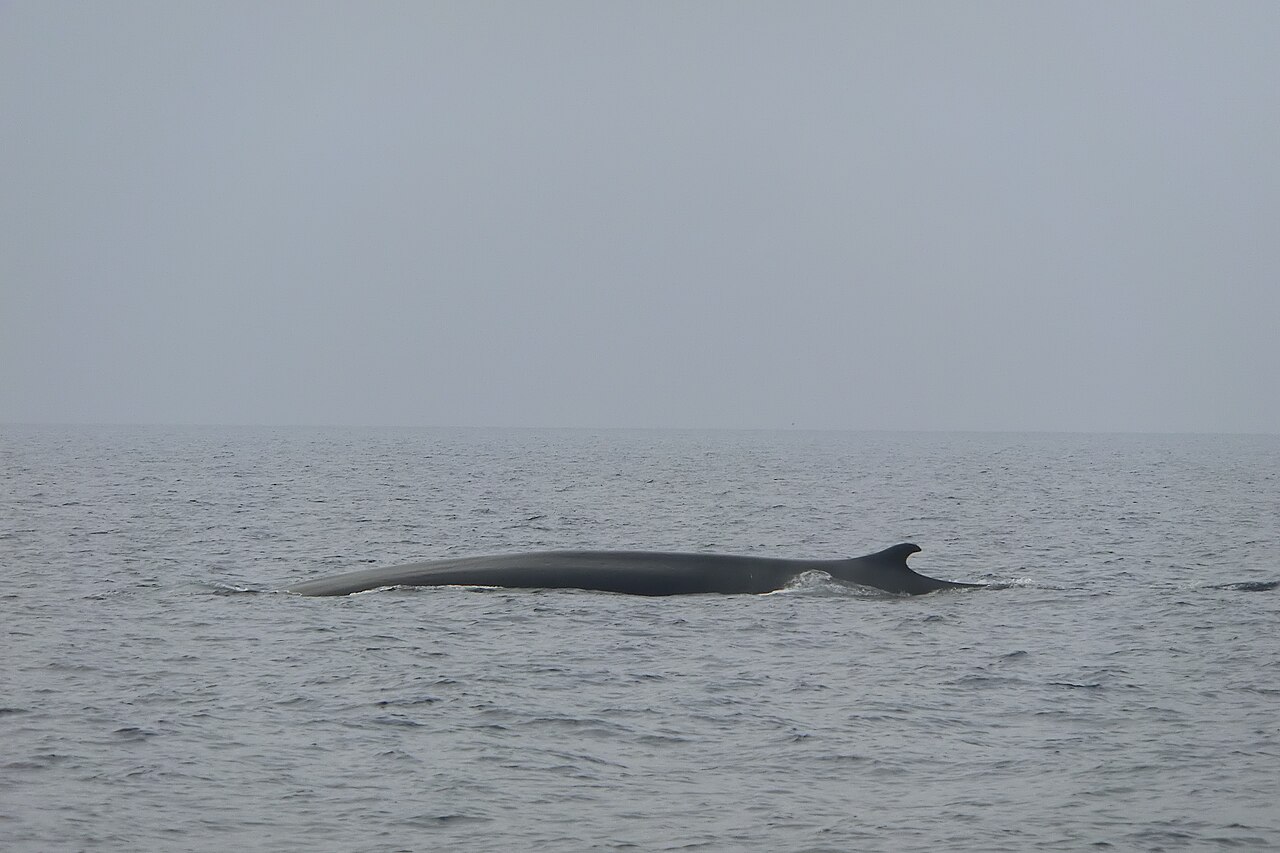
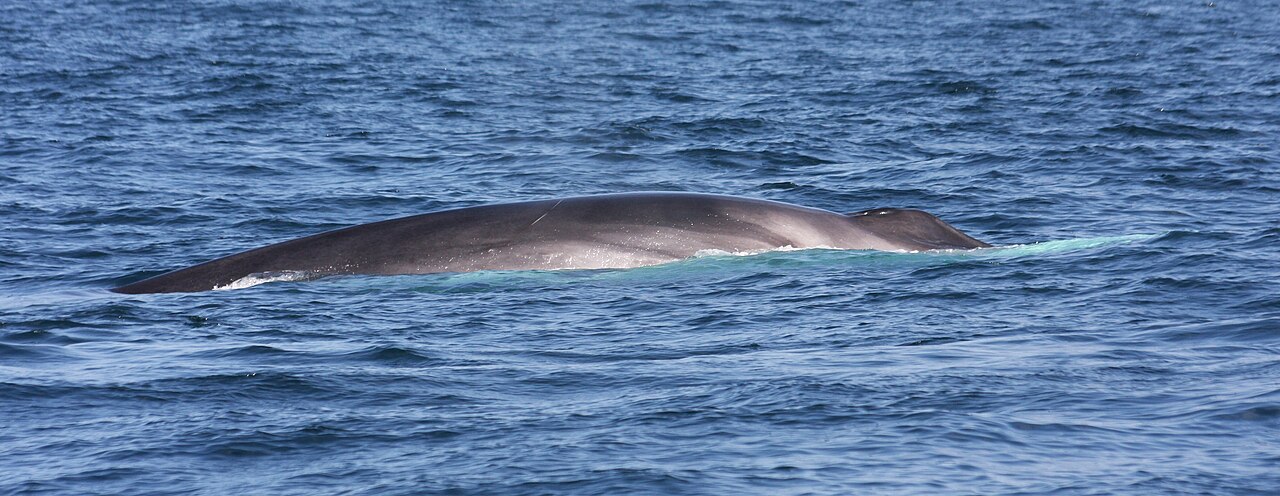
The blow is tall and narrow, an elongated inverted cone of four to six metres, visible from kilometres away in calm weather. After the blow a long dark back rolls through the water, and the dorsal fin appears only some time after the blow. On diving the flukes rarely break the surface. An animal breathes several times at short intervals and then makes a longer dive. Fin Whales are fast swimmers and more social than the other rorquals: they are seen alone, but also in groups of two to seven, and in larger numbers at food concentrations. At close range, and on an animal feeding on its side, the white right lower jaw is the decisive feature.
Head close-up
Identification
A very long, streamlined whale with a dark grey back and a white belly. The head is narrow and pointed, with a single ridge along the top. Characteristic is the asymmetric colouring of the head: on the right side the lower jaw, the lip and part of the baleen are white, sometimes tinged yellowish, on the left side dark. Behind the head a pale, V-shaped swathe (chevron) runs across the back. The dorsal fin is more than sixty centimetres tall, backward-pointing and slightly curved at the tip, and sits far back on the body. Adults are 18.5 to 24 metres long and weigh up to eighty tonnes; females are slightly larger than males.
Similar species
The Blue Whale (Balaenoptera musculus), which is scarce in the guide area, is paler and mottled blue-grey, has a broad, U-shaped head, a very small fin far back, and sometimes raises its flukes on a deep dive. The Sei Whale (Balaenoptera borealis) is smaller, has a taller, more upright fin and a symmetrically dark head, and often shows head and fin at the same time, without the Fin Whale's long roll. The Minke Whale is much smaller, has a white band on the flipper and an almost invisible blow. The Humpback Whale has long white flippers and a low fin on a hump, and raises its flukes on diving.
Habitat
The open sea over deep water, the edge of the continental shelf and deep waters close to the coast, such as the Ligurian Sea. The species eats mainly planktonic crustaceans, above all krill, and also small schooling fish. In the Mediterranean it feeds in summer on the krill concentrations of the Ligurian Sea; in the Atlantic it follows the food-rich shelf edges and submarine ridges.
Where the animal is most at home, classified with EUNIS — the European standard for habitats.

Distribution
In the eastern North Atlantic from Iceland, Svalbard, Jan Mayen and north-west Norway south to the Azores and the Iberian Peninsula. Around Britain and Ireland the species is found mainly in the Faroe-Shetland Channel, the Rockall Trough, around the Porcupine Bank and off the south coast of Ireland. It also occurs in the Bay of Biscay and can be seen there from ferries. The Mediterranean holds a separate subpopulation, which in summer feeds in the Pelagos Sanctuary between Liguria, the Côte d'Azur and Corsica; Atlantic animals pass through the Strait of Gibraltar. In the North Sea the Fin Whale is rare.
- Native
- dark = core range, pale = thinly spread
Way of life
Active by day and night. Gestation is eleven to twelve months and the mating season falls mainly from November to February. A newborn calf is 5.5 to 6.5 metres long and weighs 1,800 to 2,800 kilos. Fin Whales feed by lunging open-mouthed into a swarm of krill or a school of fish, expanding the throat pleats; in doing so they often turn onto their right side. Many animals migrate between summer feeding grounds and more southerly waters, but not all populations migrate in the same way; in the Mediterranean Fin Whales are present all year.
Where and when to look
In the Mediterranean the chances are best from June to September on trips in the Pelagos Sanctuary, from harbours in Liguria and on the Côte d'Azur, and from the ferries from Genoa, Savona, Toulon and Nice to Corsica. In the Atlantic the ferries between England and northern Spain across the Bay of Biscay are a well-known place, in summer. In the Strait of Gibraltar boats leave Tarifa on which Fin Whales are sometimes seen besides dolphins. In calm weather scan the horizon for the tall, narrow blow, and then keep watching the same spot: the back and fin follow only several seconds later.
Conservation status
Vulnerable (VU, 2018). Commercial whaling killed hundreds of thousands of Fin Whales, above all in the twentieth century; since the 1986 moratorium on commercial whaling most populations have partly recovered. Iceland resumed hunting the species in 2006 and has continued with interruptions since. The Mediterranean subpopulation is listed as Endangered (EN); ship strikes are the main known cause of death there, and between six and twenty per cent of the animals bear collision scars. Further threats are underwater noise, pollution and entanglement in fishing gear. The species is listed on Annex IV of the Habitats Directive and is covered by ACCOBAMS and ASCOBANS.
Scientific name
Balaenoptera physalus | (Linnaeus, 1758)
Linnaeus described the species in 1758 as Balæna Physalus; because it was later moved to another genus, the author and year stand in brackets. Balaenoptera is formed from Latin balaena, 'whale', and Greek pteron, 'wing, fin': the whale with a dorsal fin, unlike the right whales. physalus goes back to Greek physa, 'breath, bellows'; the usual explanation is that the name refers to the species' tall blow. The specimen the first description was based on came from Norway, Svalbard/Spitsbergen.