All species › Rodents › Squirrels and marmots › Finlayson’s Squirrel
Finlayson’s Squirrel | Callosciurus finlaysonii
Thaise eekhoorn | Callosciurus finlaysoniie
Finlayson's Squirrel is a South-East Asian tree squirrel that was released at two places in Italy and has become established there. The Italian populations derive from a few escaped or released pets: four animals in a town park in 1981 and three or four pairs in the mid-1980s. Forty years later the species is spreading along the Tyrrhenian coast from village to village, causing damage to trees by ringing stems and branches.
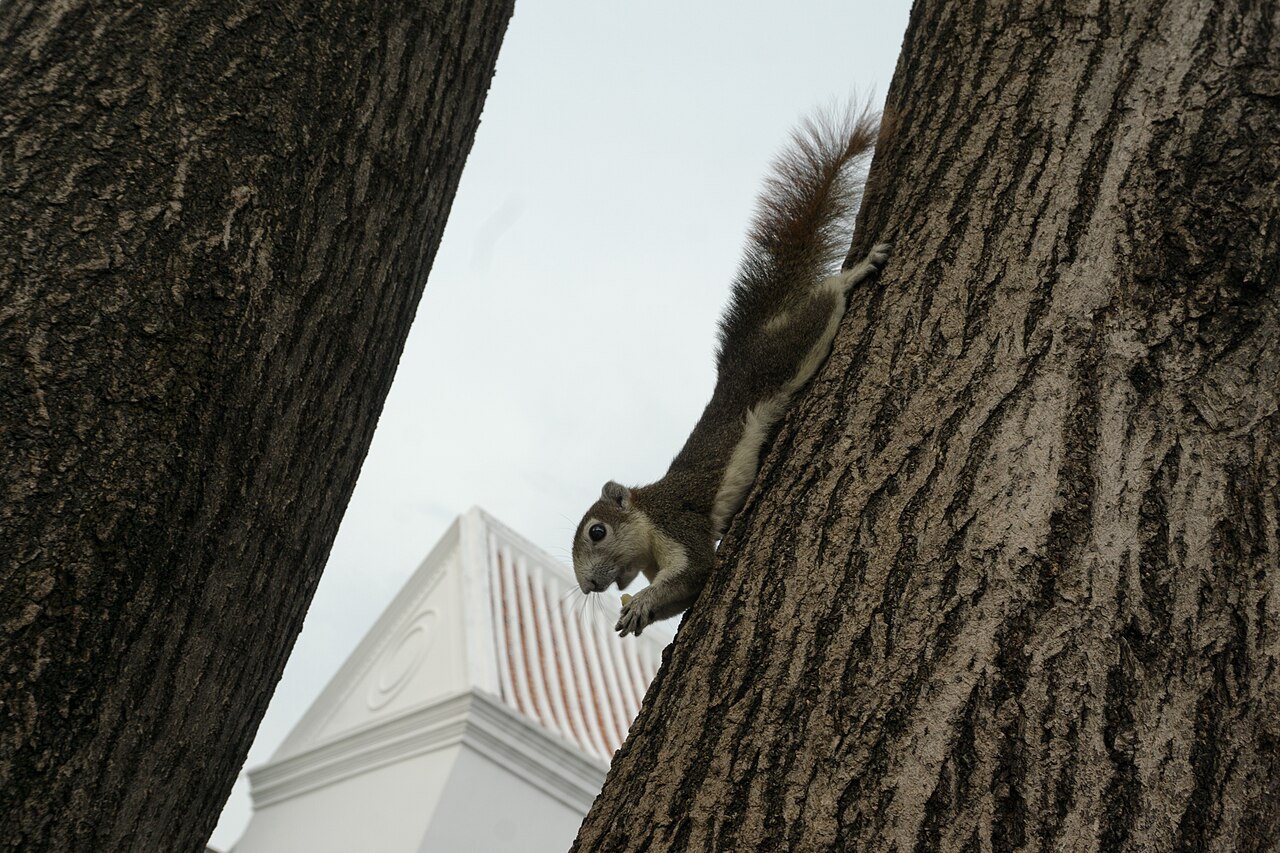
Tracks
The clearest sign of this species is damage to trees. Finlayson's Squirrel strips bark; in the town park in Piedmont where it was released, some eighty per cent of the trees were eventually damaged. Characteristic are fresh, pale patches where bark has been pulled away in strips, often high in the crown and around branch junctions, with tooth grooves in the sapwood; where a stem or a heavy branch is ringed completely, the part above it dies. In Italy the trees concerned are mainly stone pine, oak, olive and carob. Below feeding trees lie gnawed seeds and fruit, bitten-off flower buds and, in winter, gnawed twigs. The nest is a spherical ball of leaves and twigs in a fork or against the trunk, smaller and untidier than a crow's nest. Tracks are rarely found, because the animals hardly come to the ground: they spend most of the day in the canopy and cross open spaces by leaping. The call is the easiest clue: a loud, repeated, barking rattle given from a branch, audible over some distance along a village street.
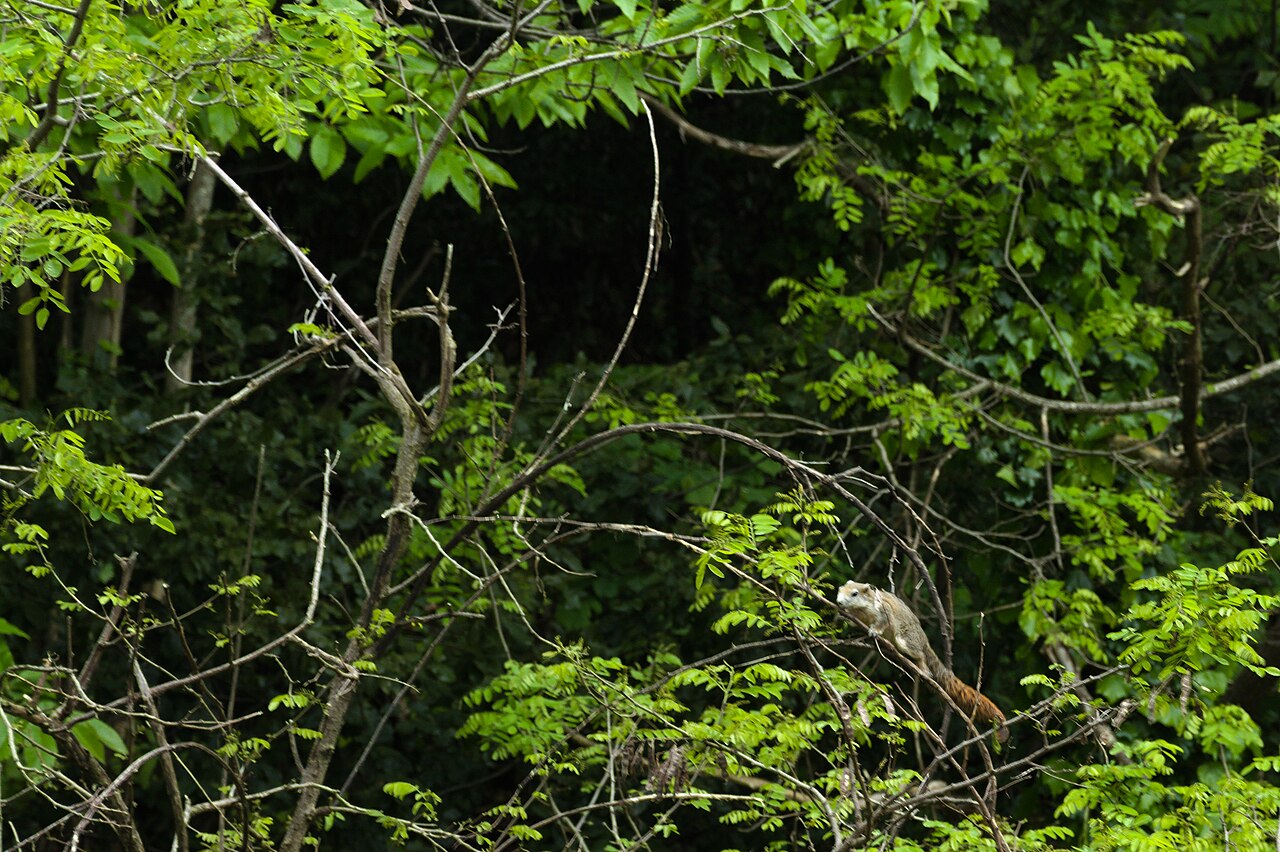
In its habitat
Head close-up
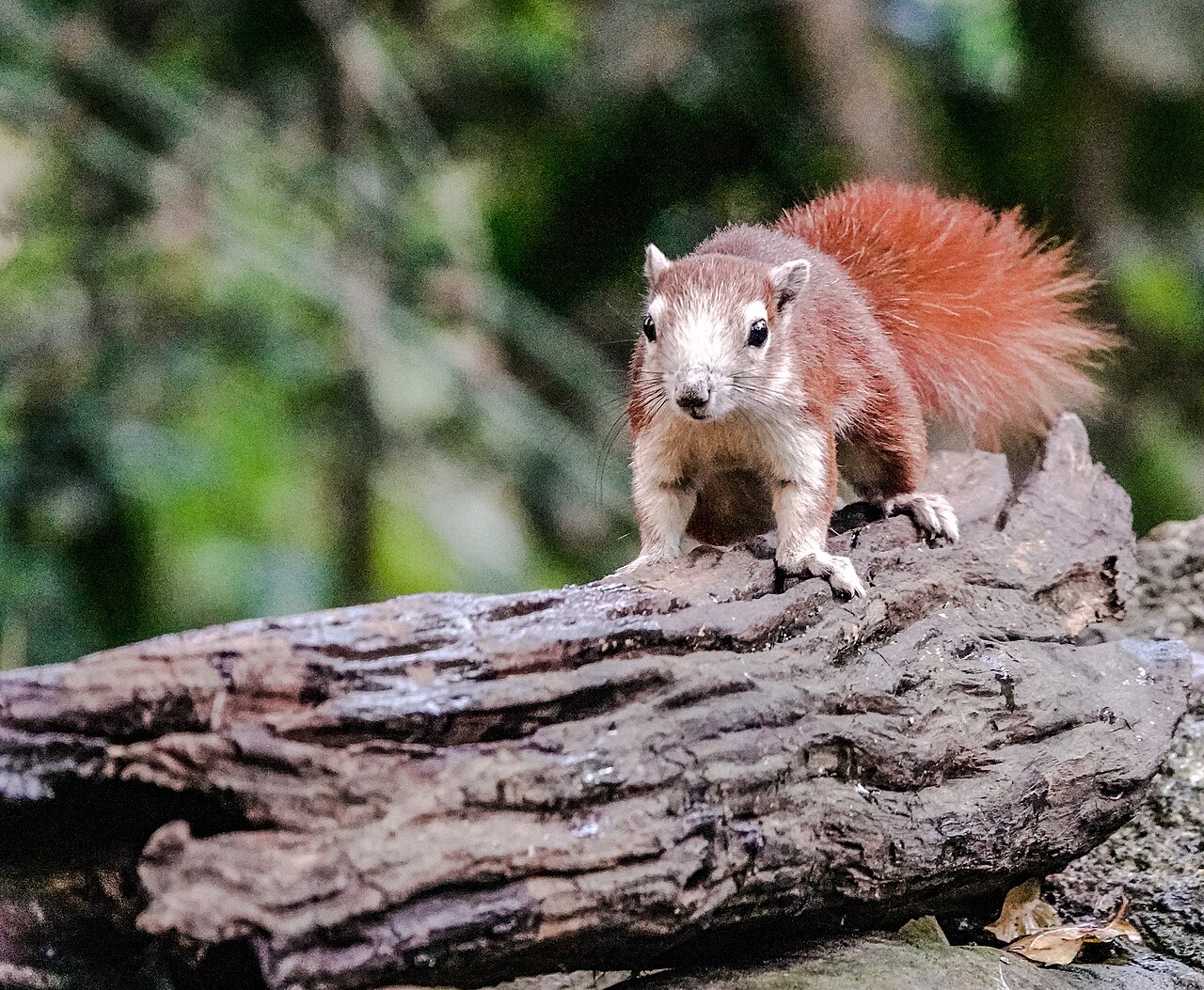
Identification
A medium-sized tree squirrel with a long, full tail about as long as head and body together. Colour is highly variable across the range: from entirely cream-white through grey, buff and rufous to entirely black, and the variation occurs not only between the sixteen subspecies but also between animals from the same wood. The Italian animals belong to the subspecies bocourti and usually have a pale grey-buff to dirty white body and head and a rusty-red to orange tail, sometimes with a whitish tip. The contrast between pale body and red tail is the most useful character in Europe. The head is short and round with a blunt muzzle; the ears are small, rounded and without tufts, which separates the species at once from the Red Squirrel in winter. Hands and feet are dark, the claws long and sharp, and the animals move through the canopy in fast, level bounds, with the tail extended behind.
Similar species
The main confusion species is the other introduced Asian squirrel. Pallas's Squirrel (Callosciurus erythraeus), which occurs in northern Italy, southern France, Belgium and the Netherlands, has the same build and the same round, untufted ears, but is olive-grey to speckled greyish-brown above and has a chestnut to red-brown belly; in Finlayson's Squirrel the red is in the tail and the belly is pale. Where both occur, the belly is decisive, not the back. The Red Squirrel (Sciurus vulgaris) has a narrower head, long ear tufts in winter and a tail the same colour as the back. The Grey Squirrel (Sciurus carolinensis) is larger and heavier, uniform grey with rusty flanks and a grey tail with a white fringe. Entirely black or entirely white Finlayson's Squirrels occur normally in the native range; an unusual colour therefore does not in itself indicate another species. In Italy locality is also decisive: outside Acqui Terme and the coast from Maratea to Scalea the species is not yet established anywhere.
Habitat
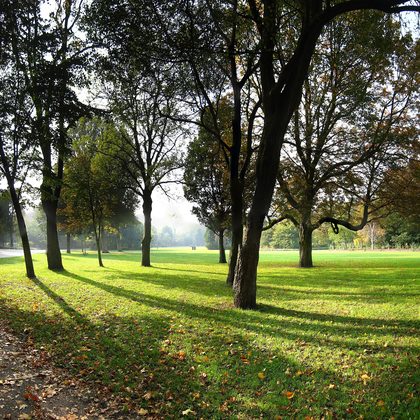
In the native range dense and open lowland forest, coconut plantations and city parks. In Italy the species lives in planted greenery: town parks, avenue trees, gardens, coastal stone-pine woods, old olive groves and macchia with carob. It tolerates built-up areas well and can persist in fragmented greenery as long as the crowns touch or the gap can be crossed by leaping; for this reason it follows the coastal towns. Models for Italy indicate that the suitable area is much larger than the area currently occupied, and that its centre lies in the coastal zone and built-up areas.
Where the animal is most at home, classified with EUNIS — the European standard for habitats.


Distribution
Native to South-East Asia: Thailand, Myanmar, Laos, Cambodia and Vietnam. In Europe the species is established only in Italy, at two separate places. The northern population lives in and around Acqui Terme in Piedmont and remains small and sedentary. The southern population originated at Maratea in Basilicata and is spreading along the Tyrrhenian coast; it has now also been reported at Sapri, Policastro, Scario, Camerota, Ascea and Palinuro in Campania and at Praia a Mare and Scalea in Calabria, reaching into the Cilento National Park. Elsewhere in Europe there are only isolated records of escaped animals, without establishment.
- Established introduction
- dark = core range, pale = thinly spread
Way of life
Strictly diurnal, most active in the morning and late afternoon; there is no winter dormancy, and the species can be seen all year. The diet is largely vegetable: seasonal fruit and seeds, buds and flowers, and in the cold half of the year sap and bark, which is the source of the tree damage. Nuts and seeds are not buried but stored in the nest or in a fork. Insects, mainly ants, form a small part of the diet. The animals do not live in groups, but their home ranges overlap widely and several animals use the same food trees. They spend almost the whole day in the canopy and come to the ground little. In Italy young are born in several months of the year; little else is known about the reproduction of the European populations.
Where and when to look
In Acqui Terme the northern population has lived for forty years on a few hectares in the town park and the avenue trees around the station; a winter morning, when the trees are bare, gives the best view. On the coast of Basilicata and Campania (Maratea, Acquafredda, Sapri, Scario) the old olive groves and the stone pines above the coast road are suitable search areas in the first hours after sunrise. Look at the trunks as well: fresh bark stripping indicates the presence of the species. Listen also for the barking rattle, which carries far. Document records outside these two areas with a photograph and report them; at the edge of the expanding range every dated record is of value.
Conservation status
Least Concern globally (2017); this assessment refers to South-East Asia, where the species is widespread and common. Since 2 August 2022 the species has been on the list of invasive alien species of Union concern (Regulation 1143/2014): keeping, breeding, transporting, selling, using and releasing are prohibited, and member states must remove new incursions rapidly and manage established populations. The objections are twofold. The first is damage to trees: ringing of stone pines, oaks, olives and carobs can affect whole avenues and orchards, and in the park at Acqui Terme the great majority of trees was damaged. The second concerns the Red Squirrel, in particular the dark southern Italian form: with the closely related Pallas's Squirrel it has been shown elsewhere in Italy that an introduced Asian squirrel can displace the native squirrel from an area. For this reason researchers are pressing for eradication while the southern population is still limited in size; they refer in this context to the spread of the Grey Squirrel in Piedmont.
Scientific name
Callosciurus finlaysonii | (Horsfield, 1824)
Horsfield described the species in 1824 as Sciurus finlaysonii; because it was later moved to another genus, the author and year stand in brackets. Callosciurus joins Greek kallos, 'beauty', to Sciurus: the handsome squirrel. finlaysonii honours the Scottish naturalist George Finlayson (1790–1823), surgeon and collector on the British mission to Siam of 1821–1822. The specimen the first description was based on came from Thailand, Koh Si Chang.