All species › Rodents › Squirrels and marmots › Pallas's Squirrel
Pallas's Squirrel | Callosciurus erythraeus
Roodbuikeekhoorn | Callosciurus erythraeus
Pallas's Squirrel is a tree squirrel from South and South-East Asia that reached Europe through the pet trade. The European populations arose in villa suburbs, parks and gardens, not in woodland. Establishments are known from the French Riviera, Piedmont, West Flanders and Dutch Limburg; the Belgian and Dutch populations were removed by trapping after prompt action.
Tracks
The most characteristic sign is damage to trees. The species rings branches and stems: the bark is gnawed away in a closed band down to the cambium, after which everything above the ring dies. The result is a bare, pale zone of a few centimetres to half a metre round a branch, with dead leaves and twigs above it, often in several places in the same tree and on dozens of trees in one street. In France and Italy this has been recorded on pine, plane, maple, eucalyptus and fruit trees; the Belgian and Dutch populations were also discovered through this damage. The species also gnaws telephone and power cables, garden hoses and plastic piping, and in the Netherlands roof boarding was chewed. The other signs are not species-specific: a drey of twigs and bark in a fork or against the trunk, gnawed nuts and seeds at fixed feeding places, and in dust or sand the jump group of four prints in a block with the five-toed hind feet in front of the four-toed fore feet. In Antibes and Acqui Terme the sustained rattle from trees in built-up areas is the first sign of presence.
In its habitat
Head close-up

Identification
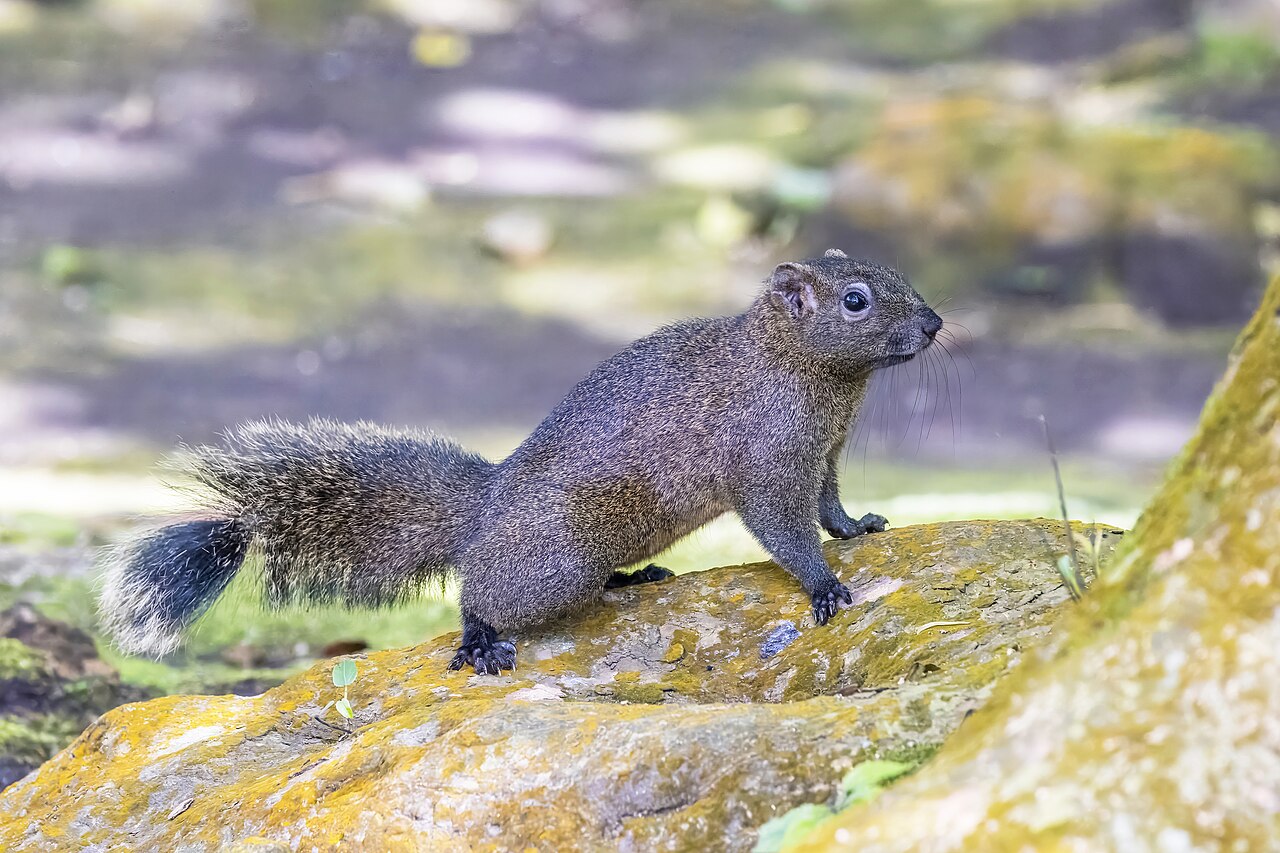
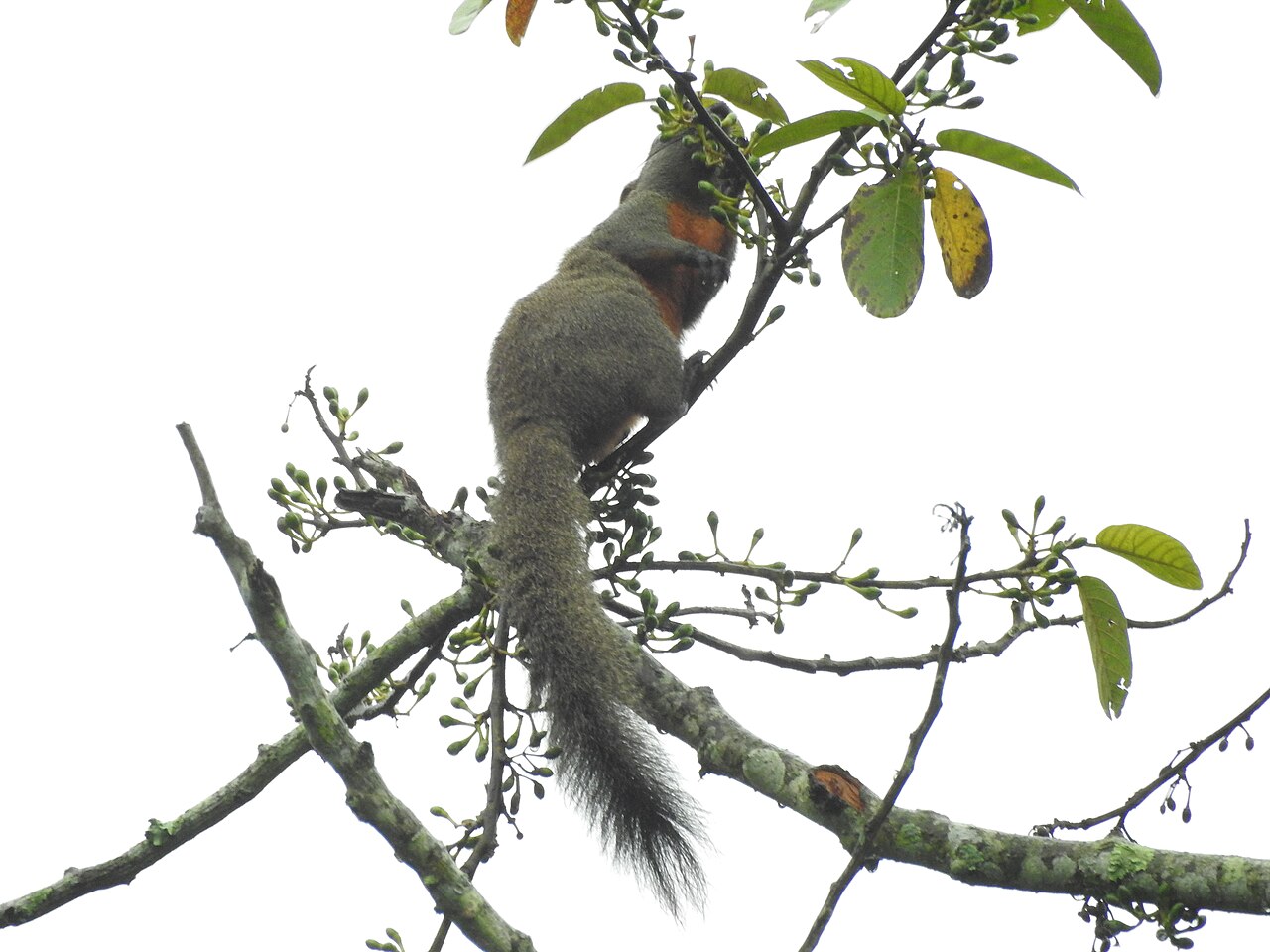
A squirrel the size of a Red Squirrel but more heavily built: head-body 21 to 23 cm, tail 18 to 22 cm, 286 to 375 grams. The upperparts are olive-grey to dark grey-brown, finely grizzled because the hairs are banded black and yellow. Ear tufts are absent; the ear is small and round, the head short and broad. The belly and the insides of the legs are chestnut to rusty red, sharply demarcated from the grey flank. The intensity of this colour varies between individuals, and across its Asian range the species is highly variable: in some forms the belly is dull brown or grey rather than red. The tail is long, densely haired and often ringed or marbled black and buff with a dark tip; when sitting the animal holds it arched high over the back. The call is a hard, rattling, far-carrying bark that can continue for minutes; the species is usually first detected by this sound.
Similar species
In the European areas of establishment the species occurs alongside the Red Squirrel. That species is red-brown to dark brown with a pure white belly, carries long ear tufts in winter and has a uniform tail; Pallas's Squirrel has a red belly, never ear tufts, and a ringed or dark-tipped tail. Pallas's Squirrel moves more slowly, is heavier and more often sits still on a branch for long periods. In northern Italy the Grey Squirrel is also present, greyer, white-bellied and with a white-fringed tail. The sustained rattling bark differs from the calls of all native squirrels. Finlayson's Squirrel (Callosciurus finlaysonii) has also been released in Europe, in Italy among other places; it is usually wholly cream-white or two-tone and lacks a grizzled grey back.
Habitat
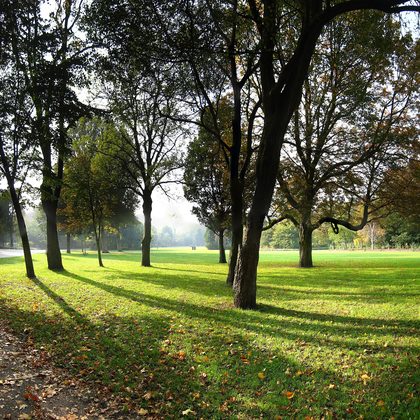
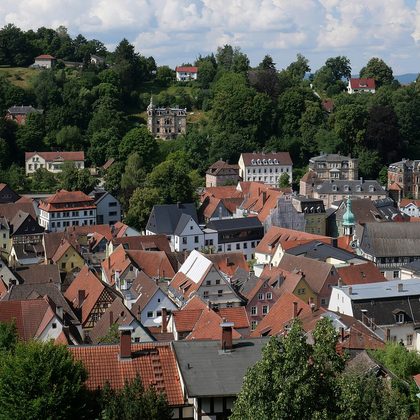
In Asia woodland of many types, from tropical lowland forest to conifer forest high in the mountains, as well as plantations and city parks. In Europe the species is confined to villa suburbs, parks, gardens, avenues, coastal pine stands and small broadleaved woods, usually with many exotic trees and shrubs and in a mild climate. On Cap d'Antibes it lives in parks and gardens, in Piedmont in mixed broadleaved woodland and orchards round a small town, and in the Netherlands and Belgium it lived in and around a village centre. It requires a closed canopy to move through, a varied year-round supply of nuts and fruit, and the absence of prolonged hard frost.
Where the animal is most at home, classified with EUNIS — the European standard for habitats.




Distribution
The native range lies in South and South-East Asia: from north-east India, Bhutan and Bangladesh through Myanmar, southern China, Taiwan and Indochina to the Malay Peninsula. All European establishments derive from the pet trade. France: on the Cap d'Antibes peninsula since the late 1960s, centred on the communes of Antibes-Juan-les-Pins and Vallauris with stray animals beyond the A8 in the Valmasque park; early this century a second nucleus was discovered at Entressen (Istres) in the Bouches-du-Rhône. A national control plan has run since 2010. Italy: since 1981 at Acqui Terme in Piedmont, from where the species has slowly spread through the surrounding hill country. Belgium: a population at Dadizele in West Flanders, founded on escaped animals, was removed by trapping. Netherlands: records from 1998 and a population near Weert (Tungelroy and Nederweert), which had been trapped out by 2017; since then the species is almost certainly absent from the country again. It is not established elsewhere in Europe. Outside Europe it has been released and is naturalised in Japan and Argentina.
- Established introduction
- dark = core range, pale = thinly spread
Way of life
Strongly diurnal, with a peak in the morning and a second in the late afternoon, and active all year: the species neither hibernates nor keeps a winter rest, which makes it vulnerable to hard winters in northern Europe. An omnivore with a strong preference for plant food: nuts, seeds, fruit, flowers, buds, bark and cambium, supplemented with insects, snails, birds' eggs and nestlings. The animals do not live in groups but in overlapping home ranges of about one to three hectares; a dominant male guards a female for about half an hour after mating. In the Asian range breeding can take place all year; in Europe litters fall in spring and late summer, of one to four young born in a drey or tree hole. The sleeping nest is a ball of twigs, leaves and shredded bark, high in a fork.
Where and when to look
In Europe, look for the species in built-up areas rather than woodland. At Antibes and Juan-les-Pins it is regularly seen in the gardens and parks of the Cap, and around Acqui Terme in the orchards and park woodland at the edge of the town. Go early in the morning and listen first: the long, hard rattle from a crown locates the animal faster than searching by eye. Then check the trees for branches with a bare ring and dead leaves above it. Report any record of an exotic squirrel outside the known establishments; with this species removal has succeeded only where action was taken early.
Conservation status
Least Concern globally (2016); the Asian range is large, and the species is locally affected by hunting there. That assessment does not concern the European populations. In the EU Pallas's Squirrel has been on the list of invasive alien species of Union concern since 3 August 2016 (Regulation 1143/2014): keeping, breeding, transporting, trading and releasing are banned, with transitional arrangements for existing keepers, and member states must eradicate new establishments. The objections are damage to trees by ringing, damage to cables, pipes and roof boarding, predation on birds' nests, and the possibility that on the mainland the species displaces the Red Squirrel as the Grey Squirrel has done in Britain; work in Piedmont points to competition with the Red Squirrel, though the picture there is less clear-cut than in the British case. Small, isolated populations have been removed after prompt action: in Belgium the one at Dadizele, in the Netherlands the one at Weert (in 2017, after a trapping operation). In France, where the species was left alone for half a century before the 2010 plan began, eradication is no longer considered feasible.
Scientific name
Callosciurus erythraeus | (Pallas, 1779)
Pallas described the species in 1779 as Sciurus erythraeus; because it was later moved to another genus, the author and year stand in brackets. Callosciurus joins Greek kallos, 'beauty', to Sciurus: the handsome squirrel. erythraeus is Greek erythraios, 'red', after the reddish-brown underparts. The specimen the first description was based on came from India, Assam.